
My back-to-work morning train WFH reads:
• The $260 Billion Mom-and-Pop Funds Distorting the Credit Market: Popular with individual investors, fixed-maturity funds are hoovering up the debt of big companies, reducing borrowing costs but obscuring repayment risk. (Bloomberg)
• Goodbye, Price Tags. Hello, Dynamic Pricing. Businesses increasingly are using algorithms to determine prices, and to rapidly adjust those prices throughout the day. This new technology is called dynamic pricing, and it’s poised to change the way businesses set and advertise their prices. Think of the ever-changing electronic signs at gas stations, but for everything. (New York Times) see also Gen X-ers Have Money to Spend. Why Are Retailers Ignoring Them? Three in four Americans ages 45 to 60 say they expect to overspend for the holidays. They’re “sort of like the glue within the consumer spectrum.” (New York Times)
• Unpacking the Mechanics of Conduit Debt Financing: Understanding the pass-through financing model behind the AI infrastructure boom. (This Is Not Investment Advice)
• Private Equity Firms Could Face More Litigation as They Push into Retail: TAMU’s William Magnuson and Oxford’s Ludovic Phalippou argue that misleading metrics and opaque fees pose “significant litigation risks when ordinary investors enter the picture.” (Institutional Investor)
• Are the rich fleeing Mamdani’s Manhattan? Not according to the data. The reasons for the increase in sales can be attributed in large part to overall gains in the stock market, the expectations of big Wall Street bonuses and declining mortgage rates. (USA Today)
• What Is a Tariff Shock? Insights from 150 years of Tariff Policy. What are the short-run effects of tariff shocks on macro aggregates? A careful review of the major changes in US tariff policy since 1870 shows no systematic relation between the state of the cycle and the direction of the tariff changes, as partisan differences on the effects and desirability of tariffs led to opposite policy responses to similar economic conditions. (Federal Reserve Bank of San Francisco)
• Mapping the Sense of What’s Going On Inside: Scientists are learning how the brain knows what’s happening throughout the body, and how that process might go awry in some psychiatric disorders. (New York Times)
• The Ultrarich Are Spending a Fortune to Live in Extreme Privacy: In Miami and elsewhere, the wealthy are moving in increasingly private spheres, shelling out big money to bypass the indignities of public life. (Wall Street Journal)
• YouTube’s Right-Wing Stars Fuel Boom in Politically Charged Ads. The popularity of YouTube podcasts among conservatives is driving a boom in small businesses tailoring ads to their millions of listeners, paying hosts like Joe Rogan and Candace Owens to read out promotions in the hope that fans will place orders. The phenomenon has enriched both the hosts and YouTube, supporting further growth of the businesses using ideology to sell. (Bloomberg free) see also How Right-Wing Superstar Riley Gaines Built an Anti-Trans Empire: The swimmer tied a trans woman for fifth. The MAGA industrial complex took care of the rest. (Mother Jones)
• Life in the Michigan-Ohio State rivalry borderlands, from beatosu to goblu: The legend of beatosu originated with a prank carried out by Peter Fletcher, a Michigan alumnus who served as chairman of the Michigan State Highway Commission in the 1970s. Fletcher was in charge of the state highway maps, which include a tiny strip of northern Ohio. At Fletcher’s direction, the highway commission’s 1978 maps included a fictional town called “goblu” near Toledo and another called “beatosu” in a rural part of Fulton County, Ohio. (New York Times)
Be sure to check out our Masters in Business interview this weekend with Wilhelm Schmid, CEO of famed watchmaker A. Lange & Söhne, the Glashütte, German watchmaker, recorded live at the Audrain Newport Concours d’Elegance.
Bitcoin Disconnecting From Nasdaq
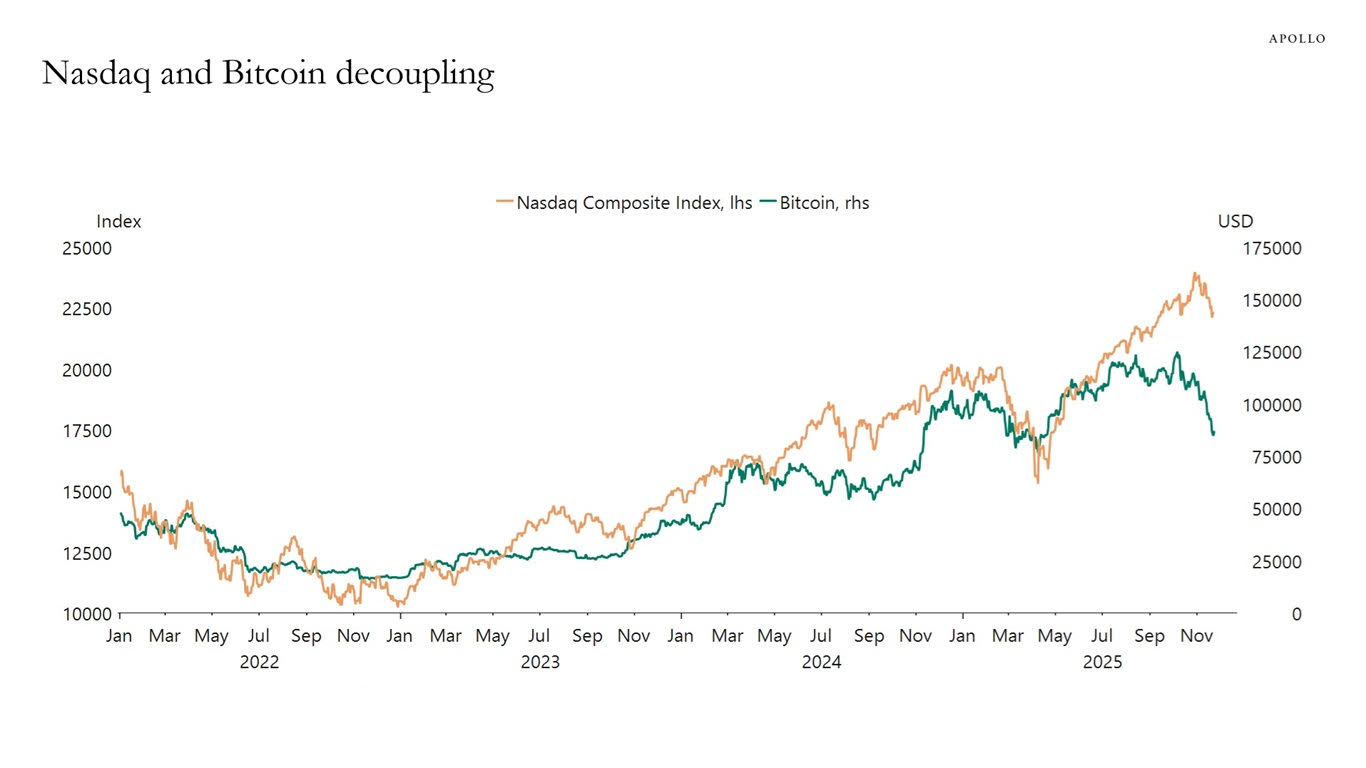
Source: Apollo
Sign up for our reads-only mailing list here.
