
My snowed-in-Nor’easter-Blizzard WFM morning reads:
• Amazon takes the No. 1 spot on the Fortune 500, ending Walmart’s 13-year run. Amazon finally overtook Walmart atop the Fortune 500, a coronation for the company that essentially invented e-commerce and now dominates 40% of U.S. digital retail. It figured out how to develop a practical, easy way to shop online and take it mainstream. The Seattle company now dominates the U.S. market — 180 million Americans have a Prime account. But Amazon didn’t overtake a rival with a 32-year head start by remaining wedded to one line of business or following one approach to running it. (Fortune)
• Hedge fund Saba offers to buy stakes in Blue Owl funds at steep discount: Boaz Weinstein’s Saba Capital is making an aggressive play for Blue Owl fund stakes, offering to buy them at a significant markdown, as private credit group is seeking to shore up investor confidence (Financial Times) see also Boaz Weinstein Is Hunting Blue Owl’s Funds: The hedge-fund manager is adding private credit to his crusade against funds sold to individual investors. (I am always interested when the manager who discovered the London Whale and beat Blackrock’s proxy spots a problem elsewhere). The activist hedge fund manager is circling Blue Owl’s closed-end funds, looking for discounts and willing to fight for them. (Wall Street Journal)
• The Reign of the Dollar Is Coming to an End. What Investors Can Do About It. The dollar’s dominance as the world’s reserve currency is eroding — slowly, then perhaps all at once. How to position portfolios for the shift?Consider investment in foreign stocks and debt juiced by a falling dollar. (Barron’s)
• How Zoning Won: In 1926, the Supreme Court’s Euclid decision enshrined zoning in US cities. At 100 years old, Euclidean zoning — the system that separates homes from businesses from industry — the landmark ruling’s mixed legacy has become America’s most durable and least questioned land-use policy. It may finally be overdue for reform. (Bloomberg)
• Stock Slide and Slow Sales: What’s Happening in China’s E.V. Market? The Chinese EV juggernaut is showing cracks — slowing domestic sales, falling share prices, and a price war that’s squeezing margins across the board. Investors are selling shares of Chinese E.V. companies, concerned that intensifying competition and shorter production cycles mean the years of easy growth are over. The global implications for legacy automakers and battery supply chains are significant. (New York Times)
• How Hamilton Lane extracted more money from its ‘NAV squeezing’ The FT digs into how one of private equity’s biggest players is gaming NAV lending to juice returns. If you don’t understand the plumbing, you’re the one getting squeezed. It’s a good example of what can happen when private capital firms seek to tap less sophisticated retail investors to replace retrenching institutional investors — something that even some industry insiders warn will end in tears — in an era where many financial watchdogs are being neutered. (We read proxy statement so you don’t have to). (Financial Times)
• The Media Can’t Stop Propping Up Elon Musk’s Phony Supergenius Engineer Mythology: “CEO said a thing!” journalism is now utterly pervasive, and includes parroting billionaire and CEO claims with a total disregard for whether or not anything being said is actually true. The press keeps treating Musk as a hands-on engineering visionary. The evidence overwhelmingly suggests otherwise. (Karl Bode)
• ‘Is university still worth it?’ is the wrong question: UK graduates are struggling — but the real issue isn’t whether degrees have value. It’s that the economy has fundamentally changed around them. The graduate earnings premium isn’t really measuring what most people think. (Financial Times)
• Look how much Canadians hate the United States now: It’s not just about the trade war. Nearly half of America’s neighbors to the north now think the U.S. is a bigger threat to world peace than Russia. Five charts showing the dramatic collapse in how Canadians view their southern neighbor. The damage to the relationship may be lasting. (Politico)
• The Multibillion-Dollar Foundation That Controls the Humanities: The Andrew W. Mellon Foundation’s $540 million in annual grants wields near-monopolistic power over humanities scholarship. Is it the last best hope for American arts and letters—or is it killing them? (The Atlantic)
Be sure to check out our Masters in Business interview this weekend with Hilary Allen, Professor of Law at the American University Washington College of Law. She specializes in financial regulation, banking law, securities regulation, and technology law, with a particular focus on how new financial technologies like fintech, crypto, and AI intersect with financial stability and public policy.
The giant void of nothingness where US financial regulation used to sit
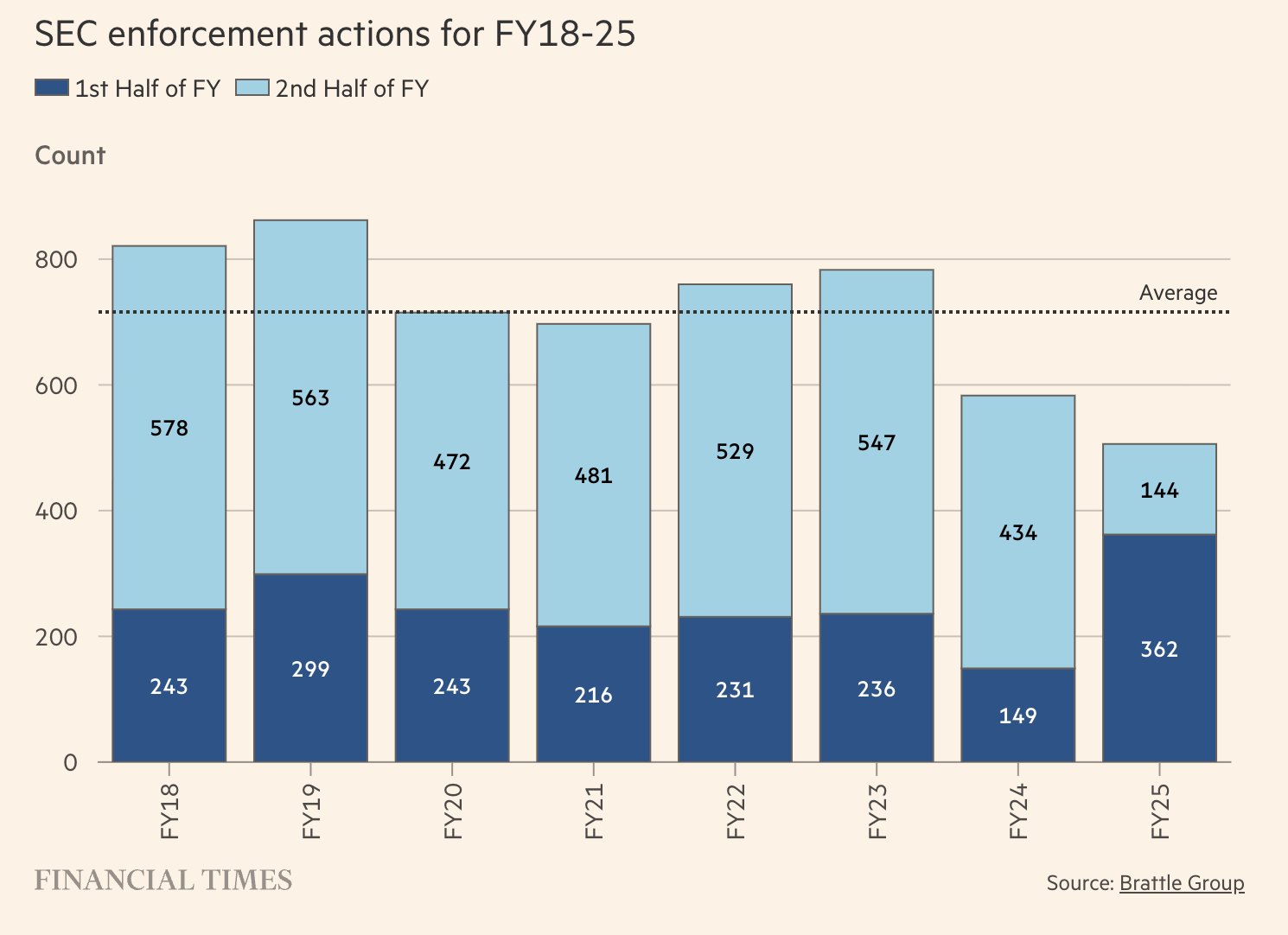
Source: Financial Times
Sign up for our reads-only mailing list here.
