
My Two-for-Tuesday morning train WFH reads:
• A Yale Professor’s Investment Formula Says You Need More Stocks. See How It Works. James Choi’s research suggests most investors are too conservative with their asset allocation — and he’s got the math to back it up. The formula incorporates income, risk tolerance and other factors absent from typical rules of thumb. (Wall Street Journal)
• Winners & Losers of SCOTUS Decision Striking Down Tariffs: The long-awaited Supreme Court decision on tariffs is finally out; it was a 7-2 decision in part, 6-3 decision more broadly. The street doesn’t quite understand the subtle nuances of the case. Take a moment to step back and consider the winners and losers of tariffs. (The Big Picture) see also Part II: IEEPA Tariff Ruling’s Losers: In broad strokes, the winners were the large companies that filed for refunds or sued the US, the dollar, consumers, the separation of powers, the US Constitution, and the Supreme Court. The losers are a bit more nuanced: some are obvious, many are not. (The Big Picture)
• Inflation May Have Cooled, But Affordability Is Still a Hot Issue: The headline inflation numbers look better. The lived experience of buying groceries, paying rent, and filling a gas tank does not. (Bloomberg)
• Pros and Cons of Artificial Intelligence: We’re in the fun phase of AI innovation — tons of overreactions, wild predictions, and nobody really knows what happens next. A balanced look at what’s real and what’s hype. (A Wealth of Common Sense)
• The Ultra-Rich Are Different from You and Me: The billionaire class doesn’t just have more money — they operate in an entirely different economic and political reality, one that’s increasingly detached from everyone else’s. (Paul Krugman) see also Billionaires Gone Wild: Since Citizens United, billionaires’ share of political contributions exploded 1700% even as their numbers only grew 85%, making the oligarch power grab the defining feature of American politics. Their power grab is a dire threat to American democracy. (Paul Krugman)
• The giant void of nothingness where US financial regulation used to sit: The regulatory apparatus that once policed Wall Street has been hollowed out. What’s left is mostly a void — and the markets know it.‘There has never been a better time to be a crook’ (Financial Times) see also Crypto super PACs have hundreds of millions ready to spend on the midterms: The crypto industry is gearing up to pour enormous sums into the 2026 midterm elections, hoping to lock in favorable regulation before the window closes. With Trump faltering and their policy agenda incomplete, the crypto industry has moved at least $288 million toward the midterms in a desperate bid to keep Republicans in control of Congress. (Citation Needed)
• Inside the Gay Tech Mafia: Gay men have long been rumored to run Silicon Valley. WIRED investigates. (Wired)
• Judges Grow Angry Over Trump Administration Violating Their Orders: At least 35 times since August, federal judges have ordered the administration to explain why it should not be punished for violating their orders in immigration cases. (New York Times)
• Trader Joe’s wines are sneaky good. Here are 9 budget bottles to try.: The cashier did a double take at the $200 total. But dollar for dollar, Trader Joe’s wine selection punches well above its weight class. (Washington Post)
• Dilbert Creator’s AI Resurrection Not So Comic for His Family: Scott Adams is being digitally resurrected via AI video — and his family is not amused. The line between tribute and exploitation keeps getting blurrier. (The Bulwark)
Be sure to check out our Masters in Business interview this weekend with Hilary Allen, Professor of Law at the American University Washington College of Law. She specializes in financial regulation, banking law, securities regulation, and technology law, with a particular focus on how new financial technologies like fintech, crypto, and AI intersect with financial stability and public policy.
Concentrated Markets? Not true We are seeing the broadest rally in history.
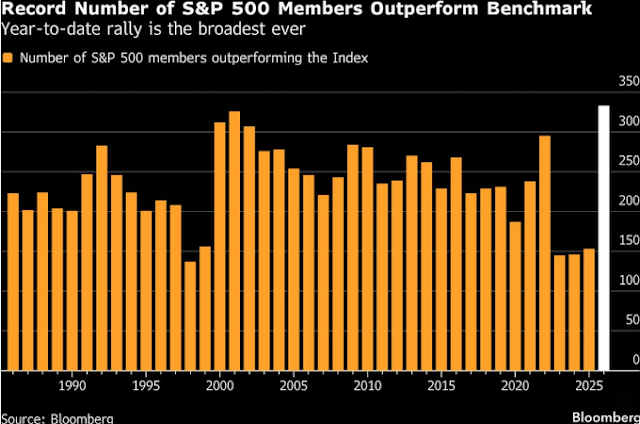
Source: @RyanDetrick
Sign up for our reads-only mailing list here.
