
My back-to-work morning train WFH reads:
• Don’t Fret the War. Why ‘Big Money’ Investors Are Bullish—and Where They’re Investing Now. Barron’s twice-yearly survey of professional money managers finds bulls firmly back in charge, with small-caps, international stocks, and energy as the consensus picks for the next leg up. Weighing the impacts of the Iran war? (Barron’s)
• Tim Cook’s Apple: Trung Phan’s sharp, deeply reported look at Tim Cook’s quarter-century at Apple — operations savant, succession question, and a company at an inflection point. A breakdown of his 15-year CEO run, taking Apple from $350 billion to $4 trillion. The Good, The Bad and the Apple Intelligence. (SatPost by Trung Phan)
• How to Wage Economic Warfare: Economic warfare works slowly, gradually imposing ever higher costs on the enemy. But there is no single trick that causes an adversary’s war effort to falter. Duncan Weldon on what Napoleonic-era blockades teach about the modern economic-warfare toolkit. (Engelsberg Ideas)
• The Unflattering Secrets Revealed So Far in Elon Musk’s Latest Legal Feud: Hundreds of court filings in Musk’s lawsuit against OpenAI have surfaced cringey texts, emails, and diary entries from Musk, Sam Altman, and the other founders — a window into how the original AI alliance came apart. (Washington Post)
• AI optimism surges in Asia, unlike in the U.S.: Surveys consistently show Asian publics far more enthusiastic about AI than American or European ones. The divergence has implications for who builds, deploys, and ultimately benefits from the technology. New research shows Americans are far less excited about AI — and far less trusting of regulators — than their counterparts across Asia. (Rest of World) see also The People Do Not Yearn for Automation: Software brain is changing the world, but most people still aren’t buying. (Verge)
• Investors lost billions on Trump’s memecoin. Another gala won’t fix that. If Dems take Congress, Trump may face reckoning for “pay-to-play” memecoin galas. Investors are still billions underwater on $TRUMP — and another dinner-for-token-holders won’t repair the damage if Democrats take Congress. (Ars Technica)
• He sat atop an extremist empire. She thought he needed money. The far-right influencer Nick Fuentes has pocketed roughly $900,000 from “fanatical” donors since the start of 2025. Some superfans see him as part of their families. Kristine Kasubienski’s donation appeared on viewers’ screens four hours into the live stream of Nick Fuentes, the far-right influencer she often called her second son. (Washington Post)
• The Pacific Bleed: The deterrence architecture was not defeated. It was redeployed: While the world watched Hormuz, the Pacific emptied. The US pulled 3 carrier strike groups from the Indo-Pacific to fight a war in the Middle East. It was the 5th time in 2 years that a carrier was pulled from Asia to the Gulf, but this time there was no rotation behind it. All 6 THAAD launchers were removed from their base at Seongju, South Korea; 48 interceptor missiles, too. Patriot batteries went with them. The 31st Marine Expeditionary Unit deployed from Japan to the Gulf. Minesweepers were rushed from Sasebo. F-15E Strike Eagles relocated from Lakenheath to Jordan. All without announcement and without explanation. (The Omission)
• What is life really like for MLB players on the road? We answer your questions: An Athletic mailbag on hotels, swag, and what road life actually looks like a month into the season. While the standings look like a creation from another topsy-turvy universe — perhaps your favorite team is one of the projected contenders currently floundering far below .500 — we’re taking a beat to step behind the scenes. (The Athletic)
• The Michael Jackson Biopic That Nearly Blew Up Is Poised to Be a Hit: The troubled production behind “Michael” — and why it’s suddenly tracking as a hit. Michael’ required costly creative overhaul after error by late pop star’s estate (Wall Street Journal)
Be sure to check out our Masters in Business interview this weekend with David Gardner, cofounder of The Motley Fool in 1993 (with his brother Tom Gardner). Originally launched as a print investment newsletter based on the idea that ordinary investors could beat Wall St., it gained traction when promoted on America Online (AOL) in 1994; it soon became a major presence on AOL and then Fool.com. His latest book is “Rule Breaker Investing: How to Pick the Best Stocks of the Future and Build Lasting Wealth.”
AI investment is a positive tailwind for manufacturing activity; hyperscalers expect to spend close to 2.1% of GDP on capex this year.
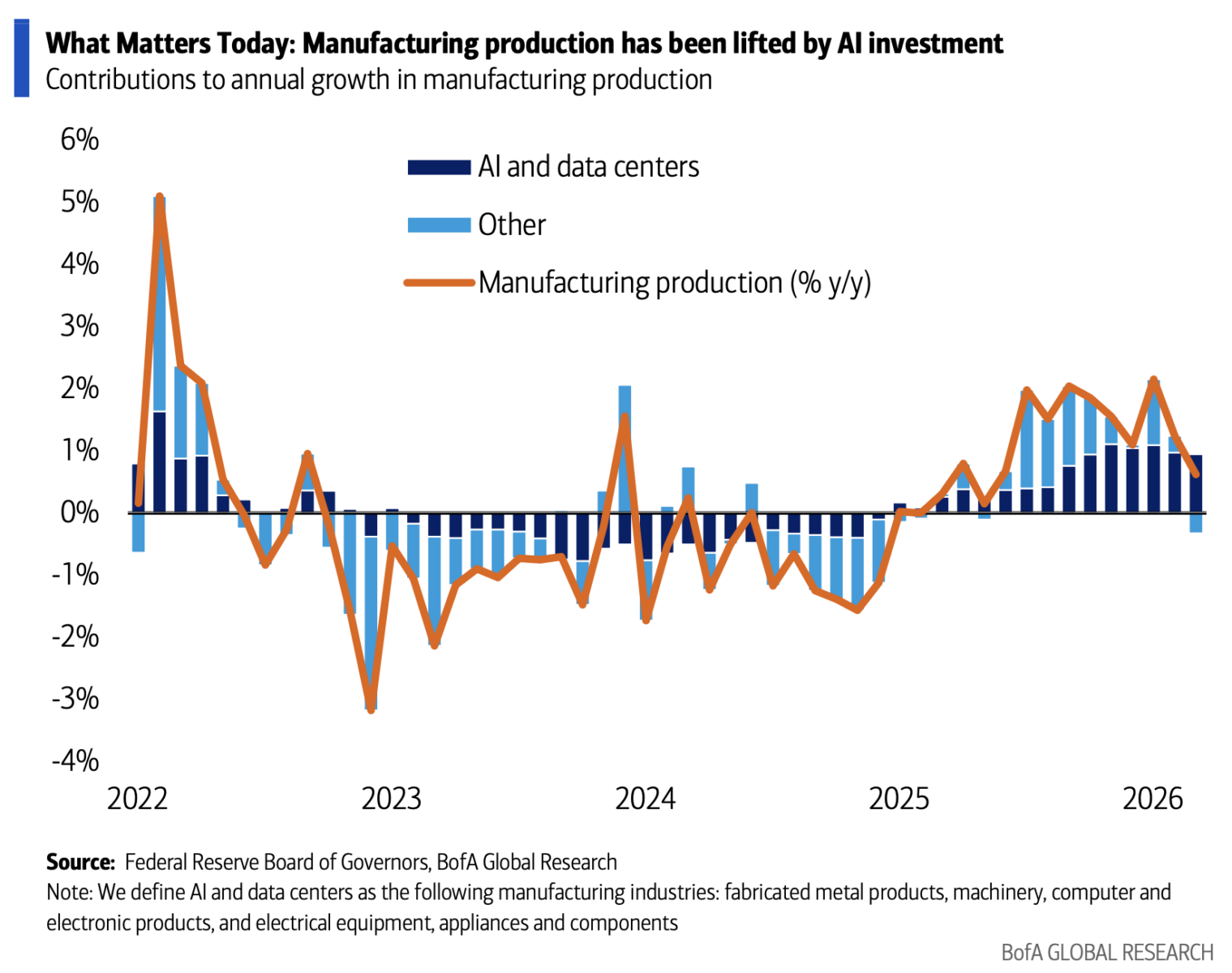
Source: BofA Securities
Sign up for our reads-only mailing list here.
