
My morning train WFH reads:
• Women get worse investment advice: There are plenty of differences between men and women; how they invest their money, how they deal with risk, etc. But given the same circumstances and risk preferences, men and women should get the same advice from their financial advisers. Guess what? That doesn’t happen. New research confirms that women systematically receive lower-quality investment advice than men. (Klement on Investing)
• Has the Stock Market Really Been More Volatile Than Usual This Year? For most investors, stock market volatility is something to endure, not act upon. Dan Lefkovitz runs the numbers against the vibes. The vibes, as usual, are losing. (Morningstar)
• Will China get richer before it gets much, much smaller? China does look likely to age more rapidly than many counterparts. According to the United Nations Department of Economic and Social Affairs Population Division, the share of its population aged 15-64 years old peaked in 2012 at 73 per cent (it is hovering now at around 70 per cent) but is set to plunge below half in the next fifty years — taking it lower than equivalent shares for the US, Europe and even Japan. (Financial Times)
• The Father-Daughter Showdown That Shook an $18 Trillion Investing Empire: Before her winning streak at Fidelity, Abby Johnson had to beat back the doubts of her rivals, and her father, too. The Abby-and-Ned Johnson succession drama at Fidelity — the sort of dynastic asset-management intrigue you rarely get to see in public. (Wall Street Journal)
• Fed Chair Apprentice: three policy themes: Fed independence, Warsh’s theory of inflation, and financial deregulation. Claudia Sahm on Kevin Warsh’s Senate confirmation heaxring for Fed Chair. (Stay-At-Home Macro)
• Helium Is Hard to Replace: Helium is produced as a byproduct of natural gas extraction. It collects in the same underground pockets that natural gas collects in. Qatar is responsible for roughly 1/3rd of the world’s supply of helium, which was formerly transported through the Strait of Hormuz in specialized containers. Thanks to the closure of the strait, helium prices have spiked, suppliers are declaring force majeure, and businesses are scrambling to deal with looming shortages. (Construction Physics)
• Why thinking hard feels bad: the emotional root of deliberation: When an intuitive answer to a problem feels slightly off, the human brain generates an uncomfortable state known as doubt. This negative feeling acts as an internal alarm bell that prompts individuals to abandon simple mental shortcuts and engage in heavy, analytical thinking. The new findings detailing this emotional trigger were published in Thinking & Reasoning. New research on why System 2 is exhausting — and why that cost is not a bug but a feature of how attention allocates itself. (PsyPost)
• The Ancient Weapons Active in Your Immune System Today. Dozens of new discoveries reveal that defenses evolved by bacteria and viruses billions of years ago still define our own innate immune system. Dozens of new discoveries reveal that defenses evolved by bacteria and viruses billions of years ago still define our own innate immune system. (Quanta Magazine)
• Searching for the ‘Smoking Gun’ in US Pedestrian Deaths: Why did American streets get so deadly for those on foot or bikes? A leading transportation safety researcher sees some surprising factors behind the crisis. (CityLab)
• ‘Wagyu’ Used to Guarantee Quality Beef. What Are You Paying for Today?: The term has been stretched to near-meaninglessness on American menus — here’s how to tell A5 from marketing. (New York Times)
Be sure to check out our Masters in Business interview this weekend with David Gardner, cofounder of The Motley Fool in 1993 (with his brother Tom Gardner). Originally launched as a print investment newsletter based on the idea that ordinary investors could beat Wall St., it gained traction when promoted on America Online (AOL) in 1994; it soon became a major presence on AOL and then Fool.com. His latest book is “Rule Breaker Investing: How to Pick the Best Stocks of the Future and Build Lasting Wealth.”
What is the price of oil—the real one?
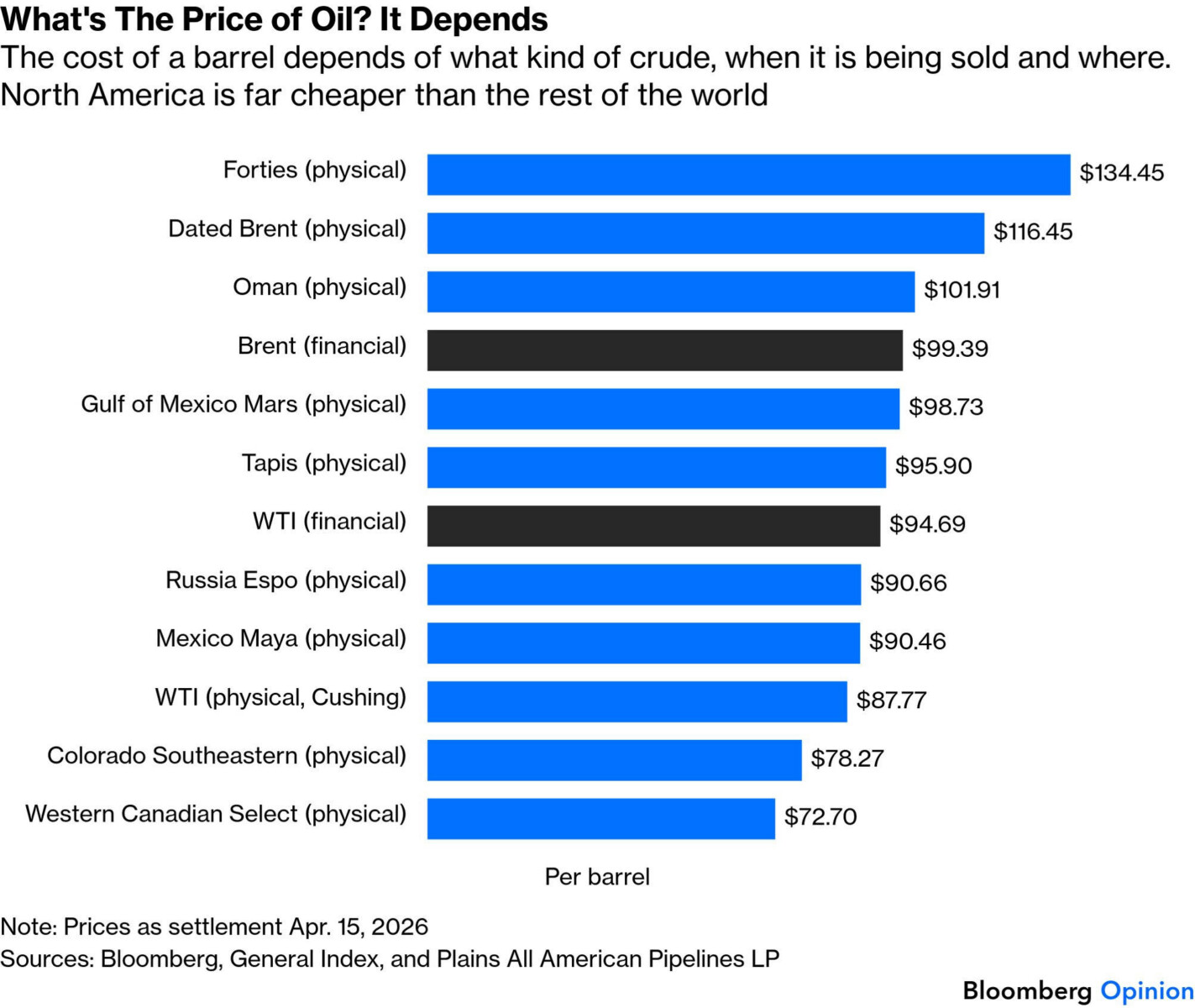
Source: Bloomberg
Sign up for our reads-only mailing list here.
