
My mid-week morning train WFH reads:
• The Worst Year to Retire Wasn’t 1929. The Creator of the 4% Retirement Rule Says It Was 1968. William Bengen, who conceived the 4% rule for safe portfolio withdrawals, to calculate the worst time to retire over the past century. A reasonable guess might be October 1929, right before stocks crashed. The Dow Jones Industrial Average lost 89% of its value by the summer of 1932. The Dow didn’t top its 1929 high until 1954. You would be wrong. Retirees in 1968 fared worse when stocks encountered a prolonged bear market that persisted until the early 1980s. However, the real killer was inflation. (Barron’s)
• The government is meddling with earnings reporting — but Tesla, Amazon and other market superstars prove there’s no problem: Investors aren’t trapped in short-term thinking — but the SEC still wants semiannual earnings reporting. (Marketwatch)
• Robotaxis are the new millennial lifestyle subsidy: Waymo and friends are torching investor cash so urban professionals can have nice things. The Uber playbook, redux — and someone always pays in the end. (Sherwood)
• The Jevons Employment Effect From AI: Apollo’s Daily Spark applies the Jevons paradox to AI and labor — when technology makes work cheaper, you often get more of it, not less. A counterweight to the replacement narrative. That includes startups launched by recent college graduates, who can now compete with established firms on certain tasks. (Apollo)
• Much ado about the 1974 ‘petrodollar’ deal. According to ominous scenarios disseminated in financial circles, social media and news organisations, the war may undo an arrangement initiated in a 1974 secret deal between the US and Saudi Arabia. This stipulated that Riyadh would use dollars for selling oil and investing the proceeds, with the US reciprocating by providing military protection and aid. The FT dismantles the mythology around the Saudi-US petrodollar arrangement. What actually happened in 1974, what didn’t, and why the conspiracy theories get the economics backwards. (Financial Times)
• The unflattering secrets revealed so far in Elon Musk’s latest legal feud: The Musk-Altman court fight is generating exactly the sort of unflattering discovery that lawsuits between billionaires usually do. The receipts so far are unflattering for Musk in particular. (Washington Post)
• It doesn’t matter how much you sit — walking more could lower your risk of death and disease: New research suggests step count dominates sit-time as a mortality predictor. Moving more matters more than sitting less — get up and walk. (Science Daily)
• Ukraine’s killer robots show how war is changing. Droid TW 12.7 was developed by Devdroid, a private tech company in Ukraine involved in the manufacture of military robotics. This robot is armed with a 12.7 mm M2 Browning machine gun, has a firing range of up to roughly one kilometre, and is equipped with night-vision capability. It is remotely operated, rather than fully autonomous, although it can carry out preprogrammed combat tasks. Autonomous weapons are no longer theoretical. Ukraine’s battlefield is the live proving ground for AI-driven combat systems that will define the next generation of warfare. (The Conversation)
• The Weird, Twisting Tale of How China Spied on Alysa Liu and Her Dad: Espionage, Olympic figure skating, and a dissident father — a story that reads like a thriller but happens to be entirely true. Years before the figure skater became an Olympic superstar, a Chinese operative tried to stalk her father and monitored other US residents deemed dissidents against China. And that’s just the beginning. (Wired)
• For ‘The Devil Wears Prada 2’ Actor B.J. Novak, There Was Never a Plan B: The ‘Office’ star on his pursuit of comedy, following in Conan O’Brien’s footsteps at Harvard and his friendship with Mindy Kaling. (Wall Street Journal)
Be sure to check out our Masters in Business interview this weekend with David Gardner, cofounder of The Motley Fool in 1993 (with his brother Tom Gardner). Originally launched as a print investment newsletter based on the idea that ordinary investors could beat Wall St., it gained traction when promoted on America Online (AOL) in 1994; it soon became a major presence on AOL and then Fool.com. His latest book is “Rule Breaker Investing: How to Pick the Best Stocks of the Future and Build Lasting Wealth.”
Most Prediction Market Traders Are Losing Money While Bots Rack Up Gains
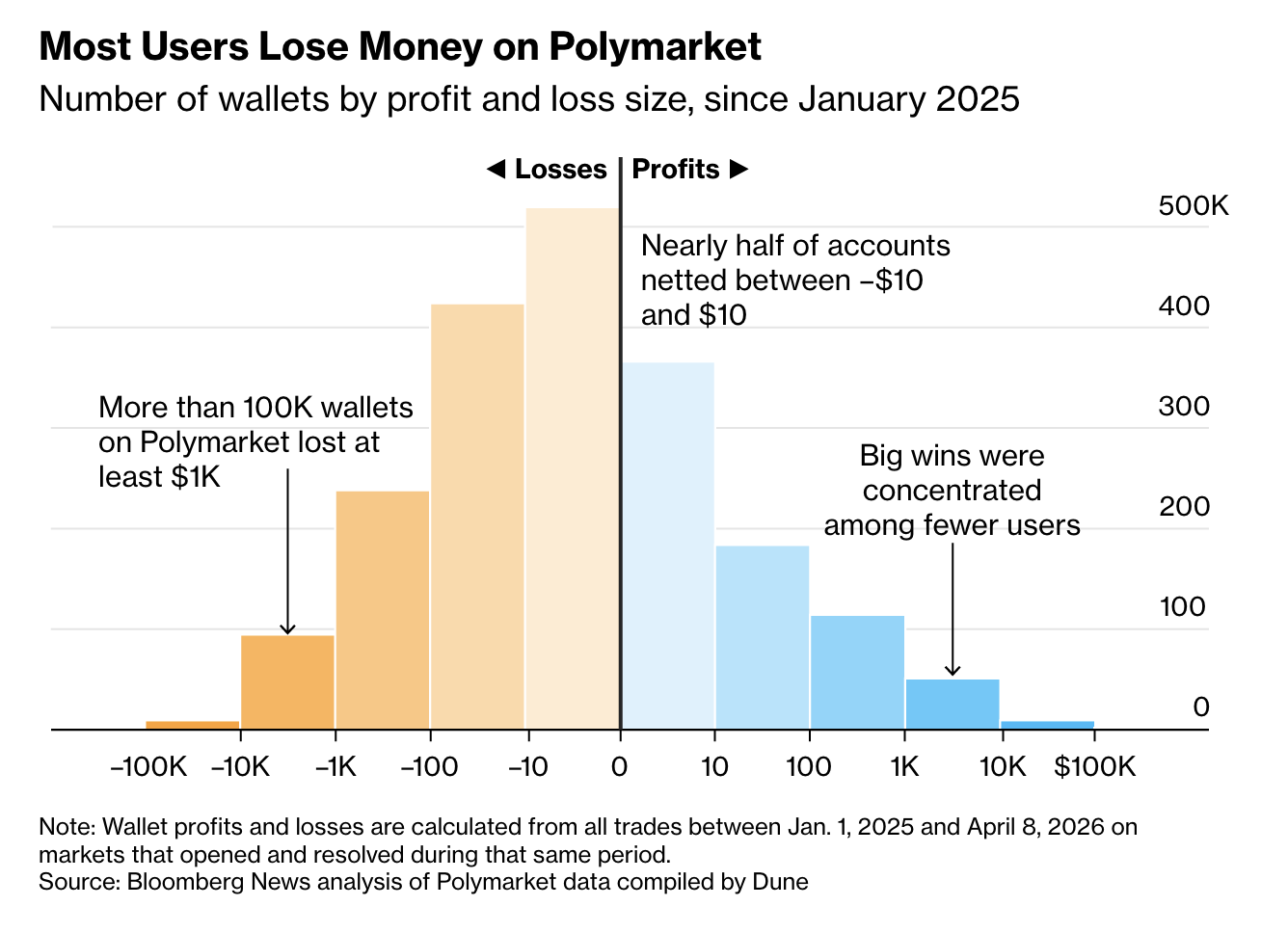
Source: Bloomberg
Sign up for our reads-only mailing list here.
