
My back-to-work morning train WFH reads:
• Trade court rules Trump’s replacement tariffs illegal: A divided three-judge panel on the U.S. Court of International Trade concluded that Trump’s 10 percent global tariffs are unlawful. Same trade-court ruling, second take. Watch the appeal closely — this one could rewrite the playbook on executive trade authority. (Politico) see also Trade court strikes down Trump 10% universal tariffs: The U.S. Court of International Trade rules the across-the-board tariffs exceeded presidential authority. Markets noticed. (Axios)
• The Nominal Anchor Still Holds: The Inflation Trauma Lingers, but the Fed’s Credibility Endures for Now. On why long-term inflation expectations remain remarkably stable despite the headline noise. Reassuring for the Fed; less so for the gold bugs. (Macroeconomic Policy Nexus)
• Why It’s So Hard to Spot a Stock-Market Bubble: Jason Zweig on the cognitive traps that make bubbles invisible until they pop. The math is easy; the psychology is brutal. A sudden surge in share prices makes us all think we know what’s coming next. (Wall Street Journal) see also The Real Reason Everything Feels So Expensive Right Now: Despite reassuring economic data, many Americans say their day-to-day costs are still rising. (Slate)
• The whining meant it wasn’t about the pied-à-terre tax It was about being personally singled out: Jonathan Miller dissects the manufactured outrage from billionaires over Mamdani’s housing tax plan. The volume is the giveaway. It was about being personally singled out. “While I very much admire what Griffin has achieved and that he should be rewarded for being innovative, smart and clever (I listen closely to his economic insights), his reaction to the mayor’s video clearly wasn’t about the pied-à-terre tax. It was about being singled out for buying the most expensive home in U.S. history, which has been exhaustively explored since he closed in 2019. I thought it was a bad look for him to talk about pivoting to Miami, which he already did the last time the pied-à-terre tax came up in 2019. However, I have no doubt he meant it when he said it.” (The Real Deal)
• ‘Blissful ignorance’: Milken elite bask in glow of roaring markets: The Milken Conference is always a good index of how the buy-side is feeling. This year: euphoric, oblivious, very interested in private credit. (Financial Times free)
• Want to understand the current state of AI? Check out these charts. According to Stanford’s 2026 AI Index, AI is sprinting, and we’re struggling to keep up. A clean visual tour of compute, capability, capex, and revenue curves. The shapes tell you more than any of the white papers do. (MIT Technology Review) see also The AI Labor Debate: Three Views on the Future of Work: AI could hollow out jobs, reshape them gradually, create entirely new ones—or do all three at once. The case for starting to act now doesn’t depend on knowing which. Carnegie lays out the three serious camps in the AI-and-jobs debate — substitution, augmentation, and reshuffling — with actual evidence behind each. Useful structure for a noisy argument. (Carnegie Endowment)
• U.S. intelligence says Iran can outlast Trump’s Hormuz blockade for months: The CIA’s read on Iranian endurance is at odds with the White House’s timeline. Worth filing for the next round of strait-of-Hormuz brinkmanship. A confidential intelligence community assessment delivered to the White House also finds that Iran retains a substantial missile and drone arsenal. (Washington Post)
• A Look Inside the Case That Enshrined Political Power for Billionaires: A walk through the Buckley-to-Citizens-United logic chain. The donor class did not get here by accident — it got here by litigation. After Watergate, Congress tried to curtail the role of money in politics. But a pivotal Supreme Court case nipped it in the bud. Years later, new details are emerging on how wealthy Americans were conferred with a “right to spend” on elections. (New York Times)
• Yankees pay tribute to ‘iconic’ John Sterling during, after win: “I still do this, and my coaches look at me like I’m nuts,” Boone said Monday. “I don’t even know if they know what I’m doing. But as soon as the final out is made and I get up to shake players’ hands, I go, ‘Ballgame over! Yankees win! Theeee Yankees win!’ And I’m shaking all my coaches’ hands. I got goose bumps thinking about that.” (ESPN) see also Broadcast booths around baseball tip their caps to John Sterling: The baseball world lost a legend on Monday, with longtime Yankees radio voice John Sterling passing away at 87. After more than three decades of calling Yankees games and injecting his one-of-a-kind personality into every moment, Sterling will leave a legacy in both New York and baseball on a larger scale. (MLB.com)
• The Stephen Colbert Exit Interview: “I Did Not Expect It to End This Way” As ‘The Late Show’ nears its final bow, the host opens up about the cancellation that shocked the industry, the win of going out as a “martyr” and his next act in Middle-earth. Colbert reflects on the abrupt cancellation of The Late Show and what it says about the slow death of network late-night. A more candid exit than the genre usually allows. (Hollywood Reporter)
Video of the day: Why Nobody Wants the Chrysler Building
Be sure to check out our Master’s in Business interview this weekend with Howard Lindzon, known as “The Larry David of Finance.” He is General Partner at the seed fund, Social Leverage, he was one of the first seed investors in Robinhood, which IPOd at $30B in 2021, eToro, Manscaped, and Beehiiv. Previously, he founded Wallstrip, a daily online video show acquired by CBS (2007). He also co-founded Stocktwits, which pioneered the “cashtag.” Recognized by Institutional Investor as a “Super Angel;” his podcast is Panic with Friends.
Wall Street bonuses hit a new record last year, edging toward $250,000 average
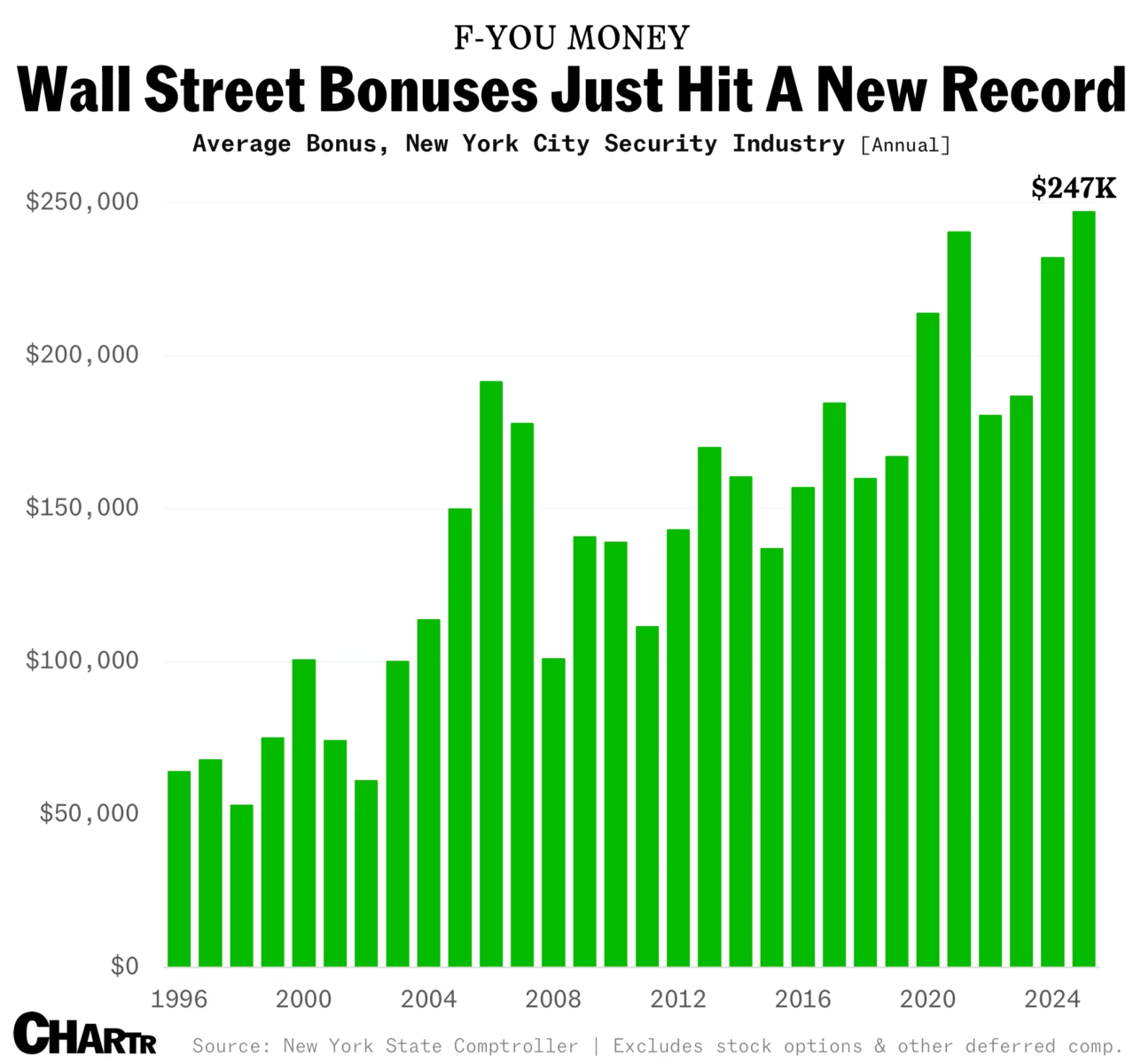
Source: Sherwood
Sign up for our reads-only mailing list here.
