
My morning train WFH reads:
• Before you invest in crypto, watch this film: Mother Jones on a documentary diagnosing crypto as a wealth-transfer machine pointed at retail. The OC star turned skeptic remains an unlikely but effective explainer. Ben McKenzie scorches the cult of cryptocurrency. (Mother Jones)
• Nobody Knows Anything: A market-strategy riff on the Goldman line — humility about forecasting as the only durable edge. Always worth re-reading when the consensus gets loud. (TrendLabs) see also Nobody Knows Anything: Derek Thompson on why a piece of AI science fiction rocked the stock market — and what that tells us about how little anyone actually understands about where technology and the economy are heading. (Derek Thompson) see also Nobody Knows Anything: Barry Ritholtz’s Bloomberg classic on the fundamental unpredictability of markets — and why anyone who claims otherwise is selling something. (Bloomberg)
• The Great 2026 Reset… — Deutsche Bank Research Institute: DB’s macro team takes a swing at framing 2026. Read it for the framework, not the predictions. (Deutsche Bank Research Institute)
• Stories vs. Statistics: Ben Carlson on why narrative beats spreadsheet for most investors even when the spreadsheet is right. The behavioral piece behind half the bad decisions our industry sees. (A Wealth of Common Sense)
• Why Humans Are Obsessed With Numbers Too Big to Understand: Mathematician Richard Elwes discusses humanity’s long-time fascination with ginormous numbers—and what this obsession reveals about us. On our cognitive failure modes around trillions, billions, and parsecs. Relevant to investors, voters, and anyone trying to process the federal budget. (Gizmodo)
• The Iran War Is Crippling One of the World’s Wealthiest Nations: The NYT on Qatar — caught between US bases, Iranian missiles, and a gas-export business that depends on a quiet Strait of Hormuz. Even the rich neighbors are paying for this war. Iranian attacks and the stoppage of seaborne transit have paralyzed Qatar’s vital gas exports, stalling the economic pivots intended to anchor the country’s growth. (New York Times)
• The paradox at the heart of American meat: Vox Future Perfect on the gap between what Americans say about animal welfare and what they buy at the grocery store. The cognitive dissonance is the product. No one likes how animals are treated on factory farms. But no one wants to stop eating them. (Vox)
• The First Atomic Bomb Test in 1945 Created an Entirely New Material: Wired on trinitite — the strange green glass the Trinity test fused out of the desert floor — and what new analysis reveals about its mineral structure. A nice science palate cleanser. The discovery from the Trinity nuclear test site shows how extreme conditions can result in materials never before seen in nature or in the lab. (Wired)
• Everyone Thinks Trump Won Last Night. They’re Wrong: A contrarian read arguing the conventional wisdom missed the actual political signal from last night. Useful as a counterweight regardless of whether the call ages well. Trump’s revenge tour just made the GOP’s midterm problem a whole lot worse.” (The Message Box)
• Jackson Pollock painting sells for record $181 million at auction: Number 7A, 1948, which went under the hammer at the renowned Christie’s auction house on Monday, smashed the previous record for the most a work by the late American artist has taken at auction. The painting, which came from the private collection of media magnate SI Newhouse, is also now the fourth most expensive artwork ever sold at auction, according to ARTnews. (BBC)
Video of the day: Americans Crave Low-Cost Chinese EVs
Be sure to check out our Masters in Business interview this weekend with Vimal Kapur, CEO and Chairman of DJIA component Honeywell International. The firm is in the midst of dividing into three companies: Honeywell Automation, Honeywell Aerospace, and Solstice Advanced Materials. The firm has fully integrated AI as the intelligence layer in all of its automation processes and products.
AI Is Fueling a New American Startup Boom
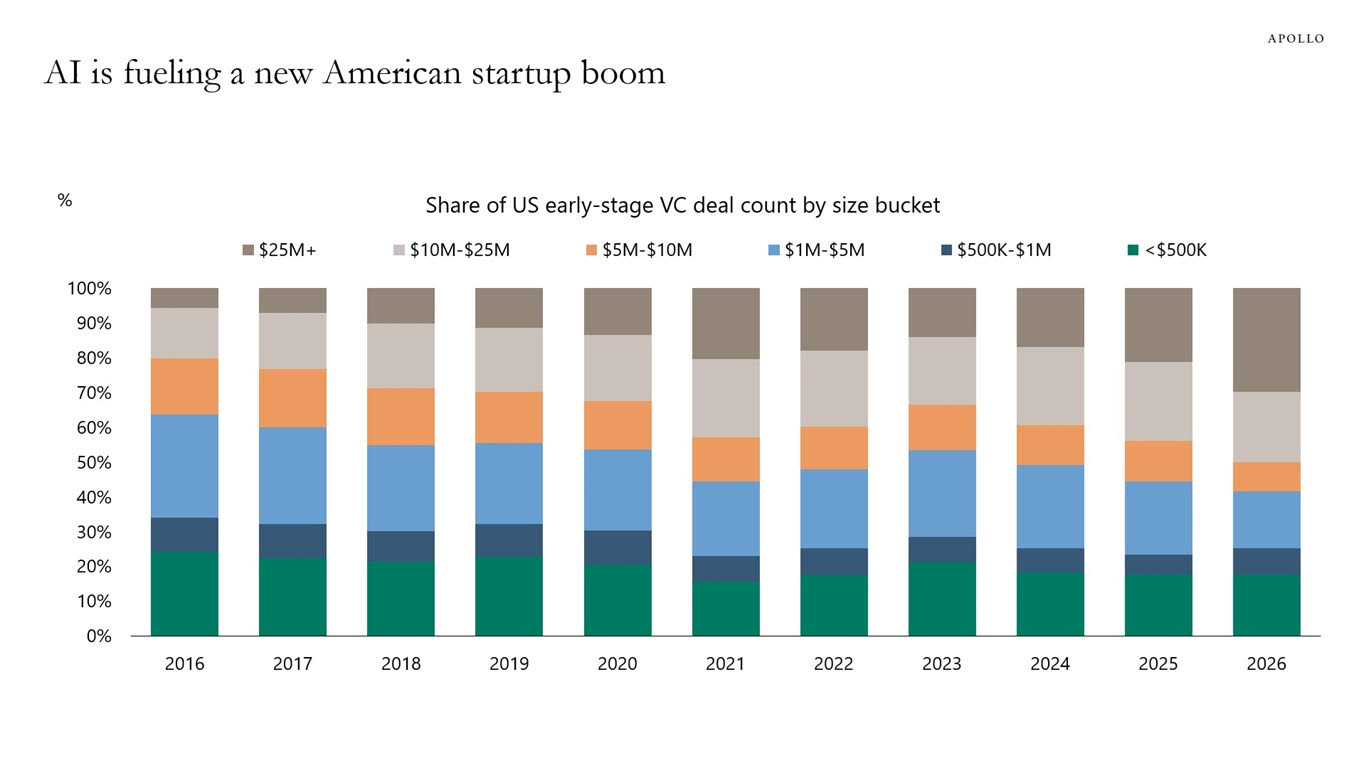
Source: Apollo
Sign up for our reads-only mailing list here.
