
My Two-for-Tuesday morning train reads:
• Speak, Yuppie: Yuppies were called into being by the forces that were remaking the economy in the 1980s.Resurrecting the Y-word as the lens for our current meritocratic discontents — and asking what the urban professional class actually owes the rest of the country. (New York Times)
• The Last Days of Butter Ridge: The Watsons were dairy farmers for generations, the rhythms of their lives defined by their cows. Until this spring. An elegy for one Pennsylvania dairy farm, told as a microcosm of the consolidation that’s quietly remaking American agriculture. (New York Times) see also Farm bankruptcies jumped 46% in 2025 as debt loads and costs rise: Chapter 12 filings climbed in the US. That’s a third straight increase annually as higher production costs and expanding borrowing put new pressure on farmers in 2026. A 46% jump in Chapter 12 filings is not a vibes story — it’s farmland deflation, input inflation, and the trade war all hitting at once. (Investigate Midwest / Farm Bureau)
• Inside L.A.’s Fake Courtroom Show Machine: Byron Allen’s syndicated TV-court empire keeps churning out reality-judgment programming. The economics are weirder than the verdicts. Entertainment Studios might be one of the busiest production facilities in Los Angeles right now. I got the scoop on the courtroom shows it churns out — and a lead role in an episode. (LA Material)
• Iran used Chinese spy satellite to target US bases: Leaked documents show IRGC secretly acquired system and used it to guide strikes during war in March. Iran secretly acquired a Chinese spy satellite to target US military bases across the Middle East. The China-Iran axis just became a lot more concrete — and a lot more dangerous. (Financial Times)
• How YouTube Took Over the American Classroom: The Chromebook generation now learns from the algorithm by default. Teachers, administrators, and Google all benefit; the question is whether the kids do. Parents find their kids captive to the video streaming site on their school-issued devices; for one, it was 13,000 YouTube videos in three months. (Wall Street Journal)
• Ukraine’s rapid rise as an anti-drone powerhouse: Necessity makes the best R&D lab. Kyiv’s counter-drone industry now exports back to NATO. In only four years after the Russian invasion, Ukraine went from being a country knocked back on its heels and scrambling for military aid to emerging as a leading provider of battlefield-tested counter-drone expertise and exporter of anti-drone weapons systems. How did this happen? Let’s find out. (New Atlas)
• How science is finally making real progress in treating allergies—and what it means for you: After decades of limited options, allergy care is may no longer a one-size-fits-all treatment approach. (Nat Geo) see also About pain and other ailments: “What wound did ever heal but by degrees?” – Othello, William Shakespeare. (Andrea Petkovic)
• Inside the Secret Group Chats Fueling MAGA’s Messaging Machine: Ashley St. Clair revealed the coordinated system shaping pro-Trump narratives online. (Slate)
• Why Does Music in Science Fiction Sound Like That? Imagining the sound of other worlds has a long past—and persistent creative limits. On theremins, synths, and why we still hear ‘the future’ as eerie tones. A fun cultural-history detour (JSTOR Daily)
• How did Banksy put up a statue in central London? The statue appeared on a plinth in Waterloo Place on Wednesday. A low-loader, some traffic cones and “the sort of dudes who can set up a Metallica concert in 24 hours” – this was all Banksy needed to install his latest artwork in central London. Under the cover of darkness, the street artist erected a statue on a plinth showing a besuited man walking forward, blinded by a flag covering his face. How did he do it? And what will happen next? The logistics of pulling off a Banksy stunt are arguably more impressive than the art itself. A short, fun read on guerrilla installation craft. (BBC)
Be sure to check out our Masters in Business this past weekend with Lawrence Calcano, CEO and Chairman of iCapital, The firm is a fintech platform built to be the OS for alternative investments and complex products for financial advisors, wealth managers, and banks. The firm has over $1.2 trillion in active global assets on platform, across 2,455 funds used by 123,ooo financial professionals.
Globalization weakened when major powers started treating trade as a tool for coercion, deterrence, and social change
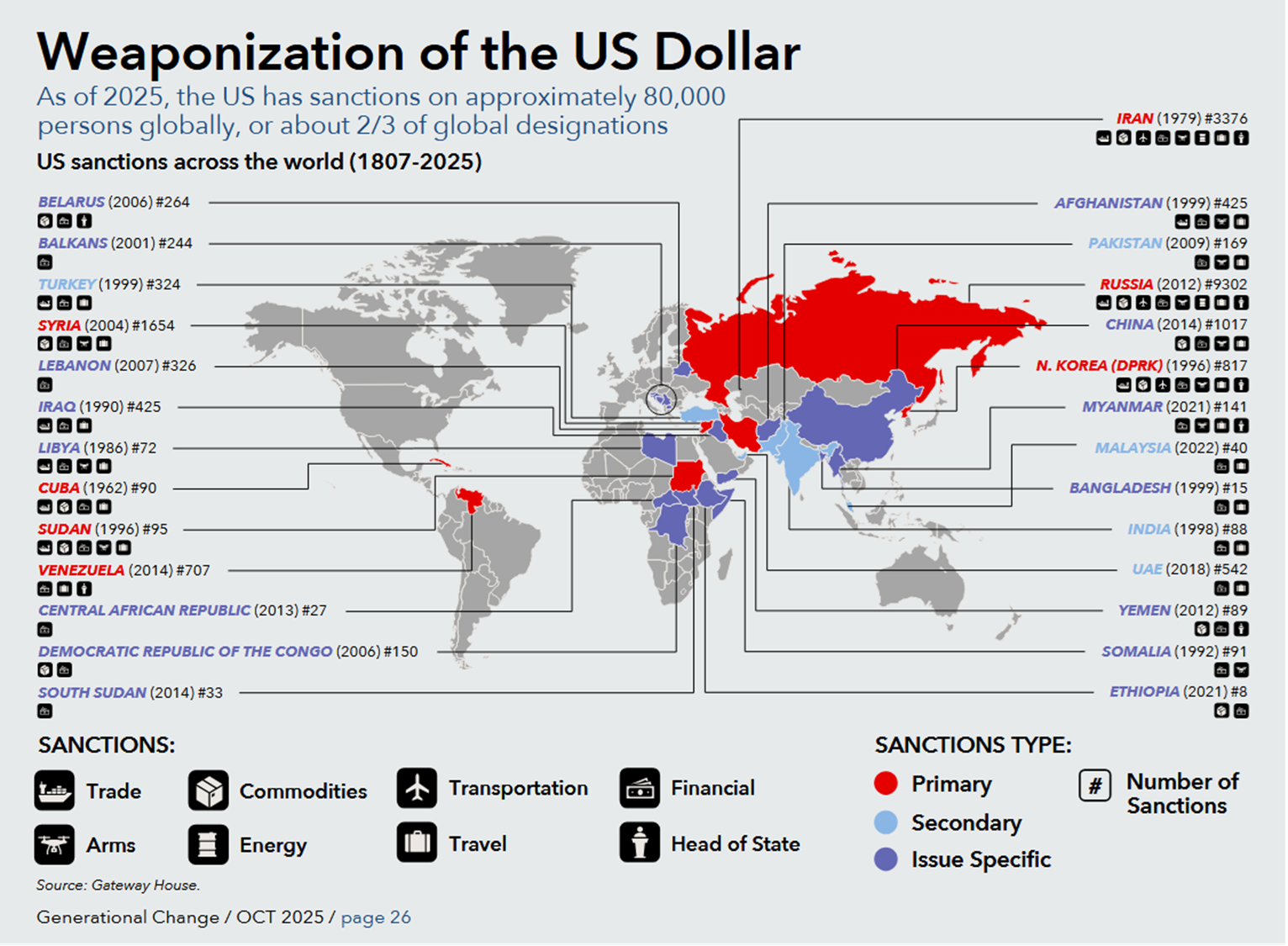
Source: Bruce Mehlman’s Age of Disruption
Sign up for our reads-only mailing list here.
