
My mid-week morning train WFH reads:
• Stock Gains Without All the Taxes? How the Hottest Trade on Wall Street Works: The stock-market surge has propelled the use of a new kind of tax-loss harvesting. We break it down. The WSJ on the surge of direct-indexing and Section 351 ETF conversions that let wealthy investors swap concentrated stock into diversified portfolios without triggering capital gains. A useful explainer for clients asking about it. The stock-market surge has propelled the use of a new kind of tax-loss harvesting. We break it down. (Wall Street Journal)
• Trump’s Investments In Palantir And Nvidia Draw Scrutiny—Here’s What Companies Were Traded. President Donald Trump drew scrutiny Friday over millions of dollars of securities trades made in recent months involving companies his administration has also made deals with — though Trump’s son Eric said the trades were made by a blind trust. Forbes lines up the President’s recent trading activity against companies with direct policy exposure. Read alongside the WSJ pieces on his accounts — it’s a single story being told in pieces. (Forbes) see also See How Trump’s Accounts Were Busy Trading Big Tech Stocks: Trump’s investment accounts had a surge in activity, with more than 3,700 trades in the first quarter. The WSJ’s data-driven look at the trading activity reported across Trump-family accounts — well-timed mega-cap entries and exits clustered around policy news. Make of it what you will. (Wall Street Journal)
• New York Real Estate in the Age of Inherited Wealth. NYC housing no longer tracks real estate fundamentals, it tracks equity portfolios and private equity flows, a concentration that feels durable but has never been historically. On the increasingly visible role of parental cash in Manhattan and Brooklyn closings. The first-time buyer cohort is now functionally two markets — those with family equity and everyone else. (Housing Notes)
• Mapping the household-level transmission of monetary policy: The monetary tightening that followed the post-pandemic inflation episode has revived long-standing debates about how monetary policy affects households. This column uses a survey of more than 25,000 US households, combining hypothetical questions with randomised information experiments, to show that monetary policy has a contractionary impact on consumption, but the transmission mechanism differs substantially from conventional theory. VoxEU on micro-data showing rate hikes hit households very unevenly — by mortgage type, age, and income. Useful corrective to anyone still treating “the consumer” as a single object. (VOXEU CEPR)
• LinkedIn Is Doing What Bluesky Was Supposed to Do: Rebuilding a public square on the platform you least expect. For a brief moment about a year ago, it really did look like Bluesky might work. Researchers and left-of-center intellectuals were flooding in, swapping starter packs, reassembling what felt like a nostalgic reunion of old Twitter. Then everyone arrived, and the center could not hold. A sharp argument that the post-Twitter intellectual conversation didn’t move to Bluesky or Threads — it quietly migrated to LinkedIn, of all places. Uncomfortable for everyone involved, but not wrong. (Popular by Design)
• Why are people so excited about Swatch’s Royal Pop watch? Similar to past sales of its kind, some people queued for days to get their hands on one of the eight models. But the ferocity of interest in the product, both online and on the high street, has split opinions about responsible marketing and whether the watches are even worth it. (BBC)
• Google Chrome silently installs a 4 GB AI model on your device without consent: Including a back-of-envelope on the climate cost at billion-device scale. The ‘opt-out’ fiction continues. At a billion-device scale the climate costs are insane. (That Privacy Guy!)
• Russia’s War Is Going Badly—on the Ground and in the Air. Ukraine’s growing arsenal of long-range drones and domestically produced missiles has been hitting oil infrastructure and military facilities deeper inside Russia. Putin shows no signs he is rethinking his aims The WSJ on a Russian summer offensive that has stalled while drones and long-range strikes are quietly wrecking the air arm. The market narrative on oil and defense names is starting to lag the battlefield. Putin shows no signs he is rethinking his aims (Wall Street Journal)
• New panels produce hydrogen fuel using only water, sunlight and no electricity: This grid-independent system eliminates the need for traditional electrolyzers in green hydrogen production. A direct-solar-to-hydrogen panel design with efficiency numbers that, if they hold up at scale, would matter. Big “if” — but the field has had a quietly good year. This grid-independent system eliminates the need for traditional electrolyzers in green hydrogen production. (Interesting Engineering) see also What It Will Take to Make AI Sustainable? Researcher Sasha Luccioni argues we need better emissions data and a better sense of how people are using AI in the first place. Wired on the brute physics problem the industry is still pretending isn’t one — gigawatt clusters, cooling water, and a power grid that wasn’t built for any of this. Real numbers, no hopium.Researcher Sasha Luccioni argues we need better emissions data and a better sense of how people are using AI in the first place. (Wired)
• US science after a year of Trump: A series of graphics reveals how the Trump administration has sought historic cuts to science and the research workforce. (Nature)
Video of the day: World War II told in 20 Episodes with Tom Hanks
Be sure to check out our Masters in Business interview this weekend with Vimal Kapur, CEO and Chairman of DJIA component Honeywell International. The firm is in the midst of dividing into three companies: Honeywell Automation, Honeywell Aerospace, and Solstice Advanced Materials. The firm has fully integrated AI as the intelligence layer in all of its automation processes and products.
Trump’s investment accounts had a surge in activity, with more than 3,700 trades in Q1
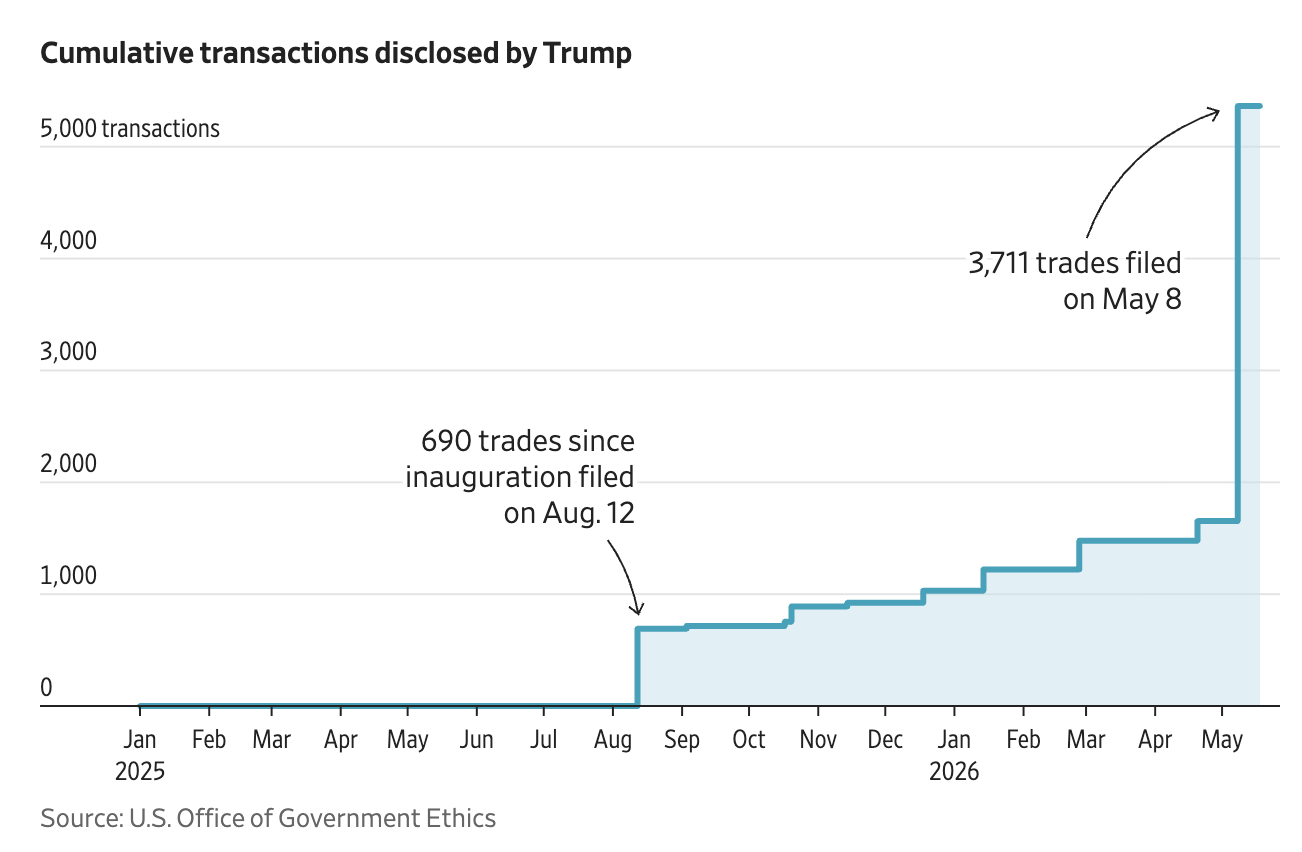
Source: Wall Street Journal
Sign up for our reads-only mailing list here.
