The weekend is here! Pour yourself a mug of Danish Blend coffee, grab a seat outside, and get ready for our longer-form weekend reads:
• Pay Attention: Essential advice for the class of 2026. It sounds simple. But paying attention is in fact one of the most challenging and meaningful things you can do. Because what you pay attention to shapes what you care about. And what you care about shapes who you become. Jonathan Haidt’s NYU commencement address, in essay form. Familiar themes, sharper delivery. (The Atlantic)
• Words That Mattered: Fed Chair Jay Powell.He was sworn in as Chair in February 2018, with an economy at 4% unemployment and inflation slightly below 2%; he leaves with unemployment close to 4% and inflation above 3% and rising—a miss on the price stability mandate. The two endpoints do not do justice to the scale of the economic challenges—above all, the pandemic—that Powell navigated. (Stay-At-Home Macro)
• How Warren Buffett Did It By Seth A. Klarman: The Buffett story keeps getting more interesting under scrutiny. The most successful investor of all time retired. Here’s what made him an American role model. On the leverage hiding inside the ‘patient value investor’ brand. (The Atlantic)
• The Long Revolution: Will capitalism last forever? If capital was viewed as a thing and capitalists as people, capitalism was something else. Blanc described it as an act, the taking of collective wealth and turning it into individual or private profit. Proudhon claimed it was a citadel, casting medieval and military shadows across the land. Despite his obvious interest and extensive writing on the subject, Marx steered clear of the term. Helpful frame for thinking about where the current consolidation cycle fits. (The Nation)
• The Founding Story Behind Japan’s Oldest Whisky Maker: The Suntory origin story — part craft history, part marketing — a satisfying read for whisky drinkers. The House of Suntory is often credited with putting Japanese whisky on the map. (Town & Country)
• I Work in Hollywood. Everyone Who Used to Make TV Is Now Secretly Training AI: For screenwriters like me—and job seekers all over—AI gig work is the new waiting tables. In eight months, The quiet new gig economy: laid-off writers, editors, and showrunners moonlighting as AI-training contractors. The talent doesn’t disappear, it just gets repurposed. I’ve done 20 of these soul-crushing contracts for five different platforms. It’s bad. (Wired)
• 5 Legendary Apple Stories That Reveal the Genius Behind Its Innovation. Apple’s greatest innovations came not just from technology, but from relentless creativity, unconventional thinking, and an obsessive drive to make products feel magical to ordinary people. Five vignettes from the Apple corpus. Hagiographic in tone, but each contains an actual decision worth studying. (Next Big Idea Club)
• The Stephen Colbert Exit Interview: “I Did Not Expect It to End This Way”: Colbert reflects on the abrupt cancellation of The Late Show and what it says about the slow death of network late-night. As ‘The Late Show’ nears its final bow, the host opens up about the cancellation that shocked the industry, the win of going out as a “martyr” and his next act in Middle-earth. (Hollywood Reporter)
• The Astounding Discovery That Could Link Eastern and Western Medicine: The detection of another circulatory system in the human body could have enormous scientific implications. (New York Times Magazine)
• Why Steve Kerr stayed with the Warriors. Kerr loves the game and its history. He’s an obsessive sports fan and has been watching the last acts of sporting lives for the past 40 years. It’s often ugly. The final years of Lute Olson’s life were not the victory lap they should have been. Kerr doesn’t want the Warriors to end up like the New England Patriots, marred by grudges and grievances. He watched Michael Jordan retire, then unretire, then retire, then unretire. His friends used to grill him about MJ. Kerr on loyalty, succession, and the Curry era’s last laps. A nice contrast to most coaching-job pieces, which read like prospectuses. (ESPN)
Be sure to check out our Masters in Business this weekend with Sheila Bair, former Chairperson of FDIC from 2006-11. She helped steer the agency through worst financial crisis since the Great Depression. Her new book is aimed at young adults and teenagers, titled “How Not to Lose a Million Dollars”
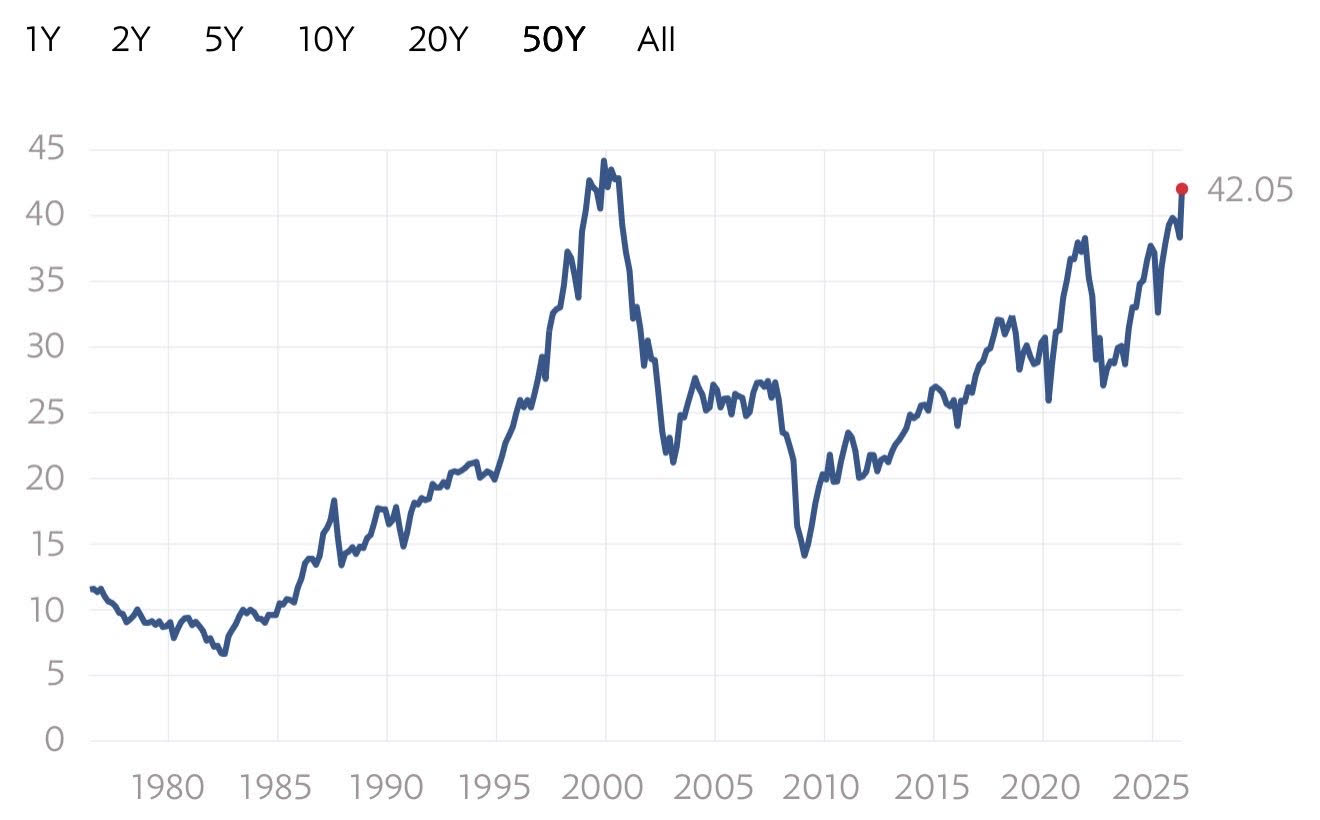
Despite peak Shiller CAPE, if you bought the Nasdaq 100 top in March 2000, you made ~8% per year since
Source: @cullenroche
To learn how these reads are assembled each day, please see this.
This content, which contains security-related opinions and/or information, is provided for informational purposes only and should not be relied upon in any manner as professional advice, or an endorsement of any practices, products or services. There can be no guarantees or assurances that the views expressed here will be applicable for any particular facts or circumstances, and should not be relied upon in any manner. You should consult your own advisers as to legal, business, tax, and other related matters concerning any investment. The commentary in this “post” (including any related blog, podcasts, videos, and social media) reflects the personal opinions, viewpoints, and analyses of the Ritholtz Wealth Management employees providing such comments, and should not be regarded the views of Ritholtz Wealth Management LLC. or its respective affiliates or as a description of advisory services provided by Ritholtz Wealth Management or performance returns of any Ritholtz Wealth Management Investments client. References to any securities or digital assets, or performance data, are for illustrative purposes only and do not constitute an investment recommendation or offer to provide investment advisory services. Charts and graphs provided within are for informational purposes solely and should not be relied upon when making any investment decision. Past performance is not indicative of future results. The content speaks only as of the date indicated. Any projections, estimates, forecasts, targets, prospects, and/or opinions expressed in these materials are subject to change without notice and may differ or be contrary to opinions expressed by others. The Compound Media, Inc., an affiliate of Ritholtz Wealth Management, receives payment from various entities for advertisements in affiliated podcasts, blogs and emails. Inclusion of such advertisements does not constitute or imply endorsement, sponsorship or recommendation thereof, or any affiliation therewith, by the Content Creator or by Ritholtz Wealth Management or any of its employees. Investments in securities involve the risk of loss. For additional advertisement disclaimers see here: https://www.ritholtzwealth.com/advertising-disclaimers Please see disclosures here: https://ritholtzwealth.com/blog-disclosures/