
Welcome to June! Kick off your back-to-work with our expertly curated morning reads:
• The Lowest Consumer Sentiment EVER: We are currently sitting at the lowest level of consumer sentiment in the past 75 years!. Lower than the Great Financial Crisis when the stock market crashed almost 60%, the financial system nearly imploded and the unemployment rate reached more than 10%. Lower than the aftermath of the dot-com bubble bursting which included a 50% stock market crash, a recession and 9/11. Ben Carlson on the new Michigan low — historically a contrarian buy signal, but the gap between sentiment and spending has gotten weird. The chart and the caveat in one post. (A Wealth of Common Sense)
• The Chip Rally Is at $5.7 Trillion and Counting. How Much Further Can It Go?: WSJ on the semiconductor complex’s total market cap, the unit economics underneath, and the multiple expansion that has done most of the work. Sober the next time someone quotes “still early.” Surging demand for chip makers has lifted major indexes from their wartime malaise (Wall Street Journal) see also The Chip Rally Has Gone Parabolic. It’s Time to Separate the Pillars From the Pretenders. A furious rally has raised fears of a new bubble. If and when the party ends, five stocks will be left standing. They all remain undervalued. (Barron’s)
• Ford’s Stock Is Surging — and It’s Got Nothing to Do With Its Car Business: WSJ on why Ford Credit is now driving the equity story. The legacy automaker has become a financial-services company that happens to ship sheet metal. (Wall Street Journal)
• The 4% rule is now the 4.7% rule. That matters for your retirement. The 4% rule has drawn praise and pillory for years. Now, says its author, it’s time for a revisionto 4.7%. The revision illustrates both the strength and weakness of the original rule. (USA Today)
• Independent bookstores are multiplying, although many people still think they’re dying out: The Inquirer on the indie-bookstore comeback — romantasy demand, third-place economics, and what Amazon and the chains can’t quite replicate. The vibe shift has numbers behind it. The latest numbers from the American Booksellers Association show independent stores expanding at a pace not seen this century. (The Philadelphia Inquirer)
• You Won the Battle on Investment Fees. You’re Losing the War Against Taxes.: Jason Zweig on where the real frictions in long-horizon returns live now — not expense ratios, but capital-gains drag, turnover, and the bracket math no one models. Required reading. (Wall Street Journal)
• A Famous Math Problem Stumped Humans for 80 Years. AI Just Cracked It. The math world is losing its mind over the new solution to an Erdős problem. This is what AI found, how we missed it—and why it matters. WSJ on an OpenAI model knocking out an Erdős problem that had been open for eighty years. The “calculator for proofs” framing is starting to look closer to reality than to hype. (Wall Street Journal)
• This High Schooler Developed an A.I. Tool to Diagnose Autism and ADHD Using the Retina: Smithsonian on a high-school project that turned a fundus camera into a screening tool. The headline is cute; the underlying methodology is not. (Smithsonian Magazine)
• Three Ways Trump Is Losing the War: At the moment, the United States is negotiating with a regime that President Trump claimed we had already changed, to open a strait that was supposed to be open last month, and to end a nuclear program that we said we had obliterated. NYT opinion on the three distinct fronts where the Iran campaign has gone sideways — operational, diplomatic, domestic. Cleaner taxonomy than most of the cable coverage. (New York Times) see also Why Trump Keeps Getting Rolled in Negotiations: The Atlantic on the pattern: Trump opens hot, the counterparty waits him out, and the climbdown gets framed as a deal. Iran is just the latest specimen. (The Atlantic)
• When Fame Comes Very, Very Late: Bob Graboyes on the people who hit their stride after sixty — composers, novelists, scientists. A reasonable antidote to the 30-under-30 ecosystem. (Bastiat’s Window)
Video of the day: Why Aldi is destroying traditional grocery stores.
Grok is the most sycophantic AI model
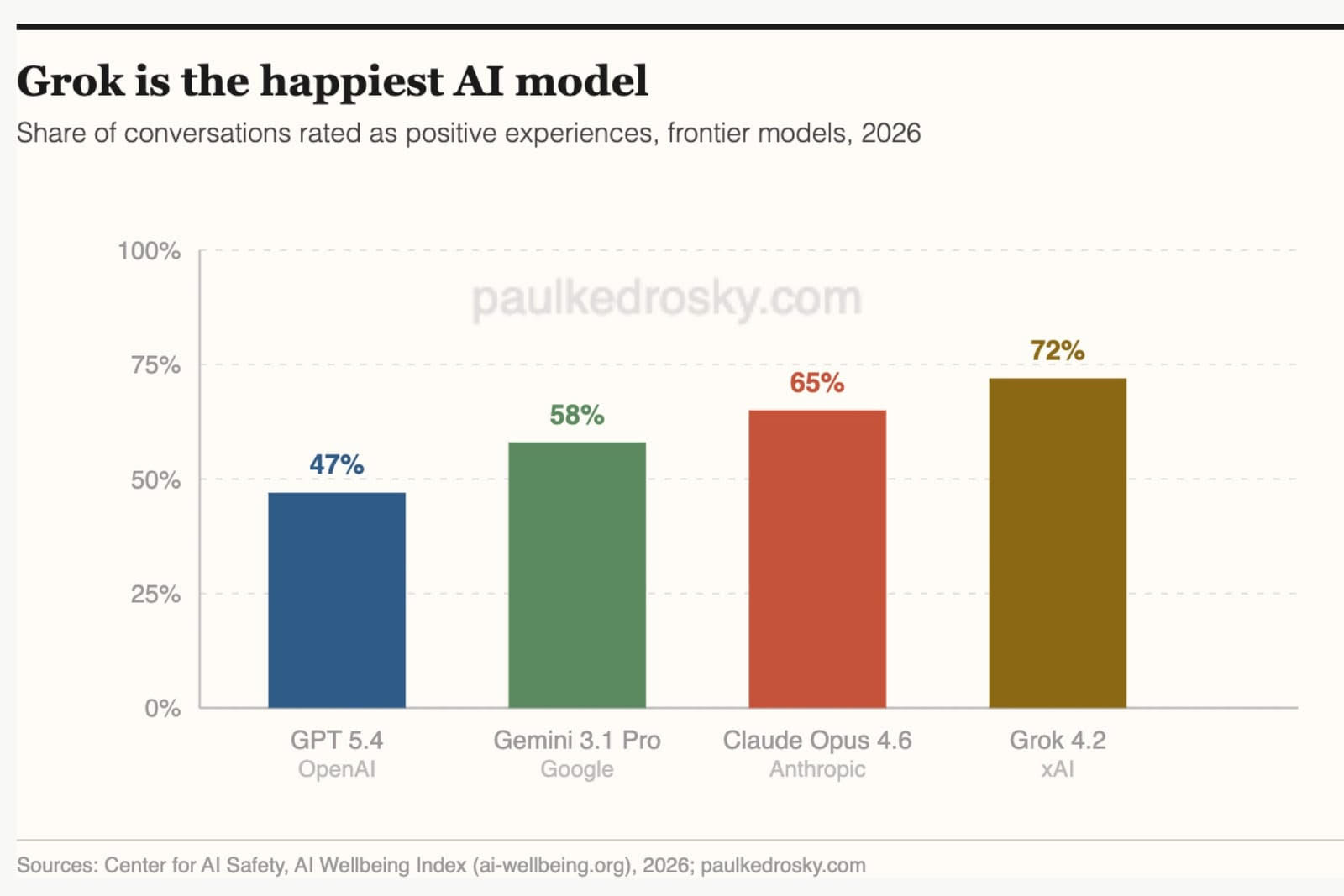
Source: Center for AI Safety via Paul Kedrosky
Be sure to check out our special Masters in Business this week, Remembering Jonathan Clements with Bill Bernstein and Jason Zweig. The two recall Clements’ impact on the investor community; they discuss his posthumous book, “Money and Me.”
Sign up for our reads-only mailing list here.
