
My morning train WFH reads:
• The Future of Work & AI: How 16 top economists think AI will change the job market, and how to prepare for AI’s labor-market implications. Useful as a baseline against the louder, less data-grounded takes. (Wall Street Journal)
• An entire industry is being propped up by math that is insane. Welcome to fantasy land Jensen Huang has apparently likened the upcoming IPO’s to Amazon, Google and Meta: Gary Marcus on the financial math underneath the generative-AI capex boom. Worth reading even if you disagree — and especially if you don’t. (Gary Marcus) see also Here’s that ‘SpaceX’s IPO is overvalued by 114%’ research in full: The stock’s probably worth $63 per share, a 53 per cent discount to the $135 issue price. SpaceX probably has an addressable market of about $129bn, rather than the $1.6tn claimed in its S-1 filing. In a (metaphorical) moonshot scenario, where SpaceX pioneers orbital data centres and captures 20 per cent of AI computing capacity by 2040, the company would be worth $1.97tn, or $154 per share. The FT publishes the full bear-case research note on SpaceX’s IPO valuation. Pair it with Damodaran for a complete debate. (Financial Times) see also The S&P 500 Just Saved Your Retirement From Elon Musk (for Now): The billionaire is going to hate this—and there’s nothing he can do about it. (Slate)
• Back Office: The Hidden Workers Most Threatened by A.I. As artificial intelligence spreads, millions of middle-class jobs in human resources, billing and payroll could be at risk. Most are held by women. NYT on the back-office workforce — the unglamorous middle of the economy — getting hit first and hardest by AI. The displacement isn’t a future story anymore. (New York Times)
• Musk Looks to an Army of Loyalists to Help Make Him a Trillionaire: The SpaceX IPO is expected to set records Friday and mark a new pinnacle in Wall Street’s retail revolution. WSJ on the SpaceX IPO retail-marketing playbook designed to channel Musk-fan demand into share prices. Engineered enthusiasm at scale. (Wall Street Journal)
• No, Artificial Intelligence Is Not Conscious: Taken to its logical conclusion, this line of thinking is absurd—and damning. A philosophy-grounded pushback against the AI-consciousness creep. The argument: stop confusing fluent mimicry of self-report with the thing itself. (The Atlantic)
• Your birth order affects your future, but not for the reason you think: Why birth order leaves an indelible mark has long eluded scientists. Now we have some answers that suggest what parents and policymakers can do about it. WaPo on the new research that reframes birth-order effects as parenting-bandwidth effects. The signal is real; the mechanism isn’t what folklore says. (Washington Post)
• WWDC26 — The Small Things: My favorite Apple updates are not the flashy new features, but the quiet little touches: annoyances fixed, workflows made smoother, rough edges sanded down, and longstanding flaws thoughtfully reworked. To me, they’re the clearest sign of a company that cares about its craft. Here’s a collection from a WWDC26 screen-grab, organized for easier reading, on improvements coming later this year. A developer’s read on the WWDC announcements nobody else covered — the small APIs and conventions that quietly reshape what app makers can do. Apple is still Apple. (Oneberri) see also Apple introduces Siri AI, a profoundly more capable and personal assistant: Powered by the next generation of Apple Intelligence, Siri AI is a completely reimagined version of Siri that is more helpful, more capable, and more intelligent. With detailed, engaging responses and natural back-and-forth conversation, Siri AI helps users get more done than ever. Apple’s official Siri-AI launch press release. The marketing copy doesn’t write itself, but read it for the shape of what’s actually shipping. (Apple)
• Cops Keep Getting Arrested for Using Flock to Stalk People: There have been more than a dozen cases around the country where police use Flock to obsessively and illegally stalk people. 404 Media on the ongoing pattern of police misuse of Flock’s license-plate-reader network. Surveillance infrastructure plus human nature is an old story. (404 Media)
• How many times has Trump claimed an Iran deal is around the corner? In case you’re keeping score, Donald Trump has claimed that a “deal” with Iran was just about to happen at least 38 times since he started the war. CNN’s count of Trump’s “Iran deal soon” claims. Spoiler: a lot. A useful skepticism calibration. (CNN)
• The US just got its first new sunscreen in ~30 years: America’s sunscreens have been stuck in the past. With BEMT, that’s finally changing. Vox on bemotrizinol finally getting FDA approval — three decades after the rest of the world. The story is half chemistry, half regulatory dysfunction. (Vox)
Video of the day: Why the SpaceX IPO Is Unlike Any Other
Be sure to check out our Masters in Business interview this weekend with Jean Eric Salata, Chair of EQT Group and Chair of EQT Asia. EQT is a purpose-driven global investment organization with over $310 billion in total assets under management, making it the largest private markets firm headquartered outside the United States.
. One of the world’s leading alternative managers, running $316 billion in client assets. The firm was formed by merging Baring Private Equity Asia and Swedish PE giant EQT Group. Salata is on the executive committee and recently succeeded Conni Jonsson as EQT’s Chairman.
Inflation Accelerates to Fastest Pace in 3 Years as Energy Prices Bite
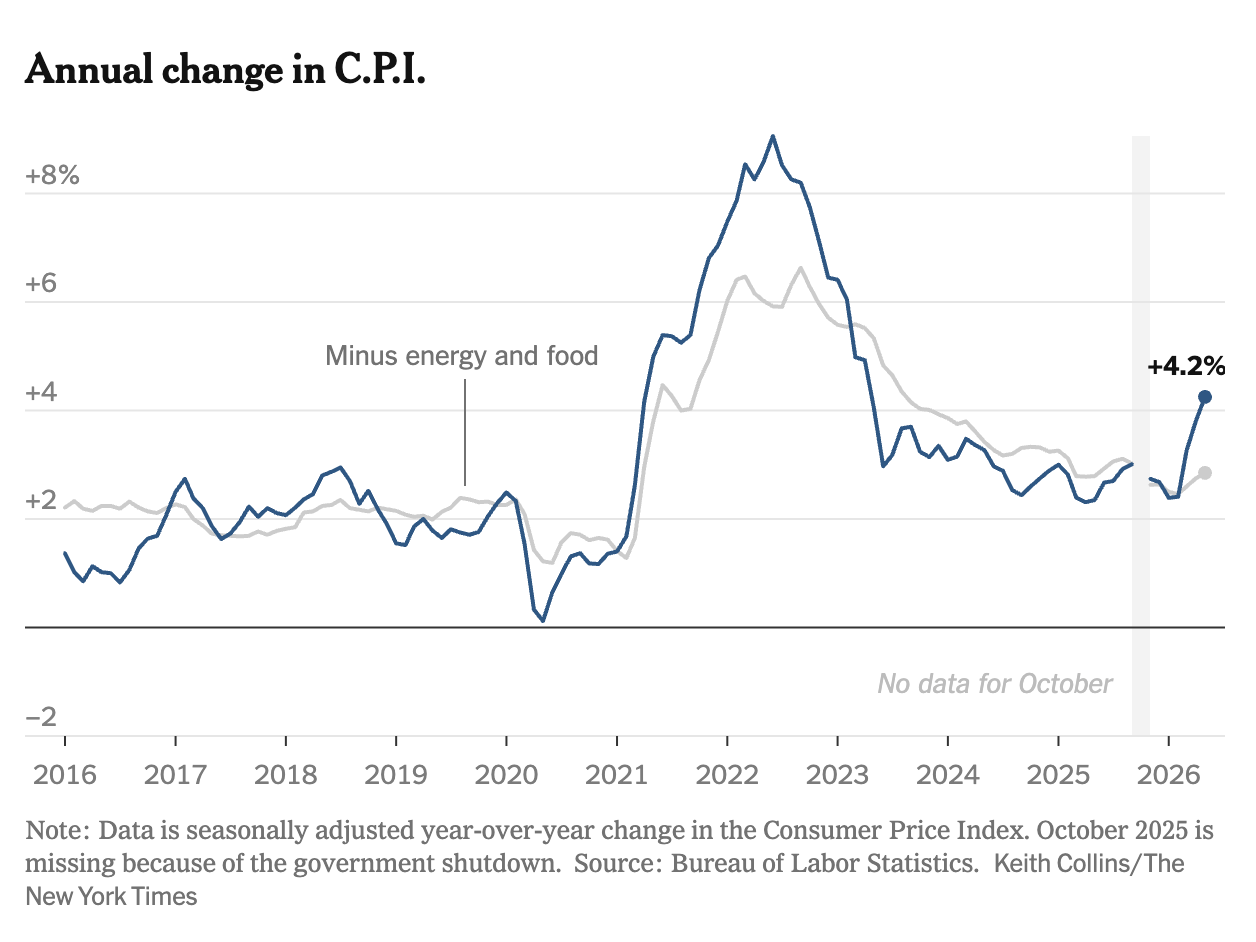
Source: NYTimes
Sign up for our reads-only mailing list here.
