
My mid-week morning train WFH reads:
• A Good Family: Fight Warsh says he wants one, inflation demands it, and the dot plot is how we’d see it. All eyes will be on Kevin Warsh this week as he chairs his first FOMC meeting. However, with PCE inflation on track to top 4% in May, the more pressing question is whether the Fed should raise rates this year. The debate around the FOMC table will be critical, and I worry that Warsh’s efforts to rein in forward guidance could bury it. Obscure a hawkish shift now, and markets get an unwelcome surprise if the Fed actually moves. The uncertainty itself could add to borrowing costs. (Stay-at-Home Macro)
• Elon Musk Is Colonizing Earth: On the surface, Starbase resembles other small Texas towns. It is run by a city commission headed by a mayor who was voted into office to serve a one-year term in May 2025. At their monthly meetings, the mayor and two elected commissioners conduct garden-variety municipal business, like voting to approve ordinances and starting the process to hire a police chief. But this American town functions very differently than most. From what I can tell, every conclusion the commission reaches seems to be a foregone conclusion, and every measure it enacts seems to benefit SpaceX. To date, all votes the commission has taken since the city was incorporated have been unanimous. (New York Times)
• How to Save Capitalism: Nick Hanauer and Eric Beinhocker have a plan for fixing capitalism: “market humanism.” Capitalism is yet worth saving, argue entrepreneur Nick Hanauer and scholar Eric Beinhocker. But they also argue for a radical rethinking of what capitalism should achieve. Their solution: a philosophy they call “market humanism,” which elevates “human flourishing” over efficiency as goals for the economy. (Washington Monthly)
• The abundance illusion: It has worked for every US Administration since Bush Sr. The inventory buffer became the policy. Consume the insurance, call it abundance, and avoid the pain of rebalancing. The hard work Carter asked for — building the physical capacity to never need the buffer — was quietly abandoned. The energy transition gradually became an environmental project, eventually losing much of its security logic and curdling into a polarised fight over green and brown that has lasted a quarter century. (Carlyle)
• SpaceX’s Critical Mineral Consumption: SpaceX’s mineral consumption could increase by 10x over the next decade: Based on an analysis of the company’s S-1, marketing materials, and public information. Over the next decade, SpaceX could consume nearly 270k tons of minerals. The majority of SpaceX’s mineral consumption will come from aluminum, with a total of 137k tons used across Falcon models, StarshipV3, and satellites (V2 and V3). The next bucket of materials contains iron, nickel, silicon, titanium, and germanium, which are used in alloys (Fe, Ni, Ti), while Si is used in high-performance ceramics for heat shields and/or seals. Ge is generally used in solar cells and semiconductors. The next tier of minerals (Ga, In, Cu, Cu, Cr, Nb, Co, Mo, Li, Mn, As) is used in a wide variety of applications, from wiring to lithium-ion batteries and high-temperature components. (Gabriel C)
• Anthropic’s Safety Superpower: To that end, I can certainly buy the case that Fable/Mythos is in fact more capable when it comes to identifying and exploiting security issues, and that Anthropic’s cautious roll-out was justified. The problem with publicly releasing models, however, is that guardrails can be jailbroken, and apparently that is exactly what happened shortly after the release. (Stratechery)
• Serendipity: The Role of Luck in Your Life and Career: But the simple truth is that random events can and do lead to unanticipated outcomes that drive much of what occurs. We underestimate fortune, randomness, and chance at our own peril. (The Big Picture)
• A solar-powered rubbish-eating boat? The vessel chomping plastic waste out of the sea: Guided by floating barriers, the Interceptor has already stopped more than 143,000lbs of rubbish from entering the Pacific from one LA river (The Guardian)
• There’s a Name for the People Who Drain You: “Hasslers” make life more difficult—and we can’t escape them. The Atlantic on the psychological literature classifying the high-maintenance people in our lives. Naming them is half the cure. (The Atlantic)
• The 2026 World Cup Is an Experiment Like No Other: The Ringer on the Trump-Infantino co-production now underway. The tournament is going to be a stress test for U.S. infrastructure and politics — in roughly equal measure. Why the vibes surrounding this World Cup are so cartoonishly bad—and why the beautiful game might beat all the bullshit. (The Ringer)
Video of the day: How a Short Unwanted Jalen Brunson REVIVED The New York Knicks.
Our Masters in Business interview this week was with Jean Eric Salata, Chair of EQT Group and Chair of EQT Asia. EQT is a purpose-driven global investment organization with over $310 billion in total assets under management, making it the largest private markets firm headquartered outside the United States.
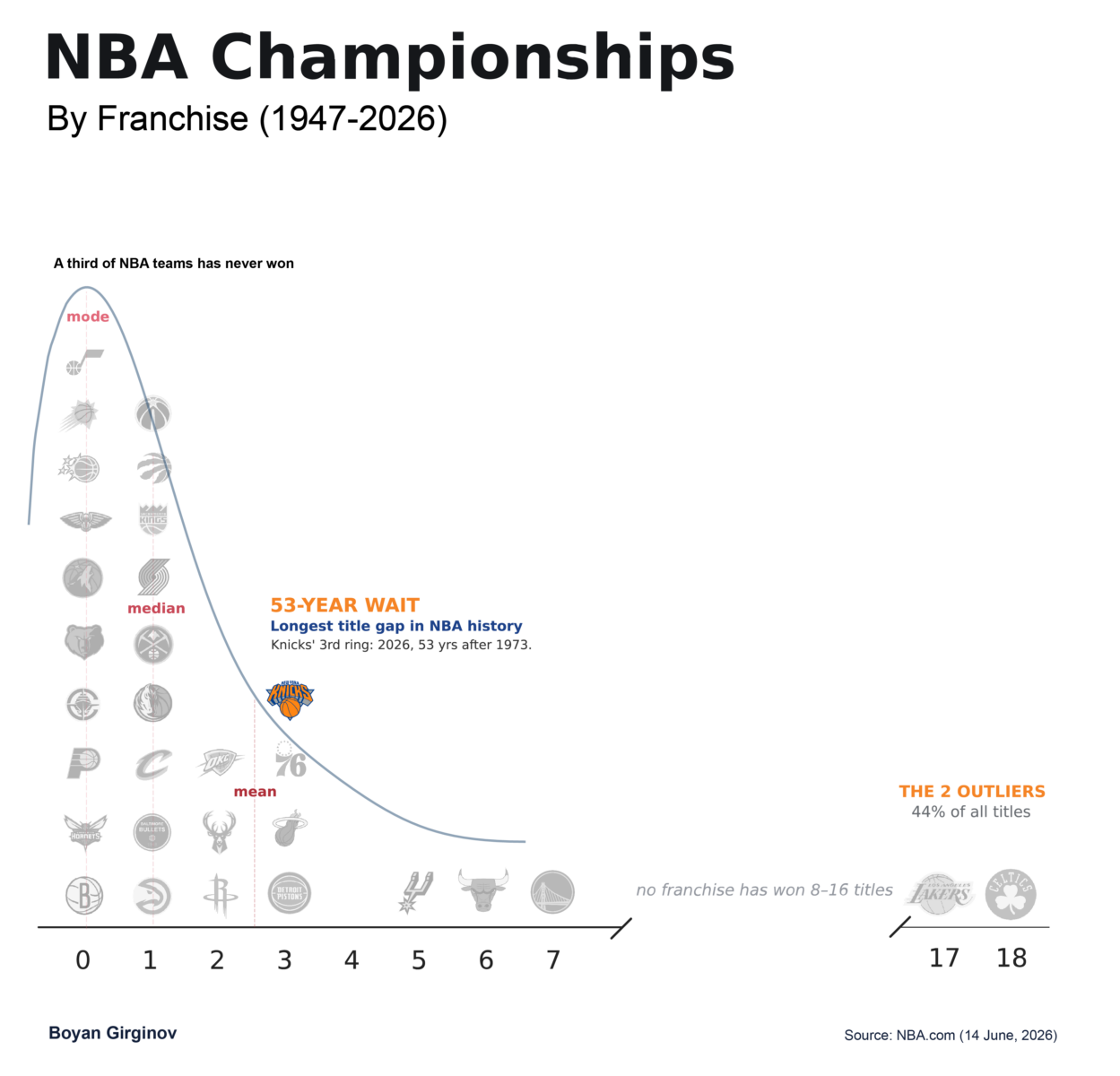
NBA Championships, by Franchise (1947-2026)
Source: Reddit
Sign up for our reads-only mailing list here.
