
My mid-week morning train WFH reads:
• I want to be in the same business as Leopold “Lumpy” Aschenbrenner: A skeptical look at the AI-fund gold rush and the boy-genius mystique funding it. The title alone earns the click. (Old Rope Research)
• A smaller Fed megaphone: Kevin Warsh: a man of few words. Kevin Warsh, the new Fed chair as of last month, is aiming to reshape the Fed’s approach to transparency. Fewer projections, fewer pressers, fewer pontifications. More task forces, apparently. On whether the Fed should talk less. A timely argument about communication as a policy tool that may be losing its potency. (OptimistiCallie) see also Will the Shadow Fed Chair Please Stand Up? Kevin Warsh may want a quieter Fed, but markets will fill the silence, just less reliably and at a high cost. On the awkward spectacle of a Fed-chair-in-waiting jawboning policy before he’s been sworn in. The shadow-chair gambit, dissected. Kevin Warsh may want a quieter Fed, but markets will fill the silence, just less reliably and at a high cost. (Stay-At-Home Macro)
• What Climate Change Costs You at the Checkout: The higher temperatures climb, the more inflated household costs like groceries will become, economists predict. Bloomberg on the climate component of food inflation — coffee, chocolate, tomatoes, citrus. The bill is itemized now. (Businessweek)
• Stocks make the rich richer. Everyone else, not so much: The wealth effect is real, but it’s concentrated where the assets are. Axios on why a roaring market and a strained household can coexist. (Axios)
• Elon Musk and The Rise of Cult Capitalism: On how parasocial CEO worship became a structural feature of public markets. Whether you find the framing fair or unfair, the data is real. Every billionaire is a policy failure. The first trillionaire is also a market failure (On Data and Democracy)
• The Brexit Vote Ten Years On. We used to think we could have both liberalism and democracy. Now we are forced to choose between them. Adam Tomkins offers a more sympathetic post-mortem than most. Read it against the New Republic and Axios takes for a fuller picture of the argument that won’t die. (Civitas Institute) see also Ten Years After Brexit, Every Grim Prediction Has More Than Come: True As the sixth prime minister since the historic vote calls it quits, most Britons agree it’s been an epic disaster. But in the next election, things may get even worse. A decade on, the receipts are in — and they’re not flattering. (New Republic)
• Why Are LLMs Smart? The amount of intelligence required to compose one coherent sentence can almost be reduced to the rules in a grade-school grammar book. But the amount of intelligence needed to produce a string of sentences focused on one topic — a paragraph — far exceeds any rules. And the amount of intelligence wrapped up in a string of paragraphs, as in a conversation, begins to approach a pattern we call “thinking.” As researchers scaled up the size and scope of LLMs, they were stunned to find that their systems could begin to imitate the elemental patterns of human thinking found in paragraphs and conversations. Sober and curious rather than hyped. (Kevin Kelly)
• The Former GOP Operative Running a News Site for the ‘Politically Homeless’: WSJ profiles Sarah Longwell and the Bulwark’s business model built on disaffected Republican readers. The audience is real and growing. the Bulwark is a profitable startup, and it approaches the news with a raw candor subscribers crave (Wall Street Journal)
• Why .400 Hitters Disappeared — and What It Means for AI: Kedrosky borrows Stephen Jay Gould’s classic argument — hitters didn’t get worse, the whole league got better — and aims it at AI. A smart frame for thinking about shrinking variance. (Paul Kedrosky)
• It’s Known as the Meat Wall—and It Could Be the Hack to World Cup Glory: The WSJ on soccer’s latest marginal-gains obsession. File under: things you didn’t know elite athletes argued about until now. (Wall Street Journal)
Video of the day: 26 Minutes Of Hilarious Clarkson’s Farm Mishaps | Clarkson’s Farm Seasons 1-4
Be sure to check out our Master’s in Business with Seth Klarman, CEO and portfolio manager of The Baupost Group. Founded in 1982 with $27 million in seed capital, over the past four decades, Baupost has grown to $22 billion, with annual net returns of over 20%. The legendary investor is known for his patient, risk-averse, and contrarian approach to finding deeply discounted securities across equities, distressed debt, and real estate. He is the author of Margin of Safety (1991) and the editor of the 7th edition of Security Analysis (2023).
Gold and Silver Are Down Substantially From Recent Highs
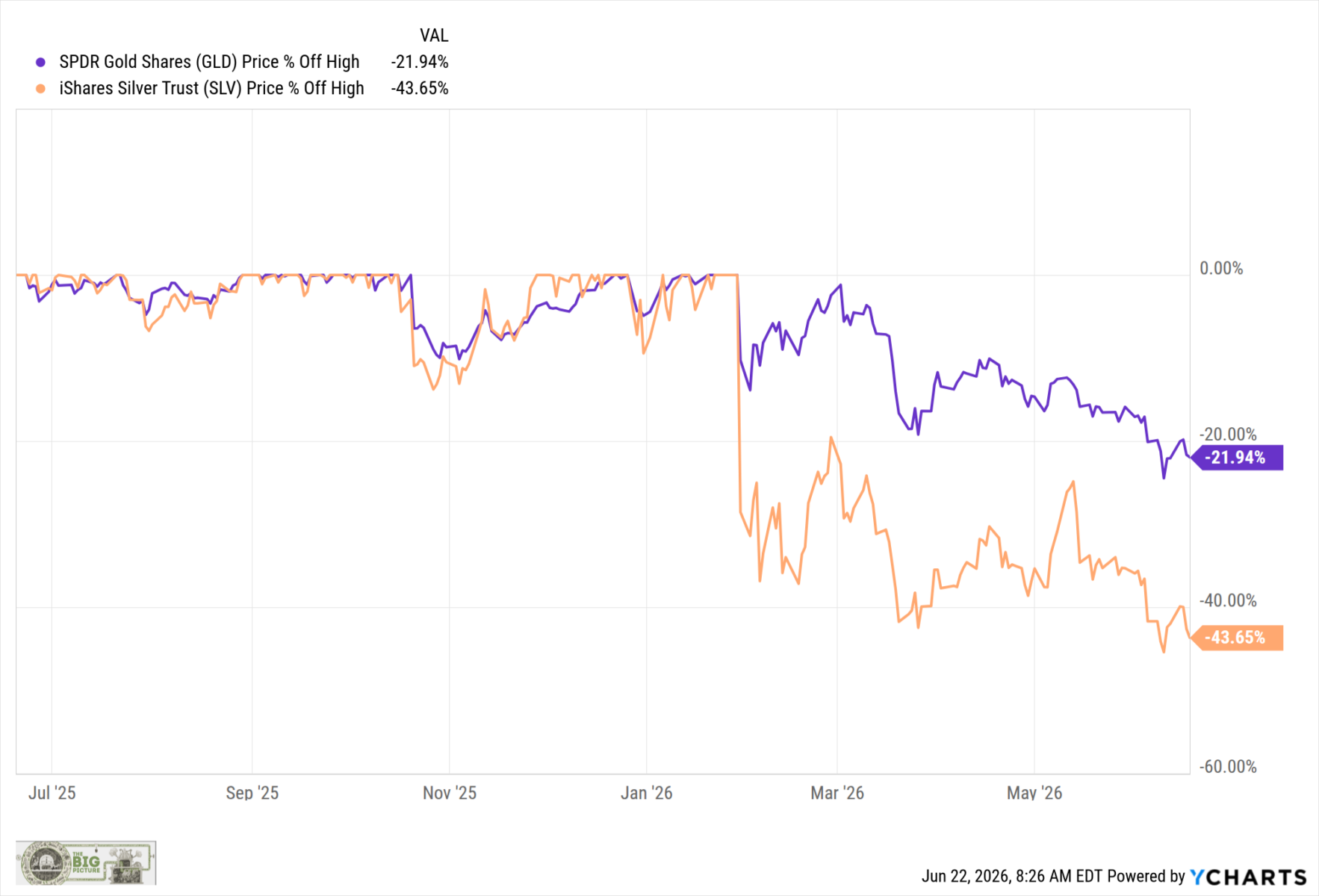
Source: YCharts
Sign up for our reads-only mailing list here.
