
Say goodbye to July with my end-of-week morning reads:
• Trying to make sense of Warsh: Not everyone in financial markets watched Fed chair Kevin Warsh’s presser yesterday. But today everyone will be dealing with its consequences. As MainFT reports, US borrowing costs surged to a 19-year high in the one-day biggest jump since Trump’s “liberation day” tariff announcement. Equity markets shedding a mere trillion-odd dollars look a bit meh by comparison. (Financial Times)
• Stocks Finally Have Some Competition: TrendLabs on the return of real yields — for the first time in a generation, bonds and cash offer genuine alternatives to equities, and the asset allocation math has changed accordingly. (TrendLabs) see also Nearly half of small-cap and midcap stocks are losing money: MarketWatch on the profitability collapse below the mega-caps — the index-level numbers hide a market where almost half the smaller companies can’t turn a profit. (MarketWatch)
• Twenty Investment Lessons of 2008 – I think this was culled from a Seth Klarman Interview. Of course, no one wants to admit to being part of the flock. Everyone is looking for “uncorrelated”, perhaps the most overused, least sincere term in our industry. (Cove Street Capital)
• Bloomberg’s post-Mike moves are in motion: In the decades since Michael Bloomberg founded his bond-pricing data provider and built it into a media and markets giant, the question has swirled on Wall Street: What does he plan to do with it? (Semafor)
• Congress Budgeted Billions for Big Transit Projects. Trump Isn’t Spending It. Ssince President Trump returned to office, the Federal Transit Administration has not signed a single new agreement under the program, known as Capital Investment Grants. Large projects ready to enter the final phase of the program’s yearslong pipeline have stalled there. The administration also tried halting payments to the New York and Chicago projects, forcing courts to intervene. The money was appropriated. The projects were approved. The administration is simply refusing to release the funds — a quiet form of sabotage that’s hollowing out public infrastructure. (New York Times)
• The False Promise of the First ‘Smart’ Homes: MIT Press Reader on the push-button houses of the 1950s and 60s — the automated home has been five years away for seventy years, and the failures are instructive. Computerized rooms, telework stations, and child-soothing technologies sold a seductive illusion that automation could solve the problems of maternal care. (The MIT Press Reader)
• How to have a happier vacation: Here’s what researchers who study happiness say about how to enjoy your time off. Five evidence-based strategies for actually enjoying your time off — instead of returning more exhausted than when you left. (Washington Post)
• Trump Turns Up the Heat on RFK Jr. to Cut Back Childhood Vaccines: President is focused on shots’ alleged tie to autism, even though White House advisers wanted to tone down attention to issue ahead of midterms. The Wall Street Journal reports the president is pressuring his health secretary to go further on vaccine restrictions — with measles already resurgent. President is focused on shots’ alleged tie to autism, even though White House advisers wanted to tone down attention to issue ahead of midterms. (Wall Street Journal) but see Measles Is Becoming So Common That Treatments May Soon Be Needed: Wired on the grim milestone — measles is now endemic enough in the U.S. that pharmaceutical companies are developing treatments for a disease vaccines had eliminated. As the US sees its highest number of measles cases in decades and vaccination rates fall, researchers are developing drugs to help those who contract the virus or who are particularly vulnerable. (Wired)
• Astronauts returning from six-month missions describe a persistent ‘observer’ sensation — the feeling of watching their own lives from a half-step outside the frame, weeks after they’re back on the ground: Astronauts returning from long ISS rotations consistently describe a half-step-outside-themselves sensation that flight surgeons recognize as part of the post-mission readjustment curve — a perceptual cost of spending six months in a body that had to learn a different world. (Space Daily)
• In the midst of his majesty: How Tadej Pogacar won the 2026 Tour de France: This Tour will be remembered as Pogačar in the midst of his majesty; a relentless march towards victory which felt all but assured within the first week. It was an imposition of order; the barbarians tamed before they reached the gates. The man astride the moat was not a new version of Pogačar, but the final optimized evolution — or perhaps not. The Athletic’s definitive account of Pogačar’s third Tour victory — the dominance, the tactics, and the growing sense that we’re watching the greatest stage racer who ever lived. (The Athletic)
Video of the day: Why Project Hail Mary Destroyed the Blockbuster Formula
Be sure to check out our Masters in Business interview this weekend with Som Seif Purpose Investments, founder/CEO, Toronto-based asset manager launched in 2012. He grew his first firm, Claymore Investments to $8B in assets by creating 34 ETFs over 6 years, establishing it as Canada’s leader in low-cost exchange-traded funds; he sold to BlackRock in 2012. Next, he co-founded Wealthsimple, which became the default investing app for a generation of Canadians. His wealth management firm, Purpose, was founded at the end of 2012, and manages>$31B in ETFs, mutual funds, alternatives, private assets, and digital assets. Som was named to Canada’s Top 40 Under 40 in 2011.
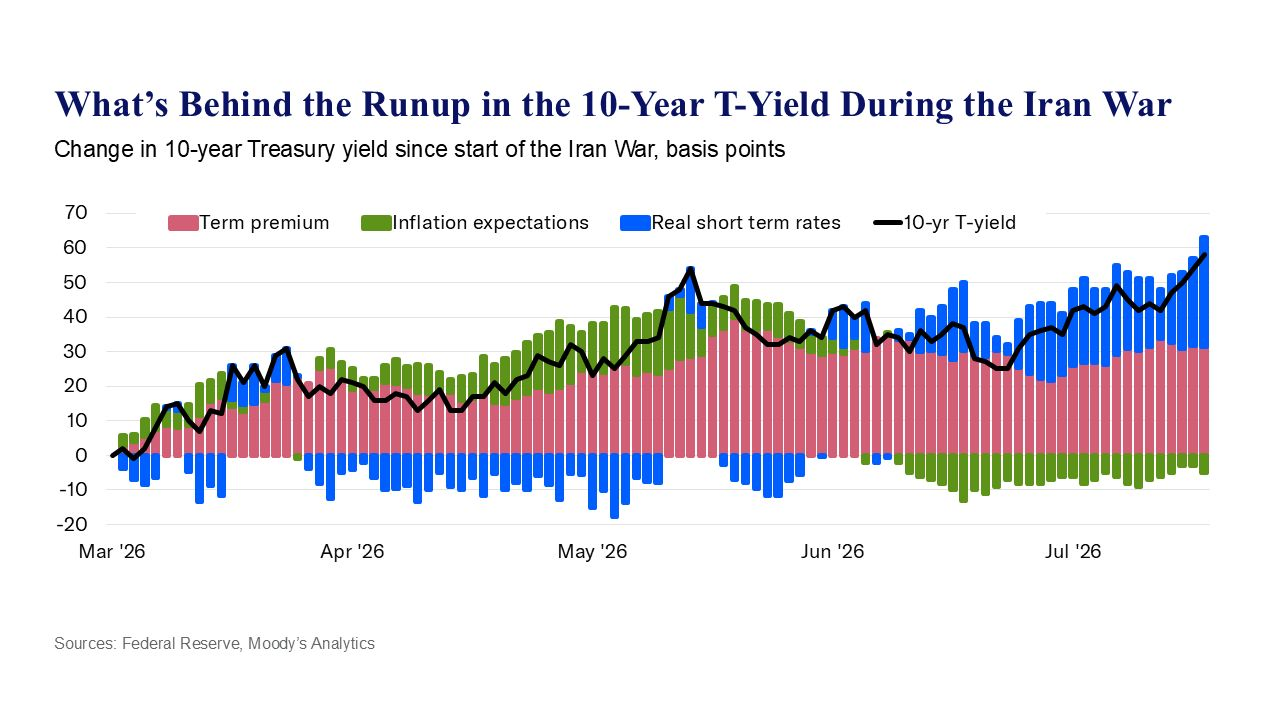
Interest rates have steadily risen since the start of the Iran War, and are an increasingly heavy burden on the economy.
Source: LinkedIn
Sign up for our reads-only mailing list here.
