
The weekend is here! Pour yourself a mug of Danish Blend coffee, grab a seat outside, and get ready for our longer-form weekend reads:
• Why You Grieve the End of Summer Before It’s Even Over: If you’re already stressed about the end of the season, you’re not alone. On anticipatory nostalgia and the human knack for mourning things mid-enjoyment. A lovely small essay for late June. (Vox)
• US at 250 – Why Has the US Been So Successful, and Can It Continue? First, we consider how the US went from being a comparatively small country to the world’s pre-eminent global power. These reasons range from the US’ natural advantages, like favourable geography, to factors like its institutional stability and risk-tolerant capital markets. We then consider the challenges that threaten US outperformance. A big-picture bank note on American exceptionalism and its durability, timed to the semiquincentennial. Sweeping, and a useful counterweight to the doomers. (Deutsche Bank Research Institute) see also How a Nation of Immigrants Traces Its Roots: A data-rich map of where Americans say they come from. The census as a mirror of a changing self-image. Melting pot, tapestry, mosaic, kaleidoscope, salad bowl. Every cliché is true. (New York Times)
• Abraham Lincoln’s War on King Cotton: How economic warfare over cotton shaped the Union strategy. A sharp piece of history for the long-read pile. Secessionists in America’s South were convinced that Britain’s mills could not survive without their cotton. They had not reckoned with how adaptable an economy under strain can be. (Engelsberg Ideas)
• Combat Experience as a Strategic Resource: Lessons of the Red Army Purges: How Stalin’s purges gutted military expertise, and what that teaches about institutional knowledge — History with uncomfortably current echoes: “Instead, at its core, a central question is their impact on the combat effectiveness, indeed the lethality, of our armed forces. I take up this question through the lens of a case study drawn from one of the most consequential instances of rapid military leadership depletion in modern history, the Red Army purges of 1937-1938 and their effects on its performance during the conflicts that followed. My central proposition is straightforward: Operational experience, especially in combat, is a strategic resource, a form of military capital that takes decades to develop and that can be squandered in months.” (Just Security)
• David Foster Wallace and Democracy. Despite the relative obscurity of even successful writers, especially those most regarded for literary fiction, Wallace continues to generate conversation sixteen years after his death. In the immediate aftermath of his suicide, the literary press, his most enthusiastic and loyal readers, and many journalists beatified him. His college commencement speech, a brilliant call for empathy later published as a booklet, This is Water, served as evidence of blessed intercession. Thus, those mourning from afar nominated the late author of the contemporary masterpiece, Infinite Jest, for sainthood. Hollywood cooperated, releasing an interesting, even moving, but also cartoonish film. (Liberties)
• Hamptons Billionaires Call These Doctors for ‘Boat-tox’: For everything from aesthetic touch-ups to 9-1-1 emergencies, the wealthy are calling on providers who charge membership fees ranging from a few thousand dollars to six figures a year (Wall Street Journal)
• A Terrible Thing Happened to My Family: Buttigieg writes personally about a family ordeal. Whatever you make of the politics, it’s a reminder these figures are people first. Even in today’s climate, there should be one fundamental principle everyone respects: whatever you think about someone in politics, you leave their kids alone. (Pete Buttigieg’s Substack)
• This Cell Feeds, Grows and Reproduces. And It’s Manmade. Scientists build a synthetic cell that does the things living cells do. A genuine landmark — and a fresh set of questions about where the line sits. We have long dreamed of discovering the alchemy by which chemicals can be turned into life. On Wednesday, a team at the University of Minnesota announced that it had taken a major step toward that vision. (New York Times)
• On the origin of continents: Continental drift is as fundamental to geology as natural selection is to biology. Why did it take us hundreds of years to discover it? Why Earth has continents at all, and what that has to do with life. Deep-time science writing at its most satisfying. (Works in Progress)
• Where the Light Falls: Who was Johannes Vermeer? Clare Bucknell on Vermeer and the mystery of his light. Art criticism that makes you want to stand in front of the paintings again. (Harper’s Magazine)
Video of the day: How this helicopter survived 1004 days on Mars, then disappeared
Be sure to check out our Master’s in Business this weekend with McKeel Hagerty, CEO/Chairman of Hagerty Specialty Insurance. He transformed a family specialty-insurance agency into an enthusiast-driven platform focused on collectible cars, events, valuation data, and auctions. HGTY is now a public company that insures everything from classic cars to boats, trucks, tractors, and military vehicles for over 2.8M collectors.
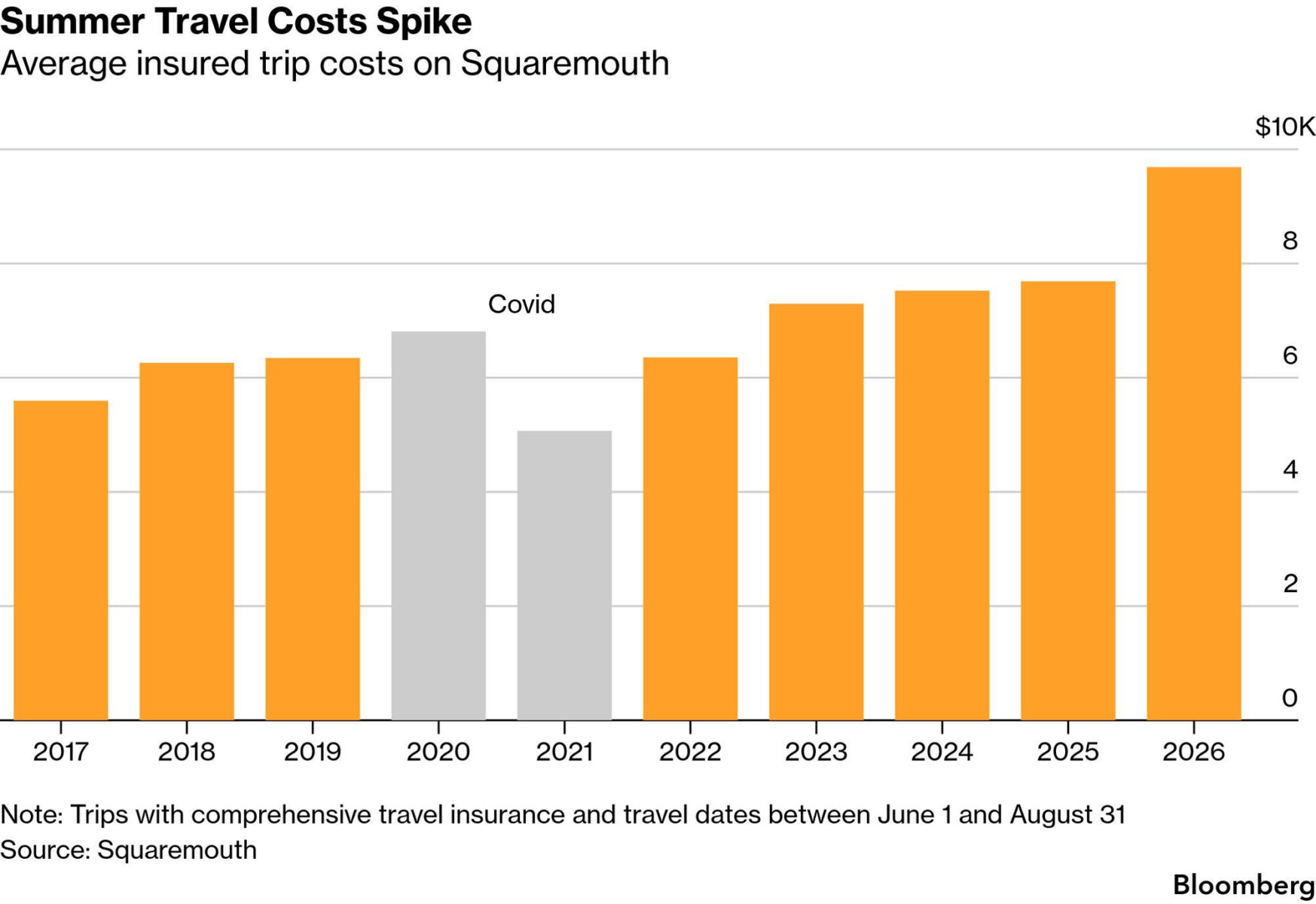
Summer gets more expensive
Source: Bloomberg
Sign up for our reads-only mailing list here.
~~~
To learn how these reads are assembled each day, please see this.
