
My morning reads:
• What 125 Years of Data Really Tell Us: Behind the Balance Sheet’s deep dive into 125 years of market returns — what the data actually shows vs. what people think it shows. The survivorship bias in historical return data is larger than most investors realize. The most valuable lessons from a great investment database. (Behind the Balance Sheet)
• Big Companies Are Starting to Hire Again, Defying Predictions of AI Wipeout: The AI job apocalypse hasn’t materialized — at least not yet. Major companies are adding headcount, not cutting it. The hiring data contradicts the doom narrative. After a year of holding back on new hires, companies from tech and transportation to defense now say they need more people to work alongside AI (Wall Street Journal) see also What is really happening to jobs? Separating AI hype from reality. AI’s effects on overall employment is likely small, though a tough job market for new graduates may be partly due to AI. AI’s impact on worker productivity is mixed but generally positive. Firm adoption has accelerated but unevenly across the economy. Early evidence is hardly the last word on the future of work in an AI world. Stanford’s policy brief on the actual — not projected, not feared, but measured — impact of AI on employment. The reality is more nuanced and less dramatic than either side claims. (Stanford Institute for Economic Policy Research)
• Compass Employees Made Their Own Report That Says Their Private Listings Sell For More: Housing Notes catches Compass producing self-serving research to justify its controversial private listing strategy. The methodology doesn’t hold up to scrutiny. (Housing Notes)
• How Meta Got Everything It Wanted in a Secret Louisiana Data Center Deal: The Times investigates a data center deal that gave Meta enormous tax breaks, cheap power, and minimal oversight — all negotiated behind closed doors. A Times examination details how the Silicon Valley giant used private talks with local officials to start a project big enough to cover nearly six square miles. (New York Times)
• AI Mania Is Eviscerating Global Decision-Making. I strongly believe there are entire companies right now under heavy AI psychosis and it’s impossible to have rational conversations with them about it. I can’t name any specific people because they include personal friends I deeply respect, but I worry about how this plays out. (Two versions of the same argument — the rush to deploy AI in critical systems is producing worse decisions, not better ones. The hype is outrunning the capability). (Ludicity)
• Inside the growing vigilante movement to knock out Flock surveillance cameras: An underground network of privacy activists is disabling or destroying the ubiquitous surveillance devices sprouting up across the US. (The Guardian)
• The Bone Rush: Dinosaurs have become an asset class for billionaires. And the market is about as orderly and genteel as a starving T. rex. (Bloomberg free)
• Stop Saying Kids Can’t Read: Everyone is talking about the reading crisis. But inside the “Mississippi Miracle,” it’s all about comprehension. (Wired)
• Greenland shark genome reveals clues to 400-year lifespan: In 2026, scientists assembled the Greenland shark’s 5.9-billion-letter genome and examined retinas from animals more than a century old, finding intact vision, expanded DNA-repair pathways and unusual chromatin machinery inside a vertebrate believed capable of surviving for nearly four centuries. (Make Tech Easier)
• The predictable disgrace of the White House Correspondents Dinner: And why I reject every specious argument that encourages the media to keep normalizing Trump. Margaret Sullivan on why the annual celebration of press-power coziness was even worse than usual this year — and what it says about journalism’s inability to adapt to an authoritarian moment.And why I reject every specious argument that encourages the media to keep normalizing Trump (American Crisis)
Video of the day: Best ever, hilarious letters of complaint
Be sure to check out our latest Masters in Business interview with Lori Heinel, Global Chief Investment Officer of State Street Investment Management, the money management arm of investing giant State Street. She oversees over $5.7 trillion in assets (as of year-end 2025), which includes everything from index funds and ETFs to active strategies, multi-asset solutions, and alternatives. She was named to Forbes’ 2025 “50 Over 50” list.
The top 1% now hold as much wealth as the entire bottom 90% of Americans combined — about 32% each
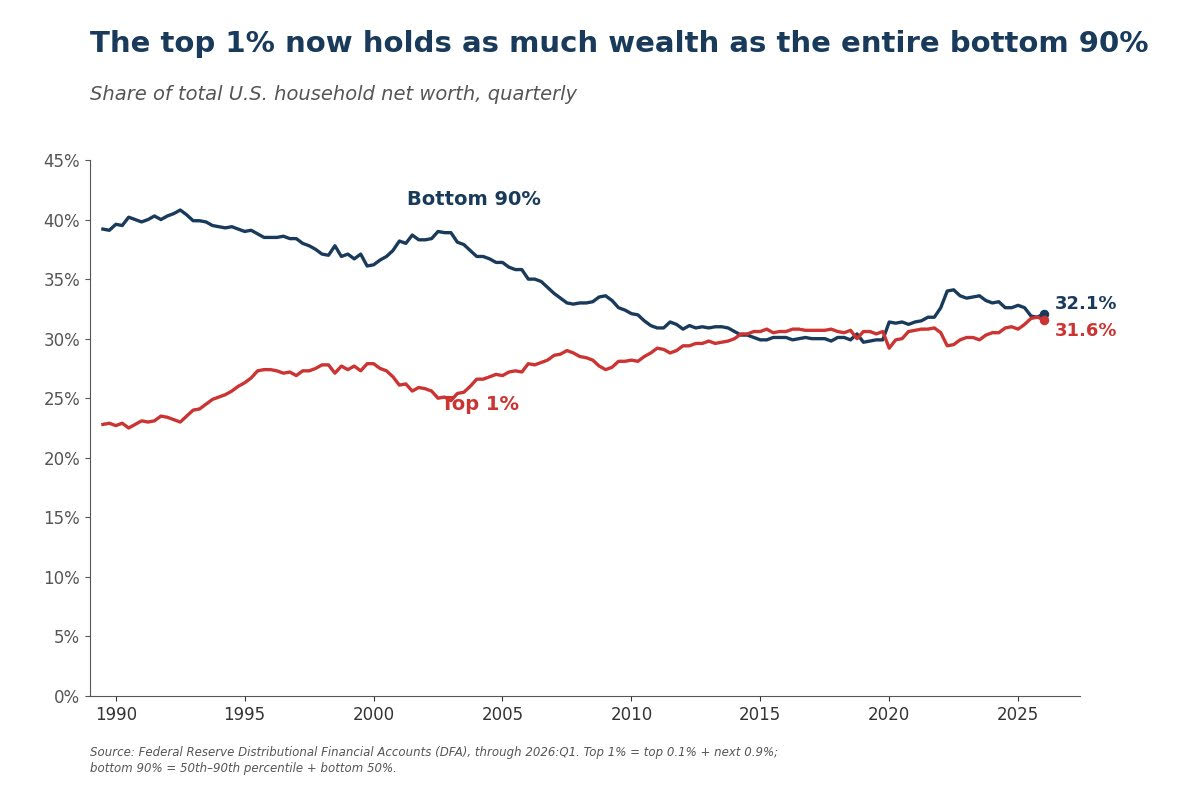
Source: @SteveRattner
Sign up for our reads-only mailing list here.
