
My back-to-work morning reads:
• Mind the Gap 2026: Morningstar’s annual investor return gap study — the difference between fund returns and investor returns, driven by badly timed buying and selling. The behavior gap persists, and it’s still costing investors more than a percentage point a year. (Morningstar)
• Elon Musk is building a form of capitalism that Adam Smith would hate: The merchants are becoming princes, writes Tim O’Reilly (Economist) (archive mirror) see also Trump quietly clears the road for Musk’s Cybercab: “It’d be wonderful for the United States to have a national set of rules for autonomous driving.” It’d be wonderful for the United States to have a national set of rules for autonomous driving. (Popular Information)
• The Mystery of Online Prices: How Personal Data and Privacy Change What You Pay for Groceries: Mozilla Foundation’s investigation into surveillance pricing — the same cart costs different amounts for different people, and the data brokers deciding who pays more. (Mozilla Foundation)
• The Service A post-mortem on New York City’s weed underground. Ariel Delgado Dixon is the author of the new novel, Sourland. Here, she remembers a kingpin whose dog she used to walk. (Dirt)
• These AI Barons Are Ready to Give Away Their Fortunes: A new generation of philanthropists made rich by artificial intelligence are preparing to give away their vast wealth. What should we make of a multi-billion-dollar pinky promise? Wired on the AI wealth pledge wave — the billionaires promising to give it all away, and the question of whether philanthropy at this scale is generosity or governance. (Wired)
• Danny Meyer Finally Tells Us What Went Wrong: Matt Rodbard’s interview with the hospitality legend — the no-tipping retreat, the Union Square Cafe moves, and an unusually candid accounting of the bets that didn’t work. The new book What Could Possibly Go Right? is honest about wrong decisions. The industry needs to hear this. (Food Time with Matt Rodbard)
• How Data Centers Broke American Politics: What the Unabomber, Steve Bannon’s tech guy, and Bernie Sanders taught me about the great data center backlash of 2026. Wired on the data center backlash as a political realignment — power bills, water rights, and land use are scrambling party coalitions in every state with a buildout. (Wired)
• How the U.S. Squandered Its Strategic Advantage: The Atlantic on the weapons shortage shaping the Iran conflict — decades of industrial-base neglect meeting the reality of sustained munitions expenditure. (The Atlantic)
• The Prettiest Town in Every US State: From Stonington, Maine, to Carmel-by-the-Sea, California, these picturesque locales prove that living large isn’t a requirement for living beautifully (Architectural Digest)
• How Jordan Harper Reinvented Noir for the Epstein Era: The New Yorker on the crime novelist whose fiction maps the actual power structures of exploitation — noir updated for a world where the conspiracies are real and documented. This year’s buzzy “A Violent Masterpiece” inverts the genre’s traditional contrast between optimism and despair. Is a hopeful crime novel still a noir? (New Yorker)
Video of the day: Erasing Taxes For the Rich Is the Hottest Business on Wall Street
Be sure to check out our Masters in Business this week with Jack Raines, a writer and venture capitalist. We discuss his new book, Young Money.
100 Years of US Stock Market Wealth Creation Breakdown – Bessembinder Findings
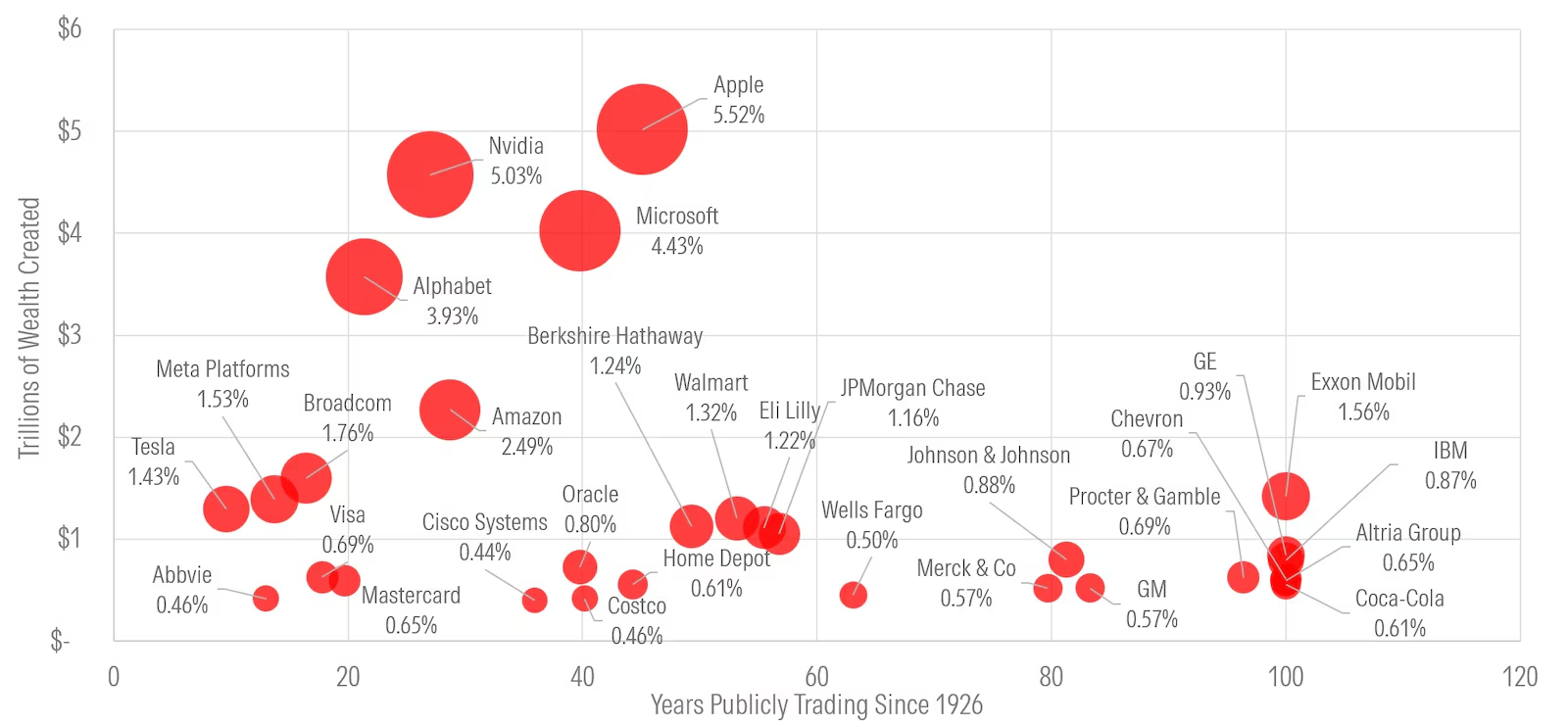
Source: Morningstar
Sign up for our reads-only mailing list here.
