
Avert your eyes! My Sunday morning look at incompetency, corruption and policy failures:
• Why does everything feel like a scam? Hanna Horvath on losing the plot in an economy of junk fees and shrinking portions — $35 for four pieces of tortellini was the breaking point for a writer who already lives inside sticker shock. When you don’t know what anything should cost, everything feels like a con (Your Brain on Money)
• Meet Gregory Fenelon, the (self-declared) $14bn man He has big stakes. We have big questions. These “funds” share a few things in common. For one, Starlite’s filings claim that someone named Greg Fenelon is its CEO. He is also listed as the CEO of Fenelon Opportunity Fund. The other thing these two have in common is they are completely bogus. Louis Ashworth on a seven-year JPMorgan veteran turned founder of “Wintellex,” who by recent SEC filings appears on Bloomberg shareholder registries at a scale that raises questions. (Financial Times free)
• The StubHub Customers Who Battled for Tickets — and Battle Harder for a Refund: The Wall Street Journal on the resale refund wars — the canceled events, the customer service maze, and the fine print doing heavy lifting. The company brought legitimacy to a business once dominated by scalpers. Now it’s facing complaints of lengthy fights to get money back; stranded outside a World Cup game. (Wall Street Journal)
• Teen Boys Are Using Meta Glasses to Harass and Bully Girls at High Schools and Middle Schools: The video has the distinctive style of the invasive “rizzcam” and other “POV” videos in which self-styled “pickup artists” and other online creators use smart glasses to record themselves harassing women at malls and boardwalks or pestering employees at their place of work for content. But the people in this video aren’t adults. Everyone in the clip — the girl, the boy filming, and hallway passersby — is a teenage student. Point-of-view harassment videos filmed on head-mounted cameras are spreading on TikTok under the hashtag #metaglasses. (Futurism)
• Hook and Squeeze: How Democratic consultants, committees, and party leaders built a fundraising spam pipeline that funnels money from a captive pool of elderly donors into their own operations. A thriving industry of digital-fundraising consultants who specialize in offering spam as a service, and the political action committees and candidates who adopt their methods. Together, they form a broader network of fundraising that deploys these methods at scale. Data for Democracy on the platform pricing playbook — hook users with subsidized prices, squeeze them once switching costs lock in, repeat. (On Data and Democracy)
• Trump’s War on Reality Comes for the Census: Catherine Rampell on the question she gets at least once a week — can we still trust the federal government’s data releases? One of America’s most trusted institutions just put its name on a totally bogus voter-fraud report. (The Bulwark) see also Experts Raise Alarms Over Census Bureau Report Trump Is Touting on Noncitizen Voting: A highly unusual Census Bureau report the President is using to reup dubious claims of widespread illegal voting by non-citizens has ties to a Trump-aligned think tank, NPR has learned. (NPR)
• The Assault on Public Health and the Self-Sabotage of a Nation: MAHA channels diffuse grievance into a radical project — a strain of extremism with a long lineage in far-right paranoid conspiracism. It’s a form of extremism that stands in a long tradition of paranoid conspiracism on the Far Right. We must stop it (Democracy Americana)
• How Vivek Ramaswamy’s mom manipulated Alzheimer’s data and made her son rich: In 2014, Ramaswamy founded Axovant, a company he used to buy the rights to an inauspicious Alzheimer’s drug that had repeatedly failed in clinical trials. Axovant then hired Ramaswamy’s mother, who, despite lacking relevant research experience, helped massage data from old clinical trials to make the drug appear more promising. The extent of the elder Ramaswamy’s role has not been previously reported. Judd Legum on Axovant, founded in 2014 to buy the rights to a drug that had repeatedly failed in trials — then staffed with Ramaswamy’s mother, who lacked relevant research experience and helped massage the old trial data. (Popular Information)
• ICE Illegally Scooped Up Medicaid Data, Then Shared It With Palantir. Last July, the Trump administration unilaterally decided ICE should have access to Medicaid data for the sole purpose of locating migrants to arrest and deport. That much was made clear by the administration itself, which said the data would give ICE officials better tools to discover “the location of aliens.” An agreement was reached with the Centers for Medicare and Medicaid Service by the DHS because of course that happened. The administration had already purged plenty of non-loyalists, which meant those remaining wouldn’t put up much of fight. (TechDirt) see also ICE Collected Nearly 1 Million People’s DNA Last Year — Including Young Children: Wired on the DNA dragnet — nearly a million profiles added to CODIS in a year, children included, with no criminal predicate required. Internal documents show ICE’s DNA collection has skyrocketed in the second Trump administration. Now hundreds of thousands of people never convicted of a crime are in an FBI criminal database forever. (Wired)
• AI Has Plunged the Book Publishing Industry Into Utter Chaos: Spectacular implosions of big deals over suspected AI use — including a multimillion-dollar debut pulled by the author’s own agents, who could no longer verify the book was human-written — are forcing a reckoning over creativity and trust. The spectacular implosions of big deals over suspected AI use are forcing a reckoning over creativity, trust and the future of the industry (Wall Street Journal)
Video of the day: “The Nerd Reich”: Author Gil Durán on Big Tech Fascism, Peter Thiel, JD Vance & the War on Democracy
Be sure to check out our Masters in Business this weekend with Alex Morris of TSOH Investment Research. He is the author of “Buffett and Munger Unscripted: Three Decades of Investment and Business Insights from the Berkshire Hathaway Annual Shareholder Meetings.” The book was named one of Amazon’s “Best Books of 2025.” To write it, he reviewed every Berkshire annual meeting from 1994 through 2024 — 100s of hours of video covering more than 1,700 shareholder questions over 31 years — after Berkshire released the meeting archives.
A leaderboard of the biggest trading losses of all time
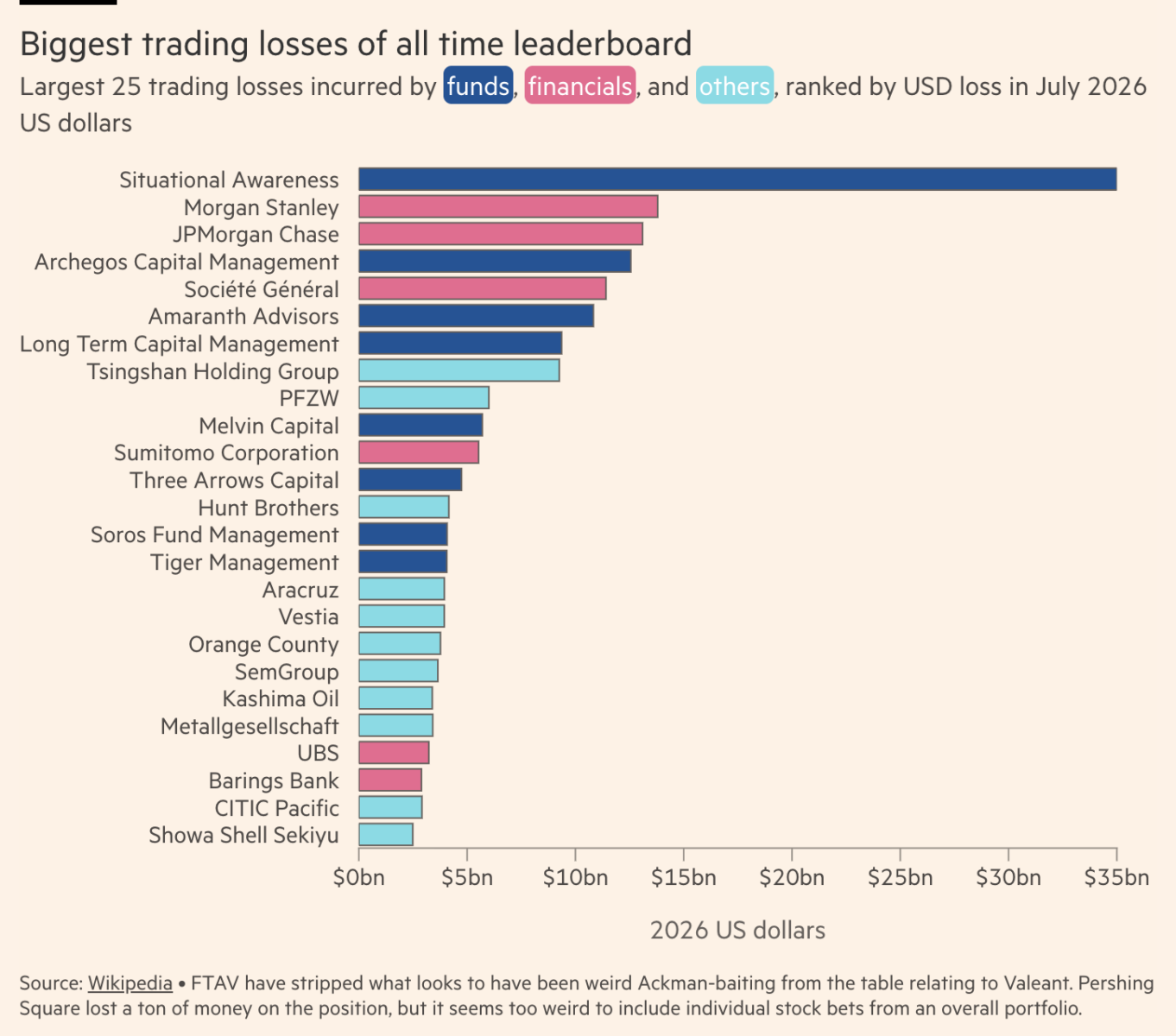
Source: Financial Times
Sign up for our reads-only mailing list here.
~~~
To learn how these reads are assembled each day, please see this.
