
My morning reads:
• Corporate America Has Suddenly Decided to Stop Blowing Money on AI: Companies big and small are mixing models and it’s changing the economics and power players of the industry. Model costs have collapsed and the spending discipline has arrived all at once. (Wall Street Journal)
• Women are making more money. Why are they still doing everything else? What happens when women’s economic role changes faster than anyone’s expectations do? Your Brain on Money on the second-shift persistence — earnings equality is advancing faster than domestic equality, and the mental load math hasn’t moved. (Your Brain on Money) see also Taylor Swift Bought Her Way Out of Biometric Surveillance. Kylie Jenner Wants to Sell It. In the age of facial recognition, privacy is a status symbol. Steffi Cao on facial recognition as ambient infrastructure — your phone, the TSA gate, the grocery store — and the one thing money can still buy its way out of. (Slate)
• For Family Offices, AI Is Both an Investment Theme and an Operational Test: Adoption of artificial intelligence tools and investments are rising across family offices. Chief Investment Officer on the double exposure — family offices allocating to AI while struggling to deploy it internally. (Chief Investment Officer)
• The Rolex Report 2026: The same leader, a different market: A Chrono24’s annual state of the secondary market — Rolex still dominates, but the price dynamics underneath have shifted meaningfully from the 2022 peak era. The analysis of completed transactions from 2018 to Q2 2026 shows Rolex’s pandemic premium has fully unwound. The brand stays in front, but its lead has narrowed across every segment and younger buyers are spreading their money more widely. (Chrono24)
• Paramount Has Spent 100 Years in Hollywood. David Ellison Loved That. Until He Didn’t: The Hollywood Reporter on Ellison’s pivot from studio romantic to cost-cutter — the century-old lot, the layoffs, and the streaming math that changed his mind. The mogul says he’s considering moving his studio out of California. Not long ago, he was talking a big game about how a merger with Warner Bros. Discovery would boost the state. (Hollywood Reporter)
• Waymo Is Growing Faster Than Ever. So Are Its Glitches: The New York Times on the scaling paradox — the expansion is working, the safety record holds, and the edge cases multiply anyway. As Waymo deploys more driverless cars to 15 U.S. cities and counting, its vehicles keep encountering new and unexpected situations that they have no script to handle. (New York Times)
• The Rise of the Unstoppable American Tourist: A strong dollar, accumulated savings and no apparent price sensitivity. Europe has noticed. A supercharged U.S. economy has helped transform a nation of homebodies into zealous international travelers; ‘Travel isn’t optional’ (Wall Street Journal)
• Google Search Is Dying. What Comes Next Is Worse: The Walrus on the post-search internet — AI answers replacing links, the traffic collapse downstream, and the information ecosystem nobody chose. As AI eats the web, the internet’s collective memory is disappearing (The Walrus)
• Dogs Can Tell When You’re Happy, Sad or Frustrated, Study Shows: Kathleen Felton on researchers scanning awake, unrestrained dogs to test how deep the emotional read actually goes. Anyone with a dog suspected as much; the brain imaging is the new part. (Washington Post) see also Can Florida’s ‘coastal corridor’ project safeguard wildlife and boost economy? Conservationists have created a ‘coastal corridor’ of ocean-based projects designed to preserve and nourish vulnerable marine life. Richard Luscombe on disappearing manatees, bleached reefs, gender-changing turtles and hurricane-wrecked oyster beds — and an attempt to borrow a conservation playbook that already worked on land. (The Guardian).
• The 2026 song of the summer: The Washington Post’s interactive on the summer-song race — the data, the contenders, and how the category itself has fragmented — a dreamy, data-driven quest to find the summer soundtrack of 2026. (Washington Post)
Video of the day: This Is The Most Effective Home Wind Turbine In The World. Why Don’t We Use It?
Be sure to check out our Masters in Business interview this weekend with Dr. Ankur Crawford, EVP and Portfolio Manager at Alger. She heads the firm’s flagship Alger Capital Appreciation strategies. She was an Engineer at Intel, won the Intel Ph.D. Fellowship, and was awarded fellowship Natl Academy of Sciences, Engineering & Medicine, and holds several U.S. patents. She was recognized as a “Top Women in Asset Management” in 2020 and serves on the board of The Knowledge House, a Bronx-based charity teaching technology skills to underserved communities.
Artificial intelligence has never been more important to the US economy than it is right now
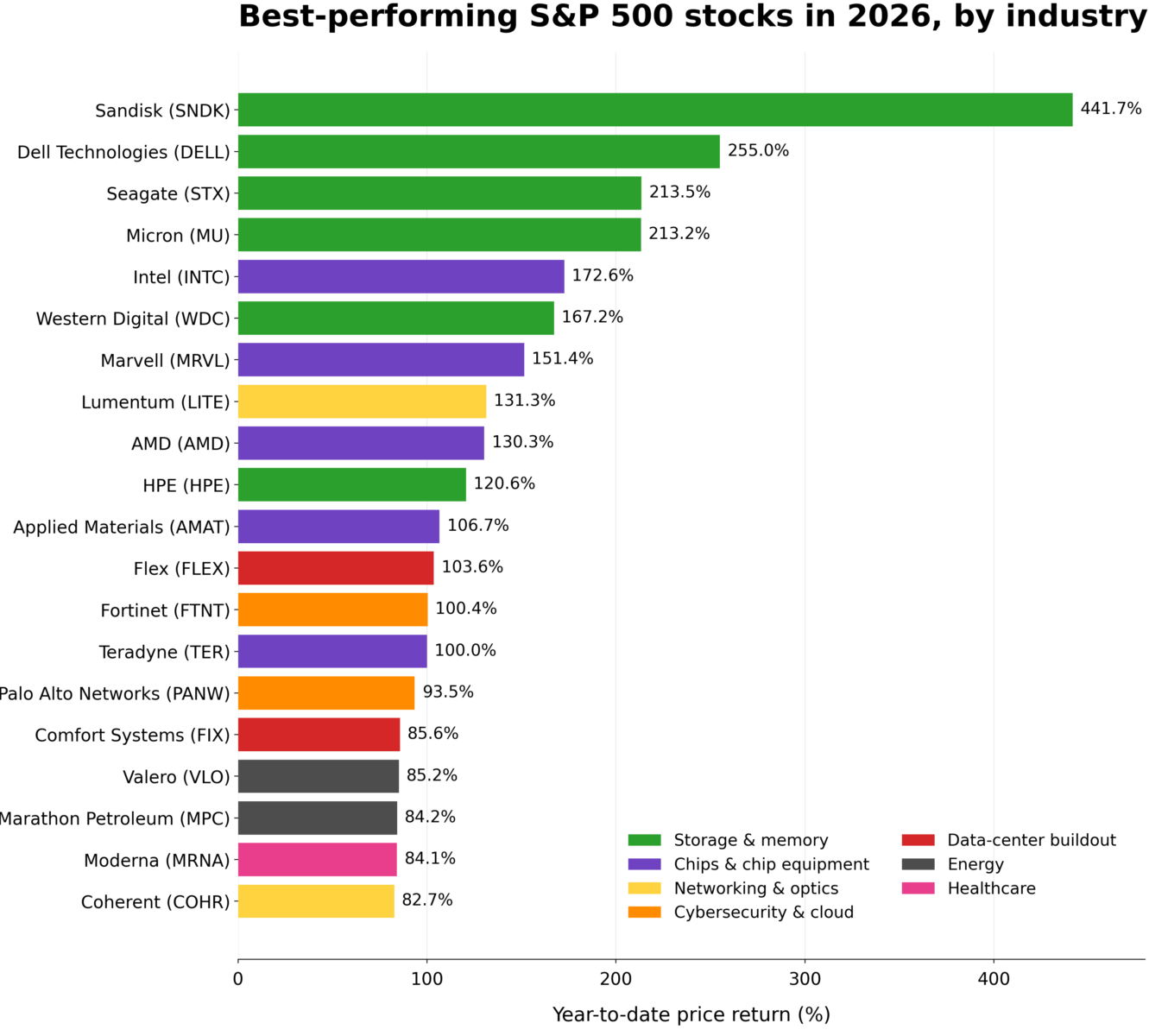
Source: Derek Thompson
Sign up for our reads-only mailing list here.
