
My Tuesday morning reads:
• The Debt-Equity Distinction: A Century of Policy by Accident: Daniel Peris asks what if much of what we treat as normal is a historical fluke. Modern finance could not exist without widespread debt financing — and the rules that produced it were never really designed. (American Affairs)
• The Moose That Roared: Why US will lose its trade war with Canada: Paul Krugman on how quickly the unthinkable arrived. Two years ago a US–Canada trade war would have seemed absurd — same language, soldiers who died alongside ours in Afghanistan, free trade agreements since 1988, the most recent signed by Trump himself. (Paul Krugman)
• The $500 Billion Experiment to Build 24/7 Markets on Blockchain: Trade.xyz, a little-known market built on top of crypto exchange Hyperliquid, allows speculators to buy and sell blockchain-based oil derivatives continuously, even when traditional markets are closed. The platform has generated some $500 billion in trading volume since launching in October and accounts for more than 99% of activity across Hyperliquid’s third-party market system. (Bloomberg free)
• Meta Is Dying. It’s About Time: Julia Angwin argues that one of the most powerful media companies in the world and one of the most valuable members of the S&P 500 is at the start of a long, slow decline — with aftershocks for the economy and for society. (New York Times) see also Meta Is Dying: David Dayen and Matt Stoller take up Angwin’s argument, casting Facebook, Instagram, and WhatsApp as zombie businesses in the mold of Yahoo, Myspace, and AOL after their peaks. (Organized Money)
• The Trump Intervention That Got the DOJ Off Live Nation’s Back: The antitrust case set out to force the concert giant to sell Ticketmaster. After two White House meetings, the settlement left the company intact.Antitrust case started out aiming to force concert giant to sell Ticketmaster. After two White House meetings, a deal kept the company intact. (Wall Street Journal)
• Once banished to trailer parks, manufactured homes are moving to suburbia: Long stigmatized and banned by many towns and cities, factory-built housing is being reconsidered in some places because of soaring home prices. Julie Weil on factory-built housing getting a second look from towns that long banned it outright — a stigma that soaring prices are steadily eroding. (Washington Post)
• It Is Past Time for You to Quit Elon Musk’s X: The case that whatever value the network still holds no longer covers what staying on it costs you. Yes, I’m talking to you. 🫵 (Public Comment)
• Behind the Mysterious Symbols Spray-Painted on Our Streets: Michael Kimmelman on markings you have registered a thousand times without once stopping to read — a cross between hieroglyphics and graffiti tags, telling excavators what lies below before the digging starts. You may have registered but never stopped to think about all those colored markings around the city. The marks are everywhere, hiding in plain sight. A cross between hieroglyphics and graffiti tags, they’re mostly put there to tell excavators what’s below ground before crews start digging up the streets. (New York Times)
• Why Scientists Are Using Cheap Picnic Coolers to Protect Some of the World’s Most Endangered Animals: Benji Jones reports from Palau, where a super typhoon had churned the famously postcard-blue water, on low-tech coral rescue in a country with some of the strictest marine protections anywhere. Climate change is killing coral reefs, but this low-tech approach could lessen its destruction. (Vox)
• Hacks Star Kaitlin Olson Laughed and Grieved at the Same Time: While filming her final episode of Hacks, the actor and Emmy nominee was also losing her father, the man who first taught her how to be funny. (Vanity Fair)
Video of the day: The Bet Shaq Lost That Made Him $500 Million Richer
Be sure to check out our Masters in Business this past weekend with Alex Morris of TSOH Investment Research. He is the author of “Buffett and Munger Unscripted: Three Decades of Investment and Business Insights from the Berkshire Hathaway Annual Shareholder Meetings.” The book was named one of Amazon’s “Best Books of 2025.” To write it, he reviewed every Berkshire annual meeting from 1994 through 2024 — 100s of hours of video covering more than 1,700 shareholder questions over 31 years — after Berkshire released the meeting archives.
When will the Existing Home Sales Slump End?
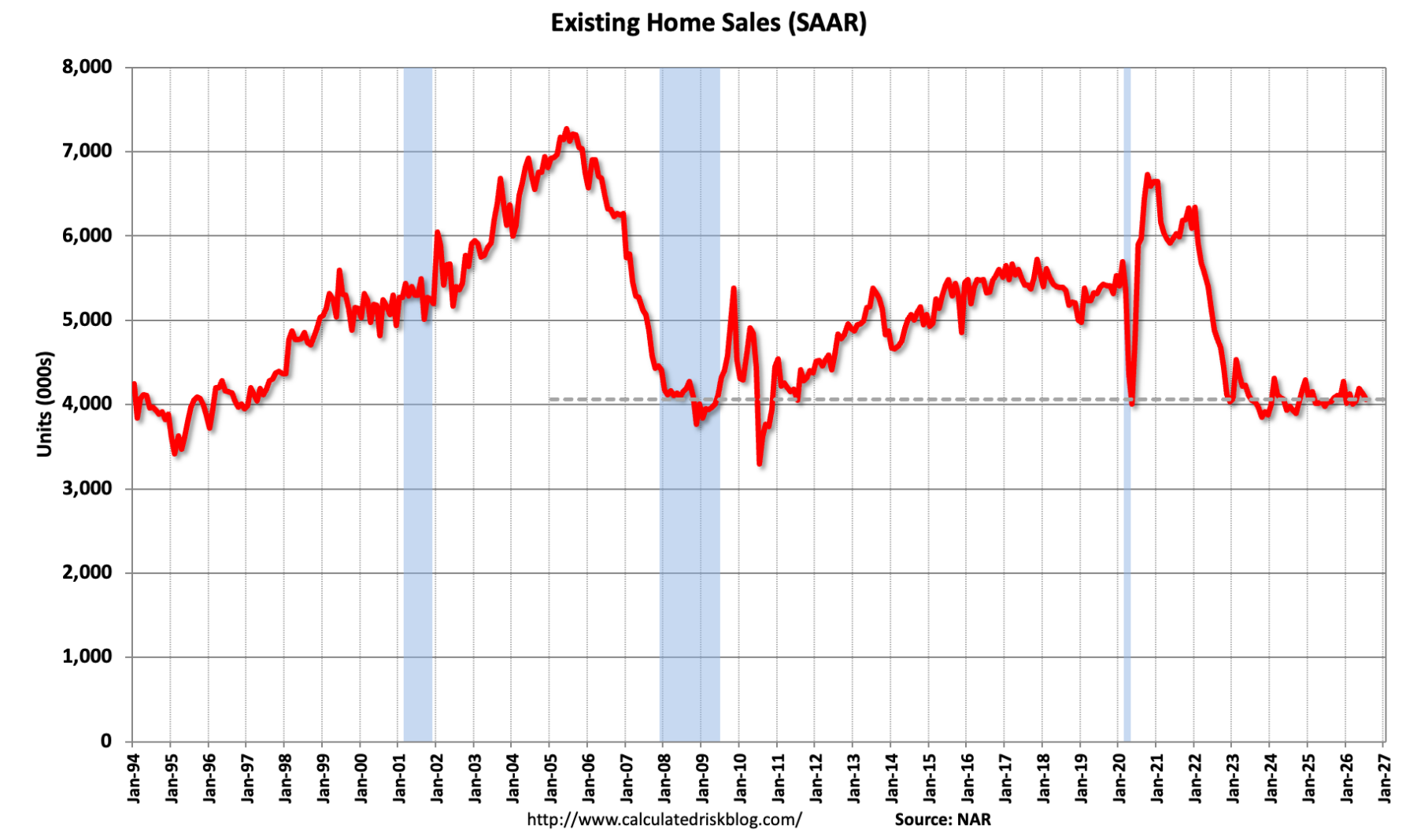
Source: Calculated Risk
Sign up for our reads-only mailing list here.
