
My back-to-work morning reads:
• What Years of Inflation Have Done to American Prices: Life has gotten a lot more expensive over the past few years. Across the economy, the cost of goods and services has soared. Consumer prices overall have risen more than 30 percent since the beginning of 2019. That’s two and a half times as much as they went up from 2012 to 2019. Edison Wu charts the damage — raw steak averaged about $6 a pound in 2012 and roughly $13 today. (New York Times)
• The Unrelenting Bond Selloff Puts the 10-Year Yield on the Cusp of 5%: Rising borrowing costs threaten to disrupt the stock market and slow the economy. The 10-year Treasury hits 4.943% — with rising borrowing costs threatening the stock market and the economy alike. (Wall Street Journal) see also How to Protect Your Nest Egg When Inflation Is Ballooning: Oil near $100, inflation above target for five-plus years, and the case for TIPS. When Inflation is a threat. TIPs can help get it under control. (Wall Street Journal)
• How much money is enough? A practical guide to deciding what your money is for, and when you’re allowed to stop moving the goalposts. Hanna Horvath follows up her financial-nihilism essay with its hardest reader question — okay, but what am I actually working toward? (Hanna Horvath)
• The SaaSpocalypse was more like a RenaiSaaS: Overall SaaS revenue growth actually accelerated through the SaaSpocalypse. Ernie Tedeschi on the early-2026 repricing that wiped out perhaps $2 trillion in enterprise software value — and why the episode looks less like an apocalypse in hindsight. (Stripe Economics)
• Moonshot Capitalism: AI Rewrites the Venture Capital Playbook: Tim Bradshaw on the resurgence of outlandish bets — nuclear fusion, melding humans with machines — as SpaceX-sized returns and falling software valuations push VCs toward capital-intensive dealmaking. (Financial Times)
• We Are Living in the Fantasy World of 13-Year-Old Boys: Many of the tech billionaires who built our world have taken the wrong lessons from their favorite science fiction. Gal Beckerman on the tech billionaires who took the wrong lessons from their favorite science fiction. (The Atlantic)
• New York changed in dramatic and surprising ways in the 25 years since 9/11: Some of the most positive changes have come with downsides that are straining the city. Hannah Natanson on the panicked predictions historians made in September 2001 — and how few of them came true. (Washington Post) see also The architect of 9/11 built the world we inhabit today: The changes to our urban design, architecture and everyday life are so profound we can hardly see them. Philip Kennicott starts with Emerson’s 1840s prediction about the view from the Capitol’s west terrace — and traces what the attacks did to the American landscape. (Washington Post)
• I interviewed Apple CEO John Ternus on the making of the iPhone Duo — here’s what made him say ‘yes, that’s it’ This is the story behind Apple’s first foldable phone. Mark Spoonauer gets the story of Apple’s first foldable — famously late to the category, as usual. (Tom’s Guide)
• Contractor Blames Its Own Repairs, Not Vandals, for Reflecting Pool Failure: Maxine Joselow on the documents showing the Lincoln Memorial pool’s new blue liner peeled because of “human oversight” and two incompatible chemicals — not sabotage. (New York Times)
• The Fantasy of ‘The Office,’ the Reality of ‘The Paper’: Monica Hesse on the viewers whose answer to “when did you finish watching The Office?” is never — and also all the time. The bingeable workplace comedy was about the glory of the mundane. Its successor is about finding serenity in chaos. (Washington Post)
Video of the day: How Larry Ellison Built His Empire
Be sure to check out our Masters in Business next week with Seth Bernstein, CEO of AllianceBernstein and Head of Asset Management of Equitable Holdings, the 69% owner AB. The firm manages $905.5B. Previously, he spent 32 years at JPMorgan Chase, where he eventually became the Global Head of Managed Solutions & Strategy at JPAM, responsible for all discretionary assets for Private Banking clients, and Global Head of Fixed Income & Currency. He eventually became CFO of JPM’s Investment Management & Private Banking division.
From 1984 to 2024, the Fed adjusted rates (up or down) within 60 days of an election (43%) as often as in any other 60-day period (45%).
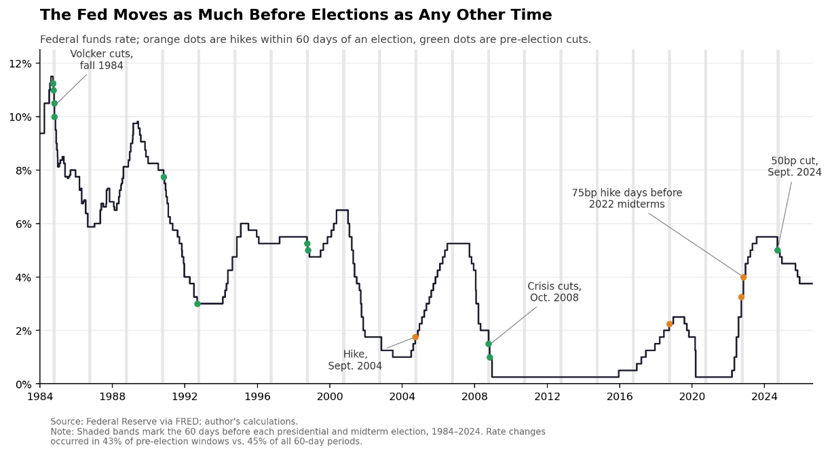
Source: Claudia Sham
Sign up for our reads-only mailing list here.
