
My mid-week morning reads:
• It’s a Concentrated World: The top 10 stocks in the S&P 500 make up almost 40% of the index. Each of the companies in the top 10 sport a market cap of $1 trillion or more. In fact, as of this writing, the 12 biggest companies all have market caps of $1 trillion or more.1 As recently at 2015, the top 10 made up just 17% of the S&P 500. Ben Carlson on twelve of the biggest names now above $1 trillion. (A Wealth of Common Sense)
• Did we make it too hard to get a mortgage after 2008? A new report says yes. Some say the pendulum has swung too far since the 2008 housing crisis. Others warn that looser standards once led to disaster. A Pew report givces the details. (Washington Post)
• The Fed’s Credibility Depends on Resisting Politics, Not Playing It: Kenneth Rogoff advised the Fed to delay its rate decision until after the midterms to preserve its independence from President Donald Trump’s attacks. Rogoff’s own 1983 research paper showed that central bank credibility matters, and that the head of the central bank should be more averse to inflation than the average person. (Bloomberg free)
• The 24-Year-Old Who Lost Billions: Leo Aschenbrenner claimed to know the future of AI. The implosion of Aschenbrenner’s AI hedge fund, Situational Awareness, over the course of a few days in late July was by any standard remarkable, and not just for the enormous sums involved. Aschenbrenner was the valedictorian of his Columbia University class at age 19. He worked for OpenAI before being fired amid murky circumstances, at which point he published a viral 165-page essay (also called “Situational Awareness”) that predicted the arrival of artificial general intelligence—an AI so advanced that it would meet or exceed all human capabilities—by 2027. (The Atlantic)
• Hollywood’s Box Office Boom Comes With 248 Million Missing Tickets: Hollywood’s summer — by its accounting — was a triumph for the ages. Ticket revenue was not only the highest since 2013, but the second highest of all time. Brooks Barnes on the summer’s “second highest of all time” revenue claim — which holds up only if you never adjust for ticket prices. (New York Times)
• He Earns $33 an Hour as a Costco Cashier. Now He’s a Millionaire: Inside Costco’s retention machine — maximum hourly pay raised to $32.90, bigger bonuses, and “culture coach” roles for long-tenured workers. Long-tenured workers like cashier Tony Barzar are reliable, experienced and able to speed shoppers through a checkout line. Costco is willing to pay to keep them around. (Wall Street Journal)
• FBI Probes Service Selling 153M+ Drivers Licenses: A new identity theft service launched on the dark web this week is selling digital scans of more than 153 million drivers licenses from people in the United States and Canada. Based on interviews with individuals whose licenses are available for purchase on this service, it appears to be siphoning images collected by a widely-used identity verification company based in Louisiana. KrebsOnSecurity also has learned that the New Orleans field office of the Federal Bureau of Investigation (FBI) today launched an official inquiry into the source of the images. Brian Krebs on the dark-web identity-theft service siphoning license scans. (Krebs on Security)
• Without New Landers or Rovers, It’s Helicopters or Bust for NASA’s Mars Program: Stephen Clark on the $2.1 billion SR-1 Freedom estimate — which doesn’t include the helicopters. NASA’s cost estimate for SR-1 Freedom is $2.1 billion, but that doesn’t include the helicopters. (Ars Technica)
• The MAGA Right Is Only Pretending to Be Censored: Anne Applebaum on the State Department operation that spent a year and a half combing old files and civil servants’ personal emails to build its case. The conspiracy theory that persists even though no evidence supports it (The Atlantic)
• MapQuest is No. 1 on the App Store after refusing to change Lake Ontario’s name: Usage of MapQuest was 50x the normal level last week because MapQuest refused to change the name of Lake Ontario. The dial-up-era mapping service is having a comeback moment after declining to adopt “Lake America.” (CNN Business)
Video of the day: OnlyFans: How an $8B Cash Machine Got Stripped Bare
Be sure to check out our Master’s in Business this week with William McNabb, former CEO and Chairman of the Vanguard Group from 2007-17. He is also an advisor to Venrock, and was an investor and advisor to Altruist, which was just sold to VG for $2 billion.
Since the Fed Started Hiking, Multiple Expansion Has Nearly Vanished as a Source of PE Value
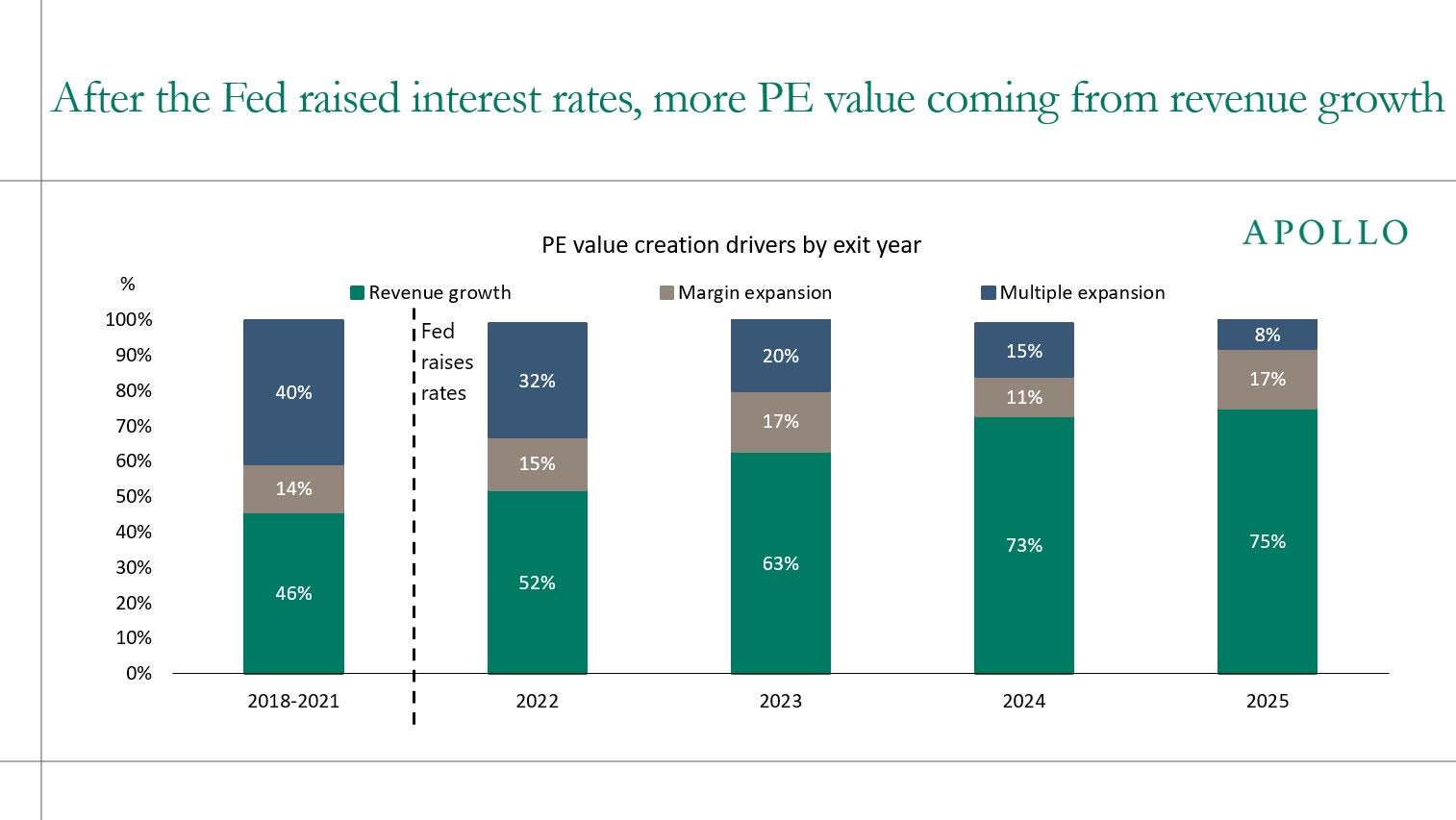
Source: Apollo
Sign up for our reads-only mailing list here.
