
Three-day weekend! Pour yourself a mug of Danish Blend coffee, grab a seat outside, and get ready for our longer-form weekend reads:
• How to build a cancer vaccine, and whether they will work this time: Typical cancer vaccines are vaccines given to you when you have cancer. These have been worked on for forty years, and have largely failed. But there is something in the air these days. If you really try, you can feel it too. There is optimism afoot in cancer vaccines. Really, there may be optimism afoot in cancer at large. Abhishaike Mahajan of Dyno Therapeutics with a deep dive on the intersection of machine learning and immunotherapy. (Seeds of Science)
• What if America Went Completely Dark? The power grid relies on thousands of aging, hand-built transformers. If enough fail, the blackout could last years. Jim Tankersley from the Asheville G-20, where a summit meant to showcase Trump’s economic policies as a model became a venue for European complaints about tariffs and the Iran war. (New York Times) see also Is This the Future of America? Massive AI infrastructure is being built out across the US. But if you want to know what the data center occupation looks like, visit Loudoun County, Virginia, where that future arrived 20 years ago. (The Verge)
• Anthony Scaramucci Thinks He Can Save America. I Hopped in His Lamborghini to Hear Him Out.: Jack Holmes rides a Huracán past the Golden Pear in Southampton — home of the $22 breakfast burrito — while the Mooch holds forth. The former White House communications director says he wants to own his bad bets, from Donald Trump to Sam Bankman-Fried. At his summer house—and around town in his Huracán—Anthony Scaramucci makes his case to Vanity Fair for how to fix this country for the working class. (Vanity Fair)
• The ‘reverse Kindleberger Trap’: reasons to worry about the next financial crisis: A US crisis is very likely to be associated with a capital outflow, rather than a capital inflow, with the result that the dollar could weaken substantially against other currencies. (Chatham House)
• No Car? No Problem: An East Coast Odyssey by Train, Ferry and Bus: A self-described transit romantic set out to visit prime summer destinations using only public transportation. Would getting there really be half the fun? (New York Times)
• Using legal loopholes and executive power, Trump is remaking Washington The president’s ballroom and other projects are racing the courts and the clock, as the GOP-led Congress largely sits silent. Dan Diamond on the ballroom exchange — “Sir, this is the White House, you’re the president of the United States. You can do anything you want.” (Washington Post) see also Who Approves Trump’s Washington Makeover Projects?: Elena Shao on the green-lit ballroom and the projects still stalled. (New York Times)
• All Wired Up: Spurred on by this paper-induced memento mori—or maybe just in an attempt to avoid my collection being too entrenched in the ’70s—I recently picked up a complete 1995-1997 run of Wired magazine. While I’m a regular reader of present-day Wired, I knew very little about the magazine’s early years, as they coincided with my toddlerhood. What became clear after flipping through these older issues was that above all, 1990s Wired is an index fossil for a period when the science and techology industry was still culturally marginal—tech’s own toddlerhood, essentially. In these early years, the field was experimental and eccentric. It was a community of hackers and artists rather than multi-billionaires on super-villainous yachts; a moment when no one would ever think to describe themselves as a nerd aspirationally. (Casual Archivist)
• What Makes the Most Expensive Paintings So Expensive?: Jackie Wullschläger on Klimt’s Lady in Gold, bought by Ronald Lauder for $135 million in 2006 — then the record for any painting — and bound for the Met in 2028. (Financial Times)
• A Mysterious Kidney Disease Has Arrived in Texas: The condition, linked to heat on a warming planet, is affecting immigrants from Central America and Mexico. As scientists race to track the growing epidemic, its victims have been driven further into the shadows. (Texas Monthly)
• The Plays of Shakespeare Rehabilitating Richard. We’ve gotten to know William Shakespeare’s Richard III pretty well by now. But who was the real Richard when he was at home? That question has been raising eyebrows and hackles for at least 400 years. (Analog-Antiquarian)
Video of the day: Death Cab for Cutie: Tiny Desk Concert
Be sure to check out our Master’s in Business next week with William McNabb, former CEO and Chairman of the Vanguard Group from 2007-17. He is also an advisor to Venrock, and was an investor and advisor to Altruist, which was just sold to VG for $2 billion.
AI Data Centers & Our Communities
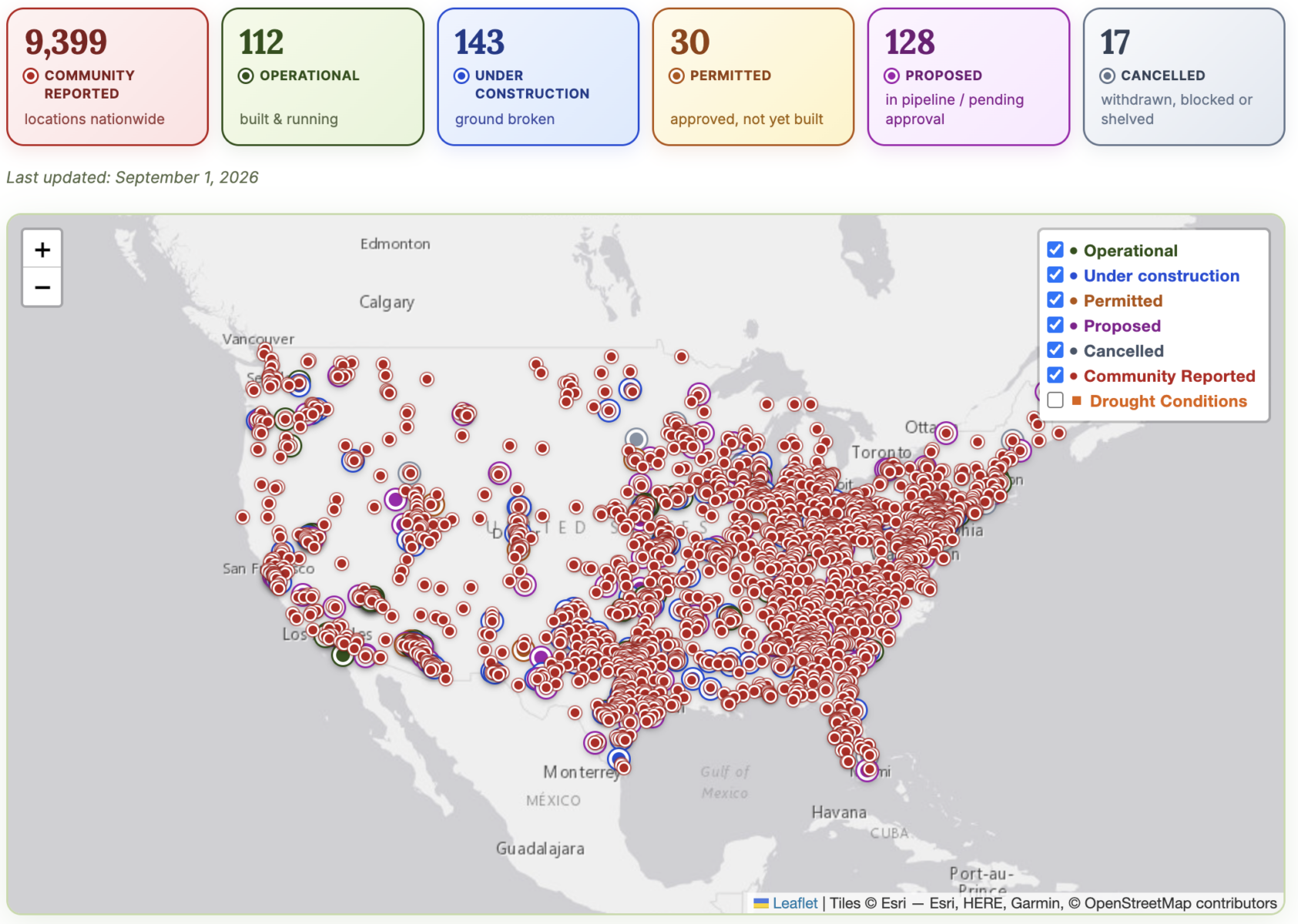
Source: Brockovich AI Data Center Reporting
Sign up for our reads-only mailing list here.
~~~
To learn how these reads are assembled each day, please see this.
