
The weekend is here! Pour yourself a mug of Danish Blend coffee, grab a seat outside, and get ready for our longer-form weekend reads:
• What happens when we admit we don’t know? Kelly Corrigan on why humility fuels curiosity — and how to cultivate these qualities in an age of certainty. Champion curiosity, and you risk sounding like a kindergarten teacher or a journalism professor. We treat it as a trait for the young and unformed — something adults either already mastered or no longer require. After all, if experience is supposed to deliver answers, what’s left to be curious about? (Big Think)
• Bubbles as a Feature Not a Bug: Drawing parallels to electrification and the internet, Jason Thomas considers how AI is reshaping corporate priorities around data, infrastructure, and productivity, and why early investment enthusiasm often centers on perceived bottlenecks, while much of the economic value ultimately accrues downstream. (Carlyle) see also The Startup Graveyard: 1100+ Failed Startup Case Studies: Where 1,402 startups and $202.6B+ in venture capital was burned to ashes. Loot the wreckage. (Loot Drop)
• Interstellar Space Travel Will Never, Ever Happen — It’s Basically Impossible: It turns out that the ships in Star Trek, Star Wars, Dune etc. are not based on some kind of hypothetical technology that could maybe exist someday with better energy sources and materials. In every case, their tech is the equivalent of just having Dumbledore in the engine room cast a teleportation spell. Their ships skip the vast distances of space entirely, arriving at their destinations many times faster than light itself could have made the trip. (Jason Pargin)
• Federal Reserve 101: What America’s central bank does and why it matters. (Paul Krugman)
• Computers can’t surprise: As AI’s endless clichés continue to encroach on human art, the true uniqueness of our creativity is becoming ever clearer. (Aeon)
• How To Become a Mathematical Genius: What many people experience as a “cognitive limit” or the edges of their own intelligence is actually just a representational limit: it’s when we use a specific way of thinking, but apply it to the wrong types of problems. This makes us think we’re stupid, when actually we’re not! And what that process tells us about how to solve the world’s biggest problems. (But This Time It’s Different) but see The Fall of the Nerds: The age of humans who could think like computers is drawing to a close. (Noahpinion)
• Daydreamers and Sleepwalkers: Crossing the Borderlands of the Unconscious: Scientists, novelists, and philosophers have spent centuries studying the boundaries between sleep and wakefulness. Each descent only deepens the mystery. (MIT Press Reader)
• How to build a girl in modern America: What can sororities, #RushTok and influencer-student megastars like the Darnell sisters tell us about US girlhood? We visit the University of Alabama to find out. (The Face)
• Is Particle Physics Dead, Dying, or Just Hard? Columnist Natalie Wolchover checks in with particle physicists more than a decade after the field entered a profound crisis. (Quanta Magazine)
• NFL & Fox: The $1.6B Deal That Changed Everything: In 1993, Rupert Murdoch vastly overpaid for NFC media rights. But the deal turned Fox into a major American TV network and completely changed the economics of the NFL. (SatPost by Trung Phan)
Be sure to check out our Masters in Business interview this weekend with Bob Moser, CEO and founder of Prime Group Holdings, a private investor in unique real estate holdings. They created Prime Storage, one of the largest, privately-held self-storage brands in the world, with over 19 million rentable square feet of space and 255 locations across 28 states and the U.S. Virgin Islands. The firm has acquired over $10 billion in real estate assets.
The $117 Trillion World Economy
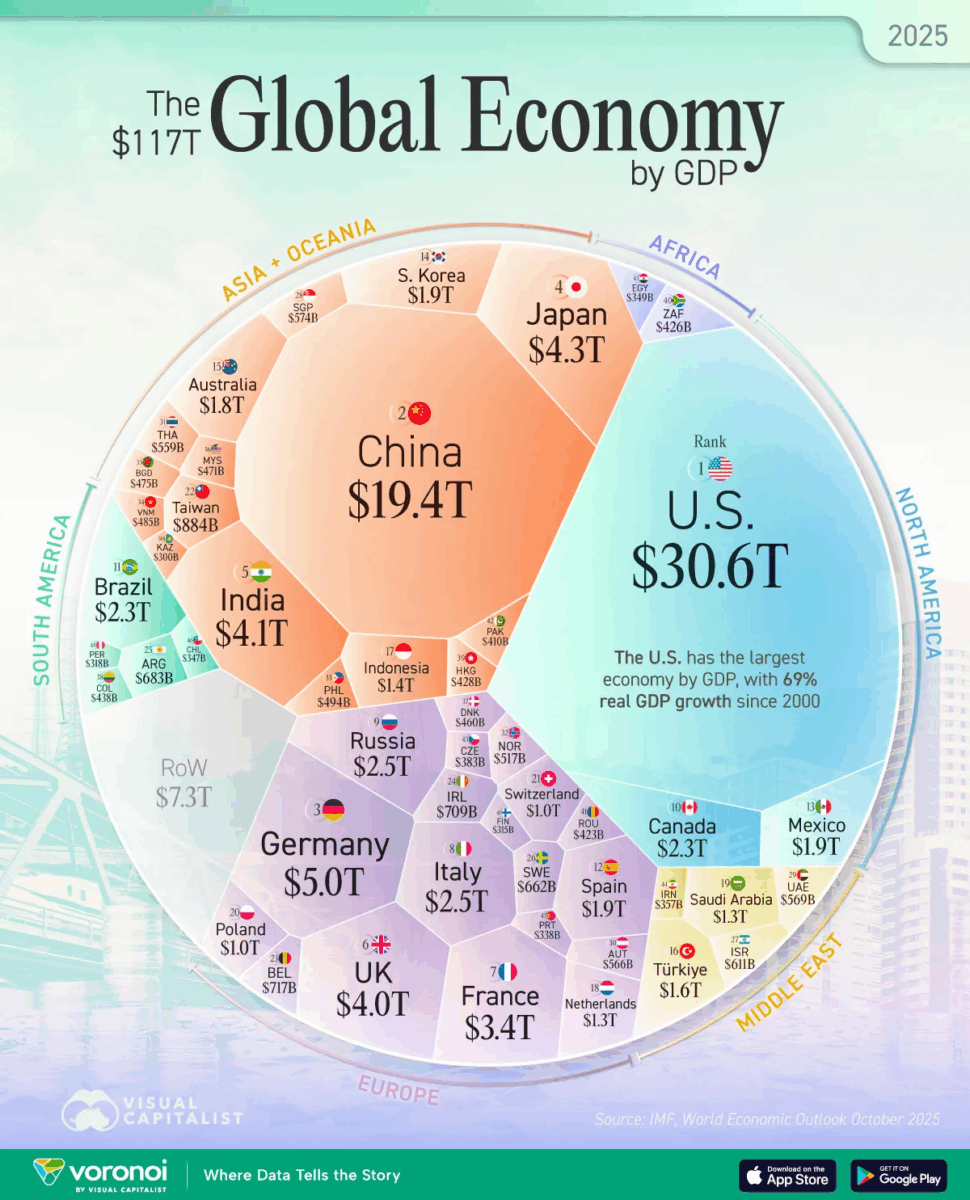
Source: Visual Capitalist
Sign up for our reads-only mailing list here.
