
The weekend is here! Pour yourself a mug of Danish Blend coffee, grab a seat outside, and get ready for our longer-form weekend reads:
• This Entertainment Lawyer to the Stars Shares His Best Negotiating Secret: Allen Grubman on why you should always overtip and why the media business is always seeking fresh blood (Wall Street Journal)
• AI and the Economics of the Human Touch: A reason for optimism: Either AI is so useless that we are in the middle of a bubble that’s about to burst and take the economy down with it, or AI is so powerful it’s going to replace us all and devastate the labor market. (Agglomerations) see also What AI says about AI eating itself and the world… AI says it is targeting IT and software, finance, customer services, manufacturing and logistics, and media and entertainment The market gyrations of the past two weeks, as fears about AI disruption hit first software and then technology and financial stocks, have left anxious investors wondering: which sector will be next to drop? Deutsche Bank identifies an $800 billion AI funding gap and questions whether the industry’s unsustainable spending can continue. (Deutsche Bank Research)
• The economics of the Kalshi prediction market: Kalshi has operated as a federally licensed prediction market in the US since 2021, free from the strict stake limits placed on previous legal prediction markets. Over 300,000 analyzed contracts and their outcomes demonstrate that Kalshi’s contract prices are informative and improve in accuracy as markets approach closing, but they display a clear favourite-longshot bias. Low-price contracts win far less often than required to break even, while high-price contracts win more often and yield small positive returns. (VoxEU/CEPR)
• The Hidden Plumbing of Stablecoins: Financial and Technological Risks in the GENIUS Act Era US dollar stablecoins are increasingly used as payment and settlement instruments beyond cryptocurrency markets. With the enactment of the GENIUS Act in 2025, the United States established the first comprehensive federal framework governing their issuance, backing, and supervision. This paper evaluates the financial, technological, and regulatory risks that may arise as GENIUS-compliant stablecoins scale into mainstream use. MIT researchers identify systemic risks lurking in the GENIUS Act’s stablecoin infrastructure, from redemption surges to technological failures. (MIT Media Lab)
• In World War II’s dog-eat-dog struggle for resources, a Greenland mine launched a new world order: Greenland’s cryolite mine was strategically vital during WWII, shaping the postwar global order in ways still reverberating today. (The Conversation) see also Hitler’s Greenland Obsession: The historical precedent for great-power interest in Greenland is darker than you think. The Atlantic on how the Third Reich saw the island as strategically vital — a useful reminder as present-day territorial ambitions echo uncomfortably. (The Atlantic)
• The New Rules of Retirement: Popular guidelines about how to save, invest, and spend need to be updated and personalized to ensure you’ll never run out of money. (Kiplinger)
• The Sweet Lesson of Neuroscience: Scientists once hoped that studying the brain would teach us how to build AI. Now, one AI researcher may have something to teach us about the brain. Brains teach themselves through internal steering systems, suggesting that the future of AI alignment might hinge less on learning rules and more on training signals—a frontier neuroscience still understands better than silicon. (Asterisk)
• The Cult Deprogrammer Who Needed Deprogramming: The long decline of religion has left a vacuum of purpose and belonging, then technology fragmented us further, and cults have flourished in this habitat, preying on a disillusioned public with promises of special knowledge, chosen membership, and a new dawn. When the mainstream feels broken, the fringe swoops in. As Antonio Gramsci said, “now is the time for monsters.” Rick Ross, America’s foremost cult deprogrammer, reflects on 40 years battling brainwashing in an era when conspiracy movements are doing the work that fringe groups used to do. (Minority Report)
• How one country stopped a Trump-style authoritarian in his tracks: What Brazil got right that America got wrong. Brazil’s Congress, Supreme Court, and military actively constrained Bolsonaro’s authoritarian impulses when he tried the moves Trump is now executing—showing that institutional resistance is possible. (Vox)
• The Rise and Fall of the American Monoculture: For most of the 20th century, pop culture was the glue that held the U.S. together. But what will it mean now that everything has splintered? Streaming and algorithms have shattered the shared cultural experiences that defined 20th-century America. (Wall Street Journal)
Be sure to check out our Masters in Business interview this weekend with Hilary Allen, Professor of Law at the American University Washington College of Law. She specializes in financial regulation, banking law, securities regulation, and technology law, with a particular focus on how new financial technologies like fintech, crypto, and AI intersect with financial stability and public policy.
Online spending is surging, at the expense of physical retail, driven by K-shaped consumer spending, rising BNPL usage and adoption of Agentic AI.
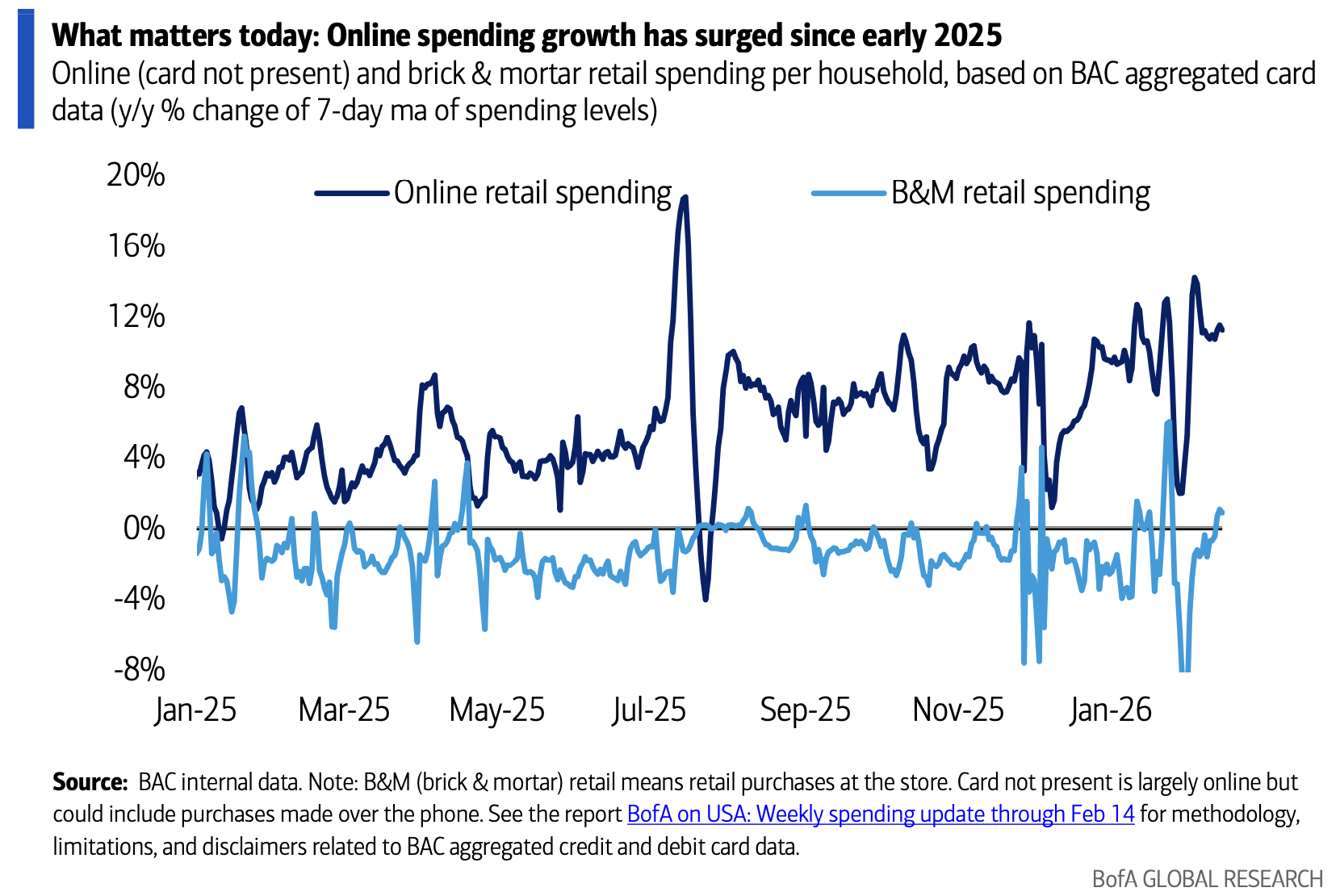
Source: Shruti Mishra, BofA Global Research
Sign up for our reads-only mailing list here.
