
My mid-morning Plane reads:
• The Era of Free Seas Is Unraveling—and Now Everyone’s Going to Pay: Three centuries of open maritime commerce are buckling under geopolitical pressure. Iran’s toll booth at the Strait of Hormuz is just the beginning of a much more expensive world. (Wall Street Journal)
• The country that can’t say no to Trump: The FT on a U.S. ally trapped between economic dependence and political humiliation. Trump’s foreign policy is a stress test for everyone’s sovereignty. Tokyo is in need of a plan B to dependence on the US. There may not be one. (Financial Times) see also The Iran War Is Hitting California Harder Than Any Other State: California imports roughly 75% of its crude oil, almost one-third of which comes from the Middle East. (Wall Street Journal)
• These Retirees Are Thriving. What Are Their Secrets? How to handle your money, spend your time and get the most out of post-work life. (Bloomberg)
• Trump wants you to invest your 401(k) in crypto and private equity. Should you bite? Trump is opening the door to risky ‘alternative investments’ such as crypto and private equity in 401(k) plans. But employers have had good reasons to keep them out of their plans. (Los Angeles Times)
• What Are Stablecoins Used for Today? Estimating the Distribution of Stablecoins: Uncovering where stablecoins are held and how they are used in the financial ecosystem provides three key insights: stablecoins are rarely used for payments, stablecoin infrastructure lacks interoperability, and the stablecoin ecosystem is still predominantly tied to crypto finance. (Federal Reserve Bank of Kansas City)
• Private credit has calmed the credit cycle: The reason the IMF, BIS, and various major central banks have been focusing on private credit is because they see it as new and untested, opaque, with the potential to amplify monetary transmission and contribute to financial stability risks. Private credit is absorbing what banks used to handle — which sounds calming until you realize the stress is just hidden, not gone. (Financial Times)
• How the Internet Broke Everyone’s Bullshit Detectors: Our cognitive defenses evolved for face-to-face lies, not algorithmic deception at scale. From AI-generated images to restricted satellite data, the systems used to verify what’s real online are struggling to keep up. Wired on why even smart people are falling for dumb things in 2026. (Wired)
• Meet Peter Magyar, the Man Who Ended Trump Ally Viktor Orbán’s 16-Year Rule: “We won not small but big—very, very big,” Magyar told a crowd of cheering supporters, celebrating the fact he toppled Orbán’s Fidesz Party by gaining 138 of 199 seats. “Together we changed the Orbán regime, together we liberated Hungary, we took our homeland back.” He pledged to spend the next four years striving for a “free, European, functioning, and humane Hungary.” The playbook for defeating entrenched autocrats might be more replicable than we thought. (TIME) see also Hungary Just Ousted the Unoustable: Viktor Orbán had support from Moscow and Washington, but not from his own people. His defeat proves autocrats aren’t invincible — they’re just good at gaming the margins until they’re not. Lessons here for every country watching its own democratic backsliding. (The Atlantic) see also New data suggests Trump’s assault on democracy may be stalling out: Three new reports give some surprising reasons for optimism. Democracy indexes show the damage may have plateaued. Not recovered, but plateaued — which is more than most analysts expected at this point. (Vox)
• ‘This Was the Real Thing’: Meet the Woman Who Alerts the World When an Asteroid Could Hit: A profile of the UN official responsible for warning humanity about asteroid impacts. The most important job nobody’s heard of. (The Guardian)
• The US small town coffee shop that created a viral drink: ‘I still don’t understand how it went so far’ A palate cleanser: a small-town coffee shop accidentally invents a TikTok-famous drink. The modern economy in miniature — scale, virality, and the limits of local. The raspberry danish latte is making its way around the world after its inventors decided to share the recipe. (The Guardian)
Be sure to check out our Masters in Business interview this weekend with Mike Pyle, Deputy Head of BlackRock’s Portfolio Management Group (PMG) and member of the Global Executive Committee. He helps oversee $5 trillion in client assets across systematic & discretionary strategies as well as directly overseeing PMG’s hedge funds platform. He also heads the BlackRock Investment Institute.
Which states have the highest and lowest income tax?
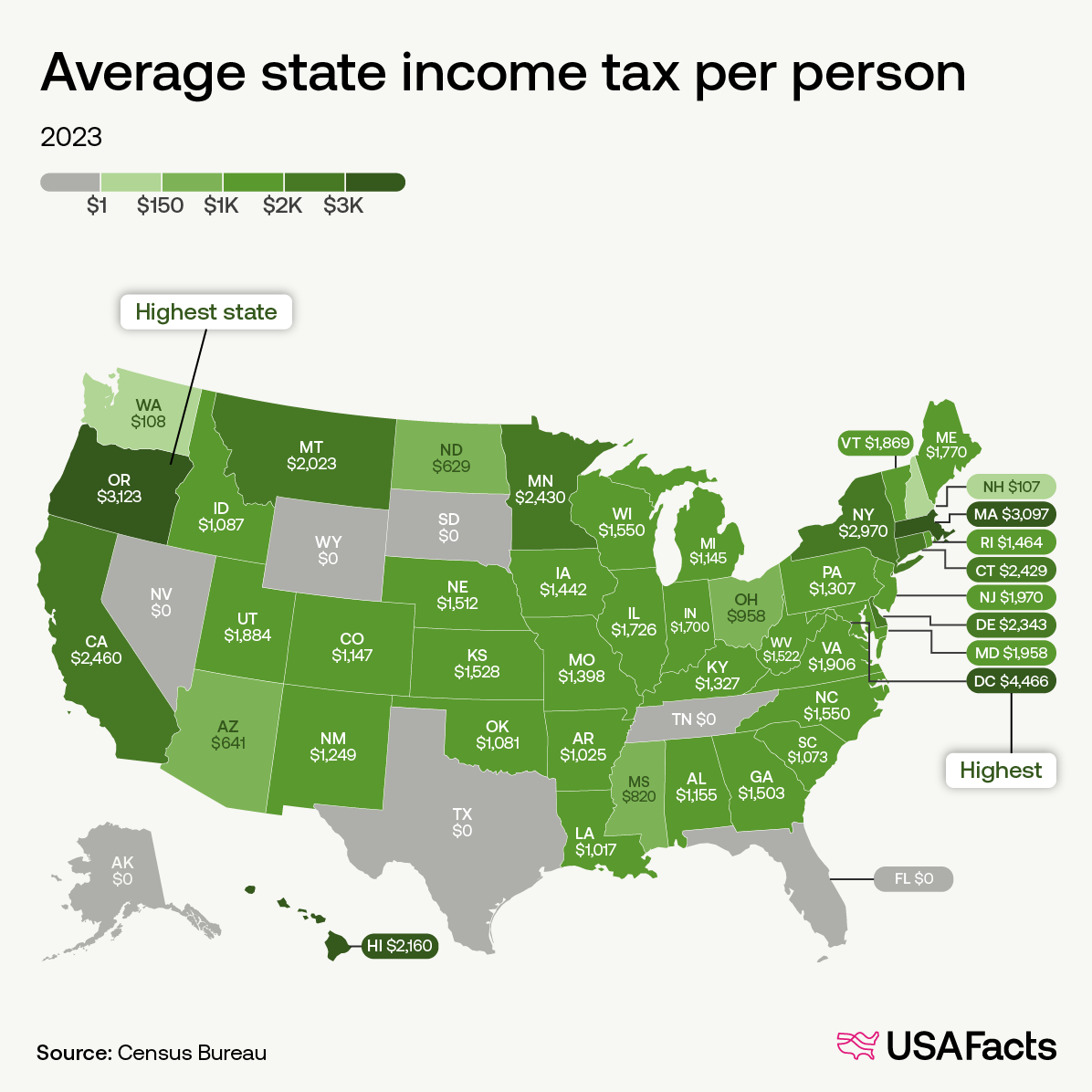
Source: USA Facts
Sign up for our reads-only mailing list here.
