
My Two-for-Tuesday morning train WFH reads:
• 50 years. 50 facts. Indexing since 1976. As the golden anniversary of index fund investing approaches, the strategy is widely available across and within asset classes. Its appeal is evident: Indexing is an easy-to-understand, cost-effective strategy that can offer diversification, tax efficiency, and consistent performance relative to the results of the market. (Vanguard)
• The U.S. Is Manufacturing a Ton of Grid Batteries: Demand for energy storage is surging on the U.S. grid — and the country now has more than enough battery-making factories to meet it. Domestic energy-storage capacity is scaling fast as grid demand climbs: (Reasons To Be Cheerful) see also AI Is Using So Much Energy That Computing Firepower Is Running Out: The AI bubble has a physics problem: there aren’t enough megawatts on the grid. Compute-constrained means capex-constrained, which means the models won’t scale the way investors are pricing. (Wall Street Journal)
• A Catechism for Robots: Kevin Kelly’s first draft FAQ dedicated to embodied AIs with persistent memories, dynamic learning, and a large dose of autonomy. (KK)
• Deals Hurt Returns. Thaler explains that auctions—especially when there are large numbers of bidders—can cause some participants to become emotional, to the point that they become undisciplined and end up bidding too much. The winners in these situations are thus “cursed” because they’re the ones who were willing to overpay the most and thus tend to be most disappointed. (HumbleDollar)
• Americans Have Always Hated Taxes. The 250-Year Battle Over Your Wallet. From the Whiskey Rebellion of the 1790s to Henry David Thoreau’s refusal to pay taxes to the 1,400 elected officials who signed an antitax pledge. Barron’s A look at the long history of American tax rebellions. (Barrons)
• How Austin’s stunning drop in rents explains housing in America: We finally have some good news about housing affordability. (Vox)
• Some of the Most Popular Graduate Degrees Don’t Pay Off Financially: New data shows the ROI on many master’s programs is worse than advertised.The report found advanced degrees in social work and psychology may have a zero to negative return, while medicine, law and pharmacy degrees show the highest return. (Washington Post)
• Why the Strait of Hormuz is a geological wonder: The continental collisions that created this narrow Mideast waterway also made it the most strategically important 21 miles on Earth. Geology is destiny, and Iran controls the choke point. (National Geographic)
• ‘An Operational Success and a Huge Strategic Failure’ Perhaps the most apt description of Trump’s policy toward Iran is an “incoherent maze” — a phrase Pete Hegseth applied in 2016 to Barack Obama’s foreign policy. Lost in his own labyrinth, Trump granted sanctions relief to Iran even as he bombed it, and careened from threatening war crimes unless Iran opened the strait to suggesting that the strait wasn’t our concern. (NYTimes) see also The Mythology of Pete Hegseth: Garrett Graff dismantles the mythology Hegseth has built around himself as the Iran War’s cheerleader-in-chief. The alternate history he’s selling is dangerous. (Doomsday Scenario)
• NBA Playoffs: Ranking the Superstar Matchups We Want to See in the First Round: The giants who rule atop the game must go to war with one another, over and over again, until only one is left standing. There’s no room for error or quarter on the way to the pinnacle of the sport. The quality of each team still matters quite a bit but it’s the superstar matchups that will determine who will be featured on the biggest stage come the Finals…(Sports Illustrated)
Be sure to check out our Masters in Business this week with Philippe Bouchaud, co‑founder, chair & head of research/chief scientist at Capital Fund Management (CFM). The $20 billion firm specializes in managed futures. He began his career in theoretical physics, was awarded the IBM Young Scientist Prize (1990) and the C.N.R.S. Silver Medal (1996), and has published over 300 scientific papers and several books in physics and finance.
The gap between Wall Street (S&P 500) and Main Street (Consumer Sentiment) has never been this wide before. Wakl St ATH, Main St ATL
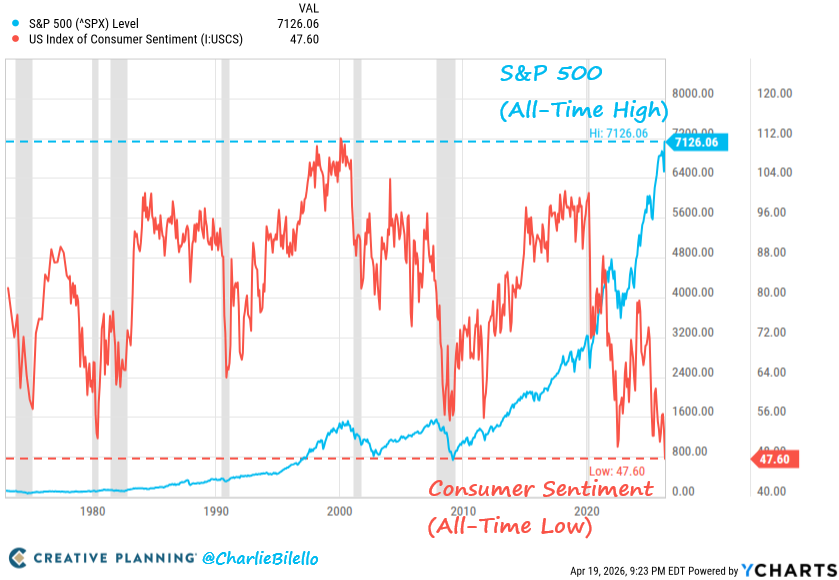
Source: @charliebilello
Sign up for our reads-only mailing list here.
