
Everybody’s attention has been focused on the Iran War,1 but I want to draw your attention back to a different war — the prior Trade War.
Eighteen months ago, the Trump administration was elected to its second term. After November 2024, there was a lot of noise about what people thought would happen. When Liberation Day rolled around in 2025, many observers, including long-standing Wall Street supporters, were shocked.
The first tariffs were on Canada and Mexico, voiding the deal the president himself had renegotiated; then came 100% tariffs on China, then a long list of other tariffs.
There was a problem with this executive-branch muscle-flexing: It was (obviously) unconstitutional. Article I, Section 8 of the U.S. Constitution specifically delegates the power to lay and collect duties, taxes, and excises to Congress.2 This was an unambiguously executive-branch overreach—arguably done in bad faith.3
The U.S. Court of International Trade found the tariffs unconstitutional; the Federal Circuit Court of Appeals (en banc, with every judge in the district participating) overwhelmingly affirmed that finding. It was fast-tracked to the Supreme Court, which ruled 6–3 against the administration.4
The President, when pushing the tariffs, promised four things: 1) Creation of industrial jobs, 2) Lower inflation, 3) Reduction of the trade deficit, and 4) Reduction in the federal budget deficit.
None of those things happened.
All of them are now worse than before the tariffs were introduced (before the Iran assault began).
Making it worse was the sheer chaos of how the policy was implemented. According to the Cato Institute, there were 50 separate reversals, new policies, changes, pauses, and exemptions (traders called it “TACO”). The chaos froze CFOs and CEOs in place. They stopped hiring. They stopped building new factories and plants. They cut capital expenditures. “Until we know what the policy is, how can we commit hundreds of millions (or billions) of dollars?”
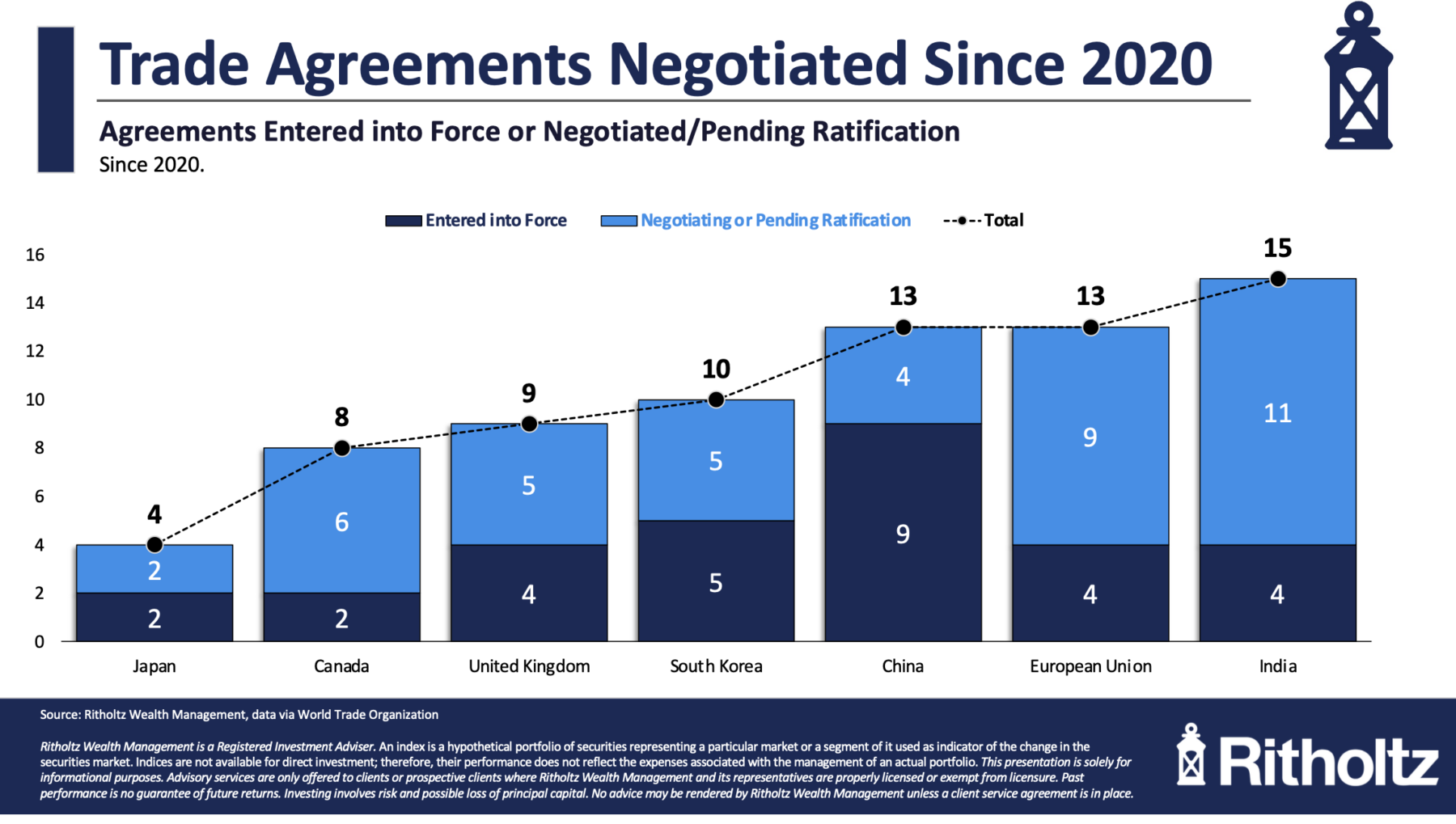
As the chart at top shows, only a few agreements were actually negotiated; normally, trade agreements take years to be hammered out, especially when more than two parties are involved. But even that small handful is now void. No counterparty is going to stick with promises based on a policy the highest court in the land has declared unconstitutional.
But what about those promised benefits of the Tariffs over the year it was in effect? Let’s consider the data, to see how the reasons for implementing tariffs have fared:
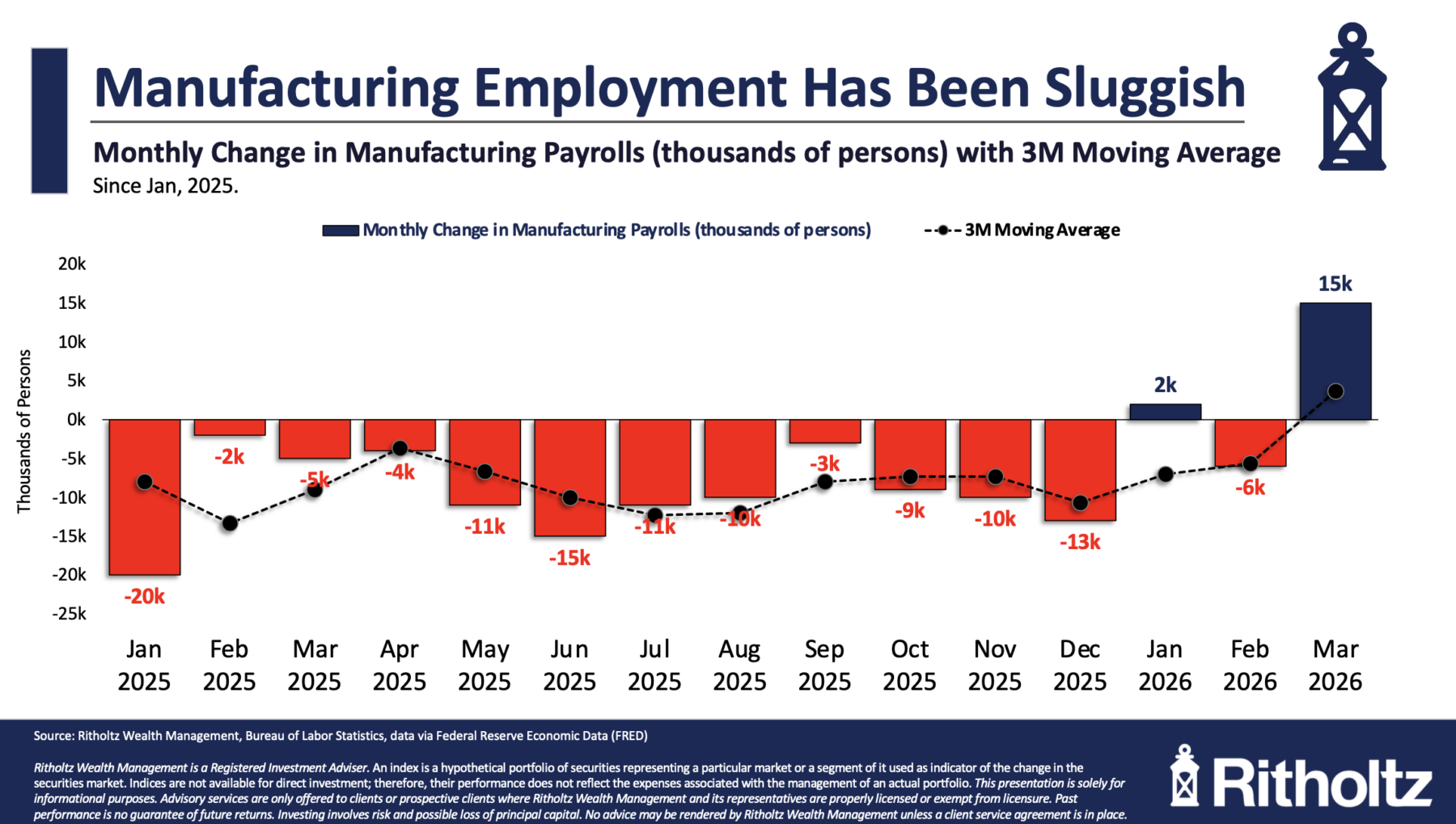
Employment: roughly 100,000 manufacturing jobs were lost over the past year:
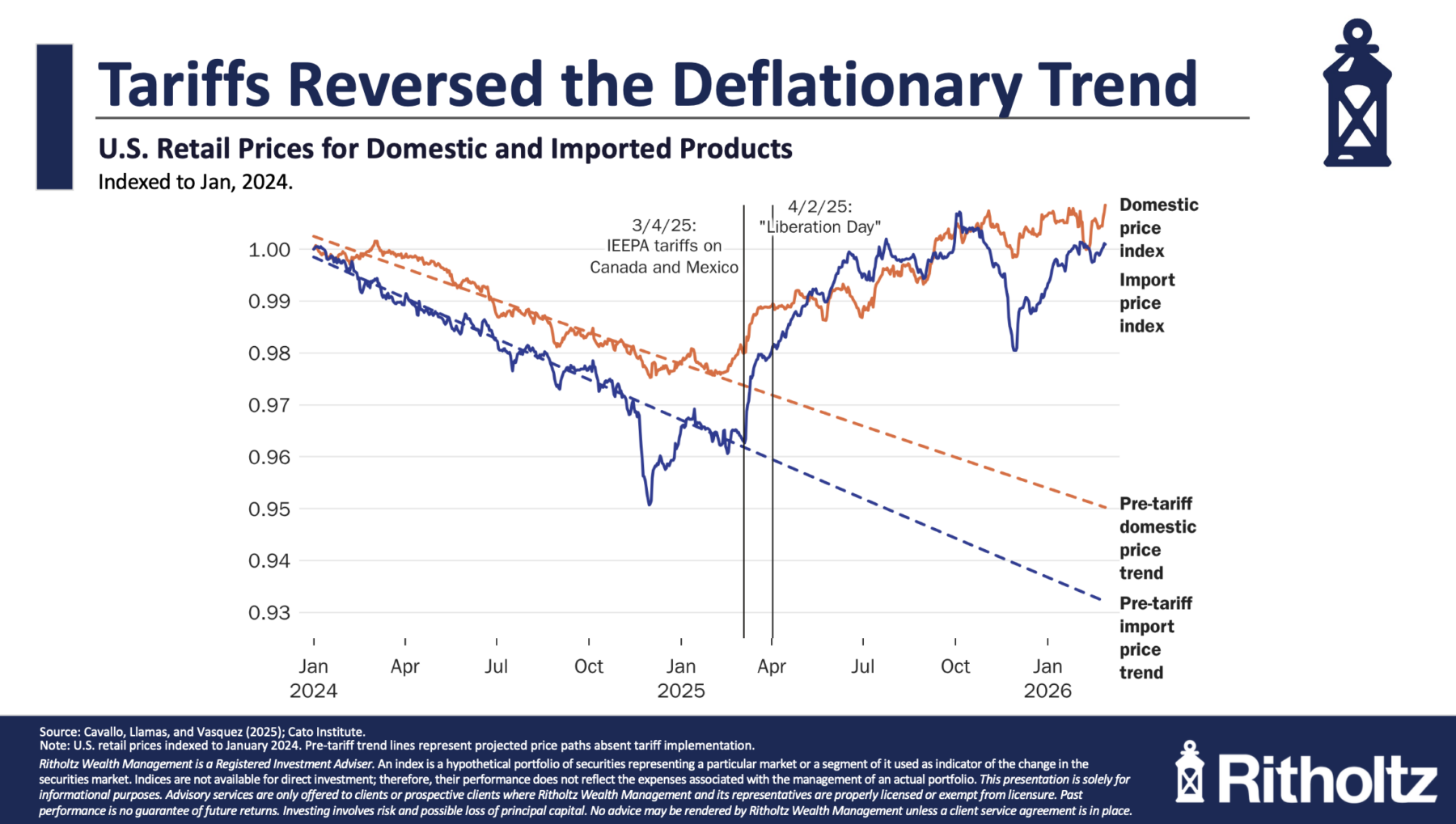
Inflation: As soon as the IEEPA tariffs were announced on Canada and Mexico, prices shot up substantially. After April 2nd, prices continued higher. Federal Reserve Chair Jay Powell specifically said that part of the reason the Fed is on hold is the higher prices consumers are paying because of tariffs.
In fact, about 90% of companies that import or retail goods said they were forced to raise prices because of tariffs. At the same time, about 75% of those companies said their margins were compressed.
Trade deficit: Reached an all-time high. The promised reduction of U.S. imports never happened, and angry allies boycotted U.S. goods.
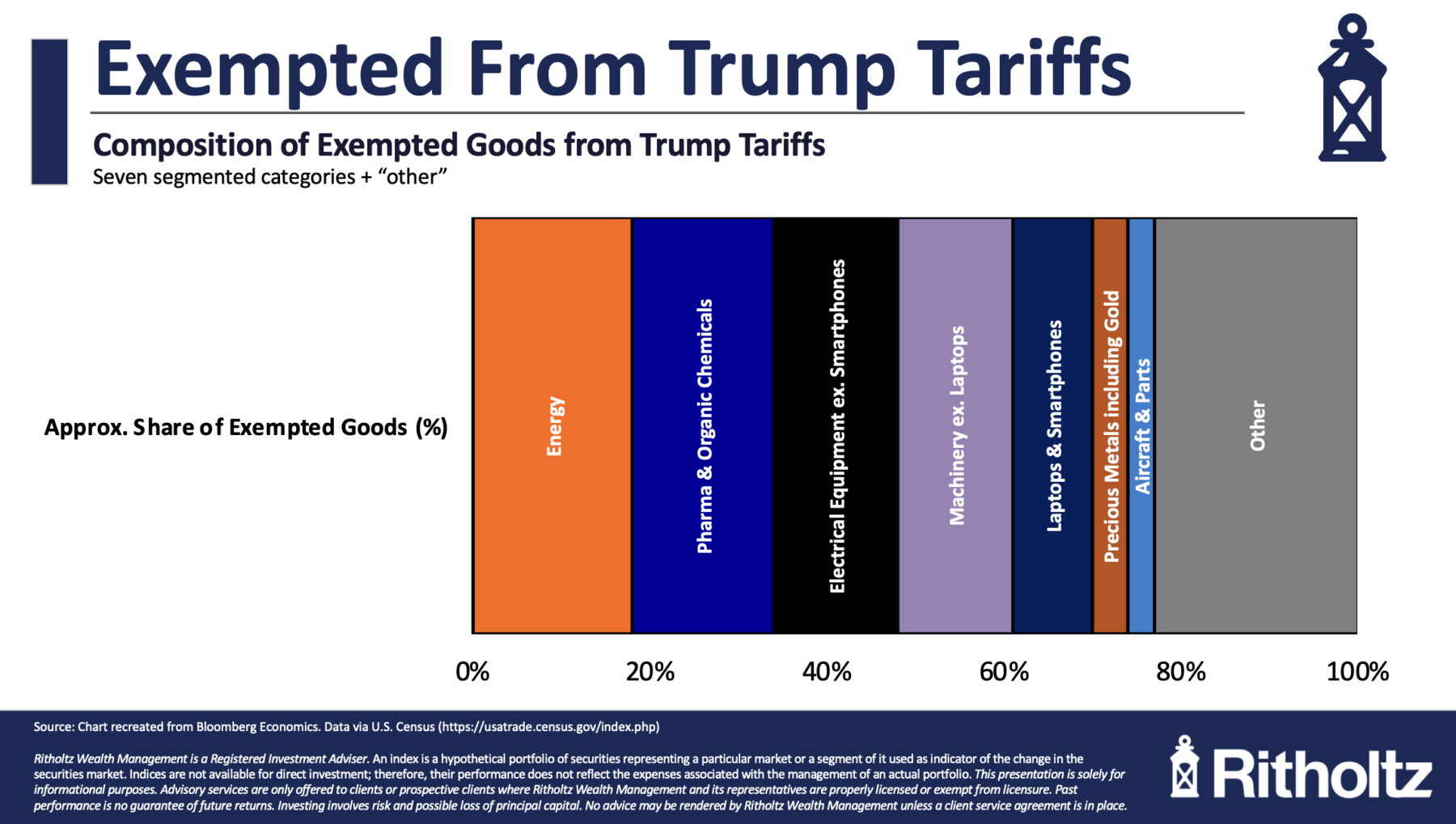
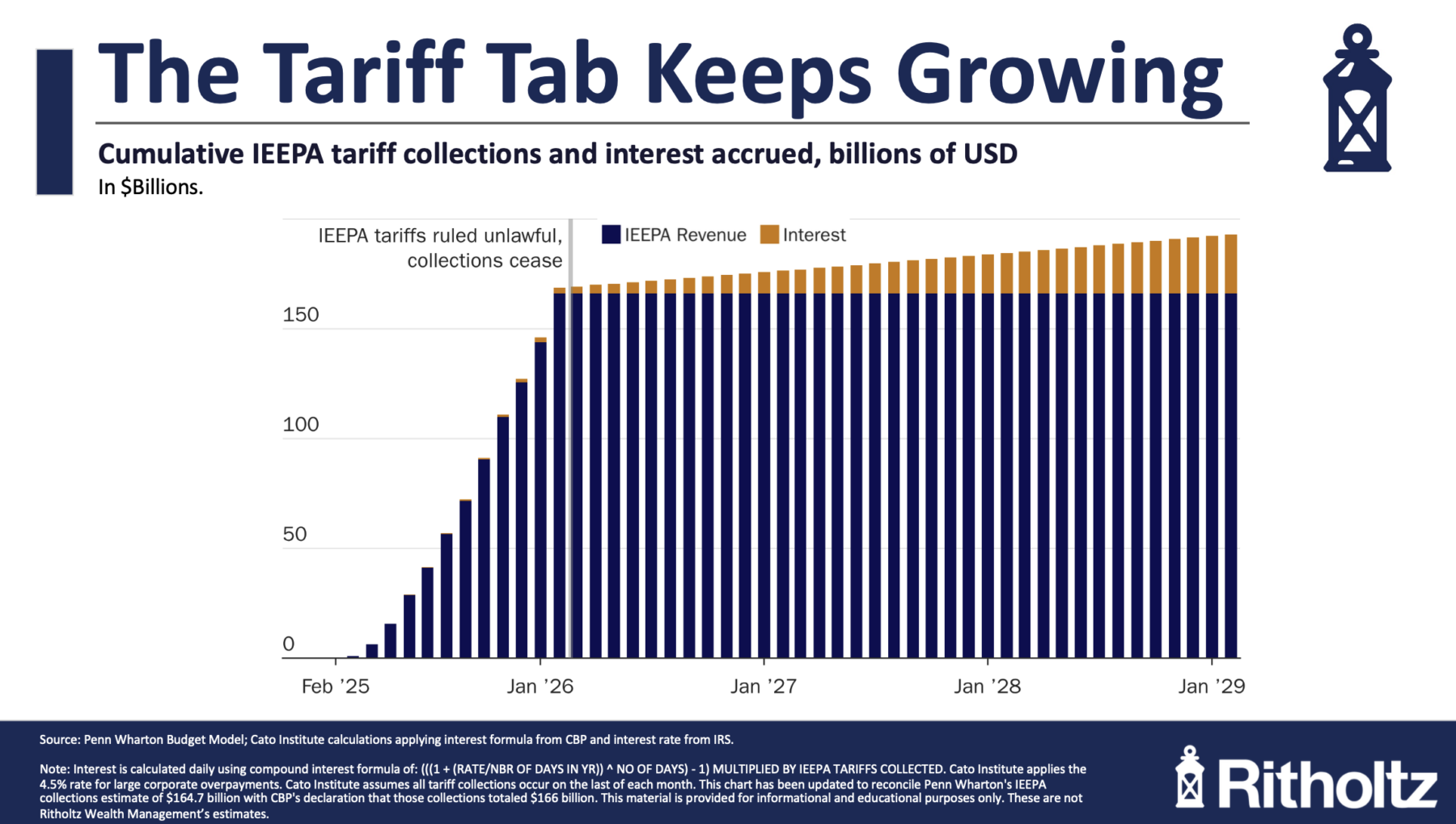
Budget Deficit: The craziest data point of the whole tariff episode: we collected about $156 billion in tariff revenue, but we already owe back roughly $166 billion—and that figure is estimated to grow to close to $200 billion by 2029. How is that possible?
The law is that if you take money that isn’t yours—money you’re not entitled to, either legally or constitutionally — when you eventually lose that litigation, you don’t just have to return that money; you must return that money plus interest.
~~~
~~~
Tariffs were the signature economic policy of Trump’s second term; he not only campaigned on them (the 10% universal tariff floor, 60%+ on Chinese goods, reciprocal tariffs), but also insisted that the revenue source would fund tax cuts and close the deficit, create manufacturing jobs, end the trade deficit, and reduce inflation.
None of the promised benefits occurred over the year when tariffs were in effect. The data shows the exact opposite happened.
This did not come as a surprise to students of economic history. We have studied the Tariff regime in the 1930s, which more or less had the exact same results. They may not have caused the Great Depression, but they certainly made it much worse.
After losing the SCOTUS case, the president lashed out with a different series of tariffs. CATO, the conservative think tank in DC, responded by observing that the New Tariffs Are Just as Illegal as the Old Ones.5 Look for those to be overturned eventually, also.6
I suspect the war in Iran prevented us from fully digesting what it means for the Tariffs to be overturned.7 That will come about eventually…
See also:
Trump Administration to Begin Refunding $166 Billion in Tariffs (NY Times, April 20, 2026)
Businesses start applying for US tariff refunds (Semafor, April 20 2026)
Section 122 Is an Anachronism, Not a License for New Tariffs (CATO, April 14, 2026)
Previously:
Winners of SCOTUS Decision Striking Down Tariffs (February 20, 2026)
IEEPA Tariff Ruling’s Losers (February 23, 2026)
IEEPA Tariffs Update (January 27, 2026)
It’s Tariff Week! * (January 12, 2026)
Tariffs Likely To Be Overturned (November 5, 2025)
Might Tariffs Get “Overturned”? (July 31, 2025)
The Muted Impact of Tariffs on Inflation So Far (July 17, 2025)
Are Tariffs a New US VAT Tax? (March 31, 2025)
MiB: Special Edition: Neal Katyal on Challenging Trump’s Global Tariffs (September 3, 2025)
Neal Katyal on Challenging Trump’s Global Tariffs (September 8, 2025)
Which States Could Suffer the Most From Trade War Tariffs? (September 16, 2019)
__________
1. Whether it was authorized by Congress or not, ~10 weeks later, with three carrier groups, and 100,000 troops, countless missiles, drones and bombs, it is hard to call this anything other than a “War.”
2, Article I, Section 8, Enumerated Powers:
“The Congress shall have Power To lay and collect Taxes, Duties, Imposts and Excises, to pay the Debts and provide for the common Defence and general Welfare of the United States; but all Duties, Imposts and Excises shall be uniform throughout the United States.”
The same issue exists with spending money appropriated by Congress as well.
3. In his first term, with a less pliable House Speaker and a more assertive legislative branch, the administration’s desire to use tariffs as a negotiation tool had been informally rejected by Congress.
4. An embarrassing dissent opinion came from Kavanaugh, joined by Alito and Thomas. (See this for more)
5. SCOTUS has given POTUS the ability to enact unconstitutional actions for about a year at a time. I wish Justice Roberts understood that “Justice delayed is justice denied.”
6. Hopefully, the judicial system won’t take another year to locate and constitution to figure out what it actually says…7. “Why are so obsessed with Tariffs?” a few emailers have asked. I am reminded of similar emails pre-GFC: “Why do you care so much about Derivatives and CDS?
7. That too, requires Congressional approval, which may or may not be forthcoming. You may be detecting a pattern here…
