My mid-week morning train WFH reads:
• What Do You Believe About Investing? Asking questions about what an investor believes, or what their investment philosophy is, can increasingly feel like a mundane tick box exercise quickly covered by some generic, unfalsifiable answers. This really shouldn’t be the case. Investment beliefs are the foundation to any approach and will likely define its success or failure. An underwhelming process supported by some robust beliefs will likely do just fine, whereas flawed beliefs won’t be saved by a good process. The investment beliefs we hold should underpin any decision we make, without them it becomes incredibly difficult to make coherent choices – particularly dur ing spells of market stress. (Behavioural Investment)
• The Trade: The war produced a market mechanism. Someone knew how it worked before the public did. Every announcement moved markets and every extension of a deadline crashed oil. Then escalation would push it back up and the cycle would repeat. This happened seven times in fifty-two days. (The Omission)
• Has the Stock Market Really Been More Volatile Than Usual This Year? For most investors, stock market volatility is something to endure, not act upon. (Morningstar)
• Tim Cook Was Very, Very Good at Making Money: How Cook turned Jobs’s creation into a $4 trillion machine. Whatever you think of him as a product visionary, the operator’s ledger is unassailable. (New York Times)
• Breaking cover: the future of the business book: Authors are experimenting with new technology and formats to better communicate ideas. Business books are being replaced by podcasts, Substacks, and LinkedIn posts. The 300-page hardback is becoming a vanity artifact, not a vehicle for actual ideas. (Financial Times)
• San Diego Now Has So Much Water That It’s Selling It: Once a drought poster child, the California city now generates enough water to rescue parched states like Arizona—and brew beer from recycled sewage (Wall Street Journal)
• You Should Be More Freaked Out by Shingles: The viral infection leaves millions with chronic pain, increased stroke risk, and lifelong nerve damage—yet vaccination rates remain dangerously low. (Wired)
• Scientists identify five ages of the human brain over a lifetime: Four major turning points around ages nine, 32, 66 and 83 create five broad eras of neural wiring over the average human lifespan. (University of Cambridge)
• Ukraine Has Finally Given Up on Trump: Kyiv has started hitting Russian oil-export facilities — a sign it’s no longer waiting on Washington. (The Atlantic)
• The man who saw the future: the legacy of cultural theorist Mark Fisher: Capitalist Realism: Is There No Alternative? was published in 2009 to critical silence—now a film revisits Mark Fisher’s prescient legacy. Touching on everything from late-stage capitalism to Adele, the work of the late writer is proving increasingly influential. Now a documentary on him is looking to live up to his ideals. Touching on everything from late-stage capitalism to Adele, the work of the late writer is proving increasingly influential. Now a documentary on him is looking to live up to his ideals. (The Guardian)
Be sure to check out our Masters in Business this week with Philippe Bouchaud, co‑founder, chair & head of research/chief scientist at Capital Fund Management (CFM). The $20 billion firm specializes in managed futures. He began his career in theoretical physics, was awarded the IBM Young Scientist Prize (1990) and the C.N.R.S. Silver Medal (1996), and has published over 300 scientific papers and several books in physics and finance.
Renewables overtook coal power in 2025 for the first time in over 100 years
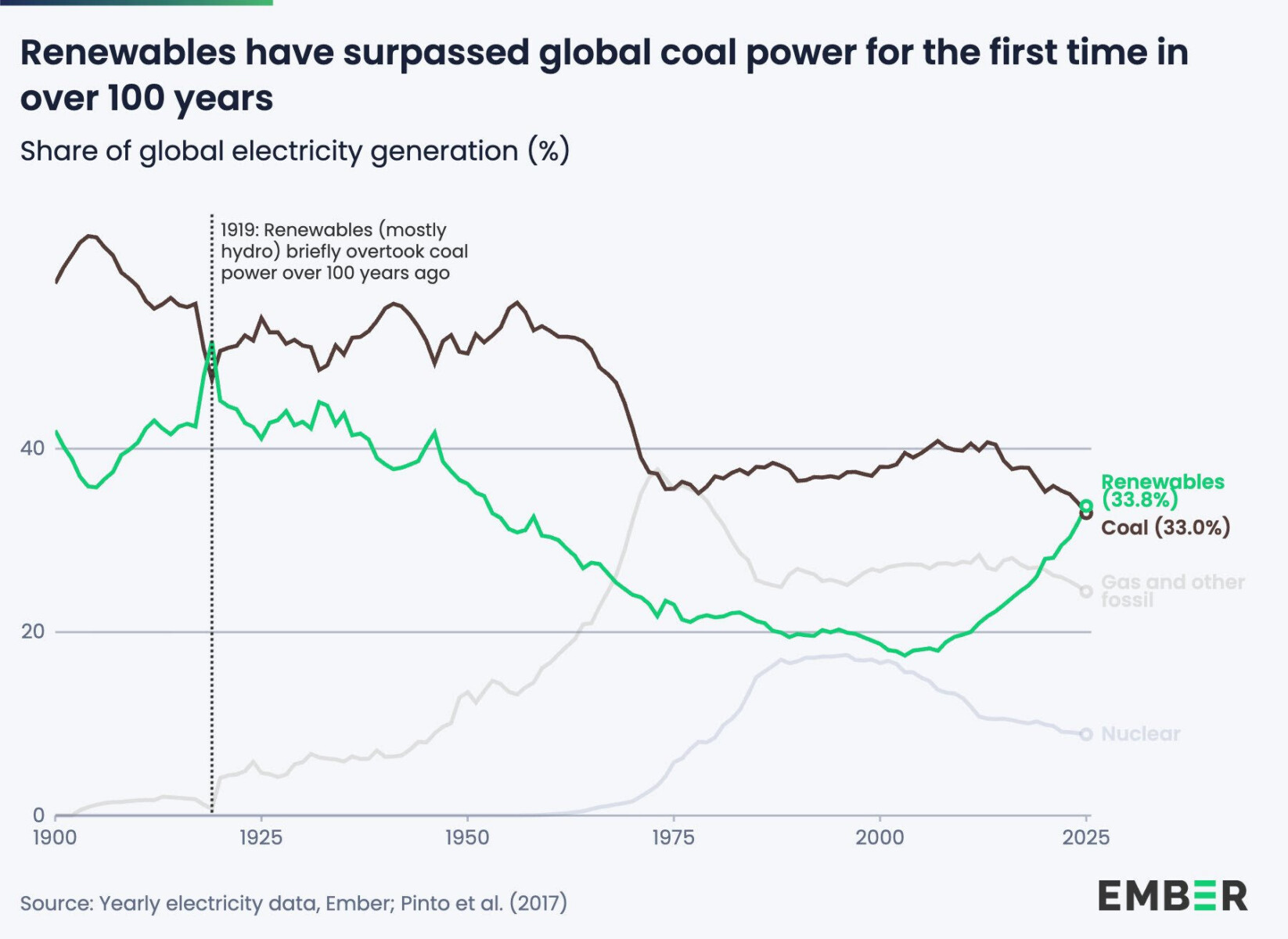
Source: @nicolasfulghum
Sign up for our reads-only mailing list here.
