
The weekend is here! Pour yourself a mug of Danish Blend coffee, grab a seat outside, and get ready for our longer-form weekend reads:
• What 1,000-year-old companies know about resilience: Long-lived companies show that resilience comes not from individual toughness, but from the strength of the systems around us. (Big Think)
• The $10 Billion Startup Training AI to Replace the White-Collar Workforce: Mercor is promising to replicate most professional work. It was also co-founded by twentysomethings who previously never held a real job. (Bloomberg free) see also Mutually Automated Destruction: The Escalating Global A.I. Arms Race: The new arms race is algorithmic, not nuclear — and the guardrails are nowhere in sight. Autonomous weapons are the defining military story of the decade. (New York Times)
• Weight-loss drugs and Mars bars: Novo Nordisk’s comeback bid: The maker of Wegovy and Ozempic wants to learn lessons from consumer groups to crack the US market. After losing share to Lilly, Novo is reinventing itself — partly by partnering with the food companies whose products GLP-1s were supposed to replace. The irony is delicious. (Financial Times)
• A Pillar of the Economics Establishment Admits That It Was Wrong: The World Bank is quietly reversing decades of free-trade orthodoxy and endorsing industrial policy. A big intellectual concession with real consequences for global investing. (The Atlantic)
• The Death of the Basic American Car: The sub-$20k new car is effectively extinct. Automakers chased margins into luxury SUVs and left working Americans with no affordable option — the economic consequences are just starting to ripple out. (New York Times)
• How the Internet Broke Everyone’s Bullshit Detectors: Our cognitive defenses evolved for face-to-face lies, not algorithmic deception at scale. Wired on why even smart people are falling for dumb things in 2026. (Wired)
• How to walk through walls: On hacker mindset. Henrik Karlsson on the hacker mindset and why the most productive people treat obstacles as puzzles rather than barriers. Robert Rodriguez’s El Mariachi is the 0pposterchild for yhis mindset. (Henrik Karlsson)
• When Flock Cameras Appear: Everything You Need to Know About This Surveillance Tech: Flock Safety is setting up cameras and drones across the country. I spoke to cities and privacy advocates fighting back against the AI surveillance, including Flock and others like it. A growing number of cities are quietly ripping out the license-plate-scanning cameras that blanketed their streets. Proof that surveillance overreach eventually meets local pushback. (CNET)
• The Shocking Secrets of Madison Square Garden’s Surveillance Machine: Famously vengeful Knicks owner Jim Dolan has long spied on people at his iconic arenas. He has turned MSG into one of the most aggressive private facial-recognition operations in the country, using it to ban critics and lawyers at the door. Private-sector dystopia that most fans never see coming. (Wired)
• The Guitar Sounds New Again: Every so often a player comes along who makes the guitar sound like something it’s never been. A look at the technology and artistry behind the instrument’s latest reinvention. The grungy, extraterrestrial “Mk.gee tone” is everywhere and depends on a decades-old device. (The Atlantic) see also Mk.gee, an Unlikely Guitar God, Chases the Promise of Pop: At 27, Mk.gee is rethinking how music is made with a confidence that belies his age. He’s not just playing guitar — he’s reimagining what it can be in a pop context. (New York Times)
Be sure to check out our Masters in Business this week with Philippe Bouchaud, co‑founder, chair & head of research/chief scientist at Capital Fund Management (CFM). The $20 billion firm specializes in managed futures. He began his career in theoretical physics, was awarded the IBM Young Scientist Prize (1990) and the C.N.R.S. Silver Medal (1996), and has published over 300 scientific papers and several books in physics and finance.
Historical data show it usually takes about 3 weeks (15 trading days) for markets to bottom after a geopolitical shock, followed by another 3-4 weeks to recover those losses
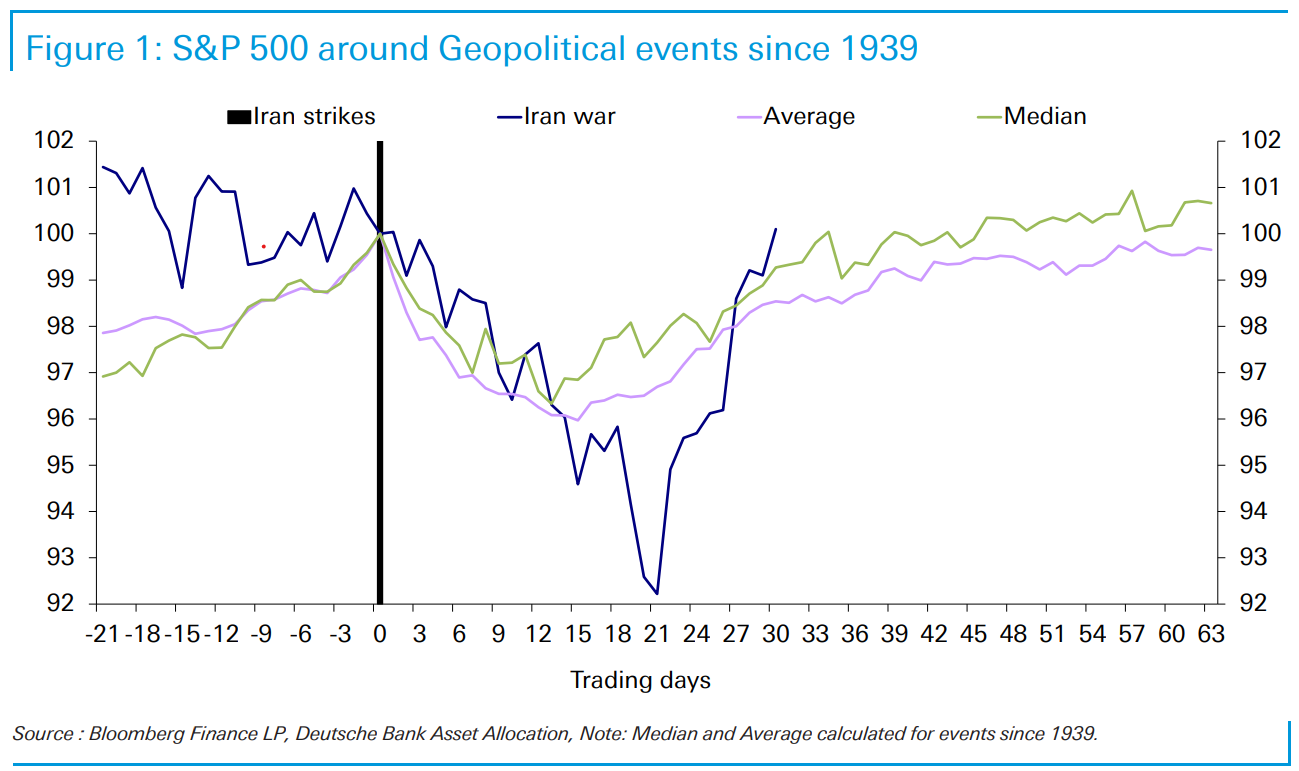
Source: Jim Reid, Deutsche Bank
Sign up for our reads-only mailing list here.
~~~
To learn how these reads are assembled each day, please see this.
