
My end-of-week morning train WFH reads:
• ‘Thoughts and prayers’: The minefield that awaits Kevin Warsh at the Fed: Jerome Powell likely presided over his final rate-setting meeting as chair on Wednesday, ending a turbulent period as central bank chief. (Politico)
• More than half of all Polymarket “long shot” bets on military action pay off: High rate of winning wagers likely to add to concerns that sensitive information can leak on prediction markets. (Financial Times) see also Most Prediction Market Traders Are Losing Money While Bots Rack Up Gains: An analysis of how retail traders fare against algorithmic players on prediction markets. (Bloomberg)
• Bitcoin 2026 opens to empty seats, protests, awkward moments: Bitcoin (BTC) was worth $110,000 at last year’s big Las Vegas conference but by the time Bitcoin 2026 kicked off this week, it had fallen to less than $79,000. Unfortunately, that was just the start of the disappointment. The conference opened yesterday at The Venetian in Las Vegas with two senior US officials addressing a mostly empty main stage. (Protos)
• Two NJ Malls Separated by Just Four Miles — and Very Different Fates: The Livingston Mall is all but dead. The Mall at Short Hills is thriving. It’s a lesson in the cruel economics of consumerism. (Bloomberg)
• The Rise of the High-Range, Less Expensive E.V. Even as the electric vehicle market has slumped, there are more long-range E.V.s under $40,000 than ever before. (New York Times)
• The problem with shopping at Costco? It’s ‘Mad Max’ with shopping carts: The internet calls the condition that afflicts some Costco shoppers “cart tunnel vision,” meaning they lose all situational and spatial awareness. On Reddit, one person coined the term “meanderthals” because “you can’t tell where they’re going and neither can they.” (USA Today)
• A.I. Bots Told Scientists How to Make Biological Weapons: Scientists shared transcripts with The Times in which chatbots described how to assemble deadly pathogens and unleash them in public spaces. Researchers jailbroke frontier models into producing detailed bioweapons synthesis routes. The ‘we’ll fix the guardrails later’ approach gets harder to defend each quarter. (New York Times)
• Two New Drugs Offer Hope for Pancreatic Cancer: Pancreatic cancer is one of the most challenging diseases to treat, and while survival rates have improved since the 1970s, they have plateaued in recent years. But two promising drugs in the pipeline each seem to double survival. (Time)
• In Backlash Against Tech in Schools, Parents Are Winning Rollbacks: From Salt Lake City to New York City, parents are demanding more sway over the digital tools that schools give children. After a decade of evangelism, parents are pulling Chromebooks out of classrooms and putting paper back in. The ed-tech bubble’s slow deflation continues. (New York Times)
• The Slugger Who Only Walks, Strikes Out—or Hits Monster Home Runs: Japan’s Munetaka Murakami has struck out, walked or homered in 61 of his plate appearances, for the Chicago White Sox this season. He has also been one MLB’s most productive hitters. (Wall Street Journal)
Be sure to check out our Masters in Business this weekend with Lawrence Calcano, CEO and Chairman of iCapital, The firm is a fintech platform built to be the OS for alternative investments and complex products for financial advisors, wealth managers, and banks. The firm has over $1.2 trillion in active global assets on platform, across 2,455 funds used by 123,ooo financial professionals.
Almost a quarter of jobs worldwide could be “exposed” to AI
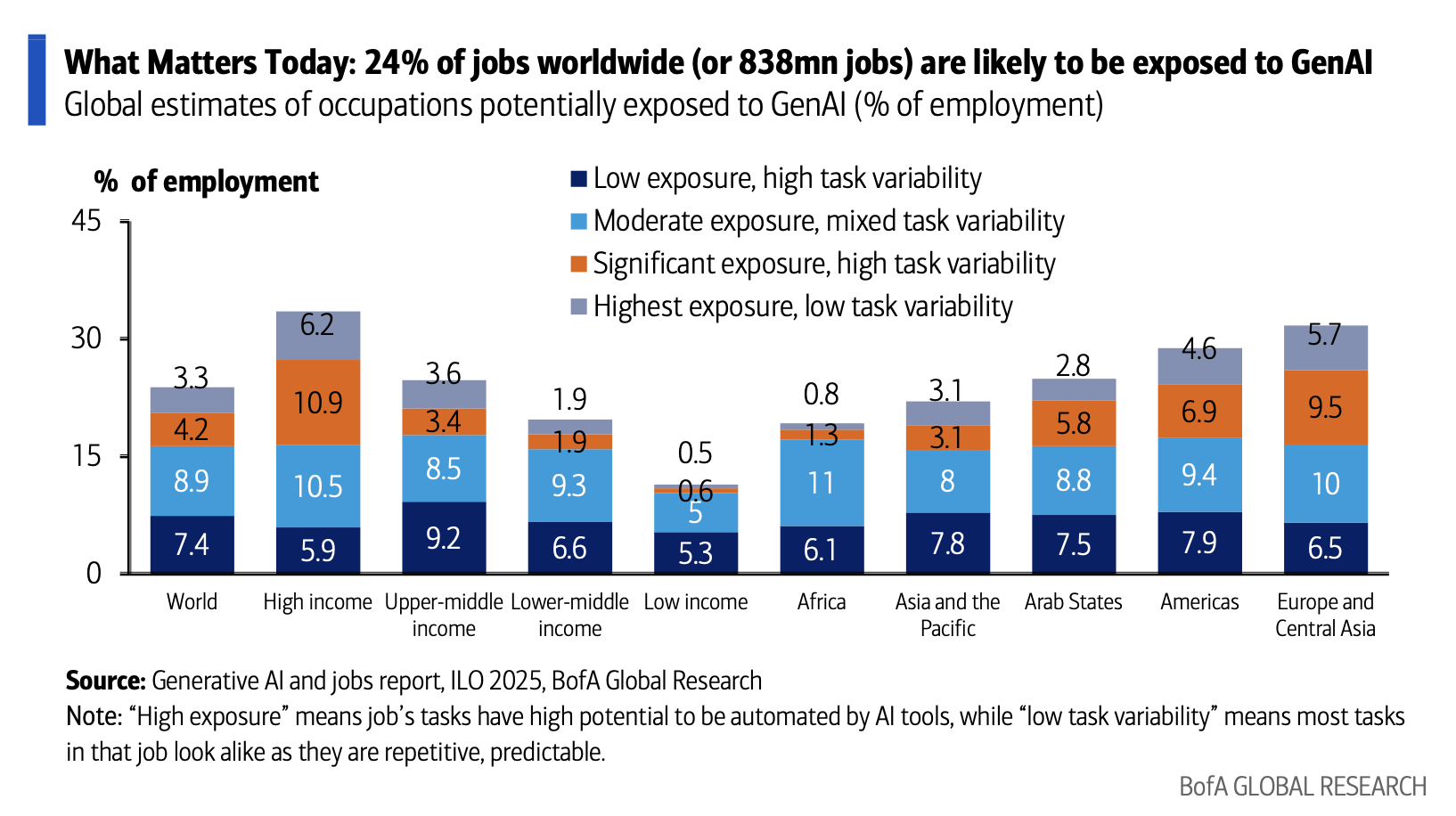
Source: BofA Global Economics Team
Sign up for our reads-only mailing list here.
