
My end-of-week morning train WFH reads:
• Miami got NYC’s billionaires. Will it get their businesses? The fact is, high earners who were formerly geographically tethered to their companies can now work remotely. They are optimising their domicile for taxes, weather, and quality of life. On the slow second leg of the Miami trade. Family-office migration is one thing; firm relocations are a much higher bar. (Financial Times)
• Repeat after me: Higher minimum wages are good for business. Higher minimum wages seem to be beneficial for small businesses. Changes in employee retention rates after minimum wages increased. On average, existing employees were slightly more likely to stay longer at their employer if they got a higher wage. And that reduces costs for businesses in the medium term because every employee who leaves creates costs for hiring and training a new employee. The data has been clear for years; the politics catches up slowly. (Klement On Investing) see also Why the U.S. job market is so hard, especially for recent college graduates: Hiring has slowed even as the economy keeps growing, and millions of workers are navigating a labor market that no longer follows the rules. The entry-level pinch is real, and it’s not just the AI scare. Hiring patterns are getting structurally less forgiving of inexperience. (Washington Post)
• How does Jane Street’s trading haul stack up against the hedge fund elite? We use some proprietary data, an iPhone calculator and a ton of assumptions to find out. The FT compares Jane Street’s revenue against the biggest hedge funds. The market-maker has quietly become a top-tier predator. (Financial Times)
• FICO And Mortgages: Rent History Now Matters More Than Your Plastic: Fannie Mae and Freddie Mac are starting to accept a newer credit score model that includes rental history. Jonathan Miller on the underwriting shift that finally credits renters for paying rent. Long overdue, modestly meaningful, and politically harder than it looks. (Housing Notes)
• The World Has Officially Reached Peak Bagel: From Chicago to Berlin, bakers are reimagining the bagel—and honoring its roots. Here’s where to try the very best. Saturation in the boutique-bagel economy. Either we’ve hit the bagel cycle top or H&H is about to IPO. (Wall Street Journal)
• Jung’s Five Pillars of a Good Life: The great Swiss psychoanalyst left us a surprisingly practical guide to being happier. (The Atlantic)
• America the Undammed: Cara Buckley on the biggest dam removal project in U.S. history. Restoring rivers and salmon runs while quietly retiring infrastructure that was due for replacement anyway. More miles of the country’s rivers were reconnected last year thanks to dam removals than at any other time in history. (New York Times)
• Grievance Poisoning in the First Degree: Nolan on the political economy of resentment — who cultivates it, who profits, and who pays. Is “I am so great” an actual philosophy? (How Things Work)
• Trump actually started to decouple America from China: The “economic divorce” between the two countries is proceeding slowly, but it is proceeding. Noah Smith on the tariff numbers that actually moved the bilateral trade balance. Whatever you think of the policy, the data is now legible. (Noahpinion) see also The Hippocratic Summit: On the choreography of the Trump-Xi meeting. Diplomatic theater as the only product the principals know how to make. (The Atlantic) see also Taiwan’s chips power the global economy. China holds the leverage: Big Tech’s reliance on TSMC makes the China-Taiwan dispute the world’s most dangerous geopolitical flashpoint, says writer Eyck Freymann ahead of this week’s Xi-Trump meeting in Beijing. Reporting on the asymmetric supply-chain choke points that get buried under the TSMC headline number. The vulnerability isn’t where the fabs are — it’s where the gases come from. (Rest of World)
• Broadway Has a Problem: Audiences Won’t Stop Laughing: Theatergoers are howling like they’re at a comedy show—even during serious moments; ‘a shrill horrible laugh.’ (Wall Street Journal)
Be sure to check out our Masters in Business this weekend with Sheila Bair, former Chairperson of FDIC from 2006-11. She helped steer the agency through worst financial crisis since the Great Depression. Her new book is aimed at young adults and teenagers, titled “How Not to Lose a Million Dollars”
Video of the day: The HBO documentary on “Yacht Rock.” Is Bullsh*t
Is Tech Financial Market History is Repeating?
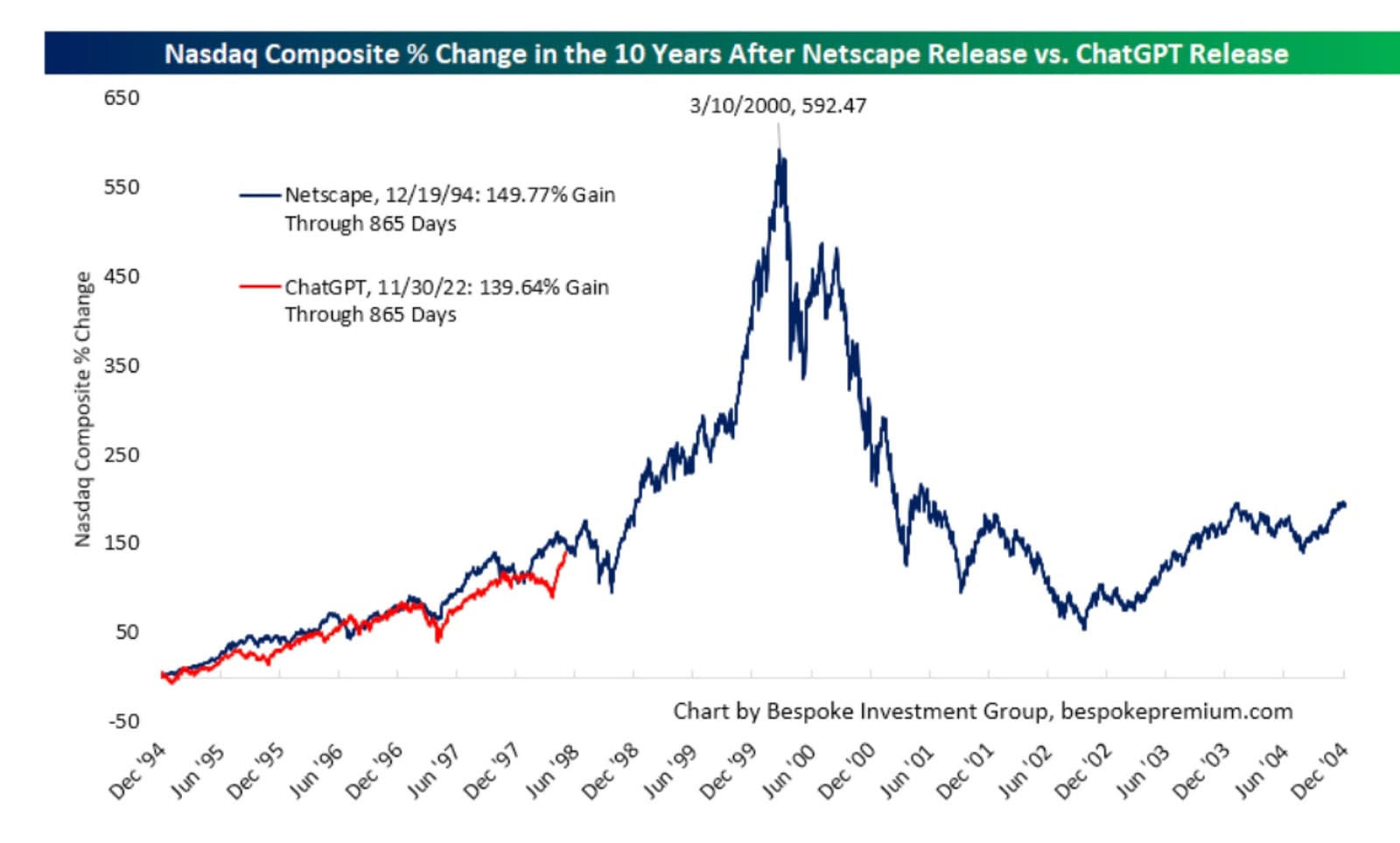
Source: Bespoke via Paul Kedrosky
Sign up for our reads-only mailing list here.
