
My end-of-week morning train WFH reads:
• What’s the Sticker Price of Exorbitant Privilege? A clean Substack walk-through of the dollar’s “exorbitant privilege” — what reserve status earns the US, what it costs, and what would actually shake it. The de-dollarization chatter usually skips the math; this one shows it. That raises the obvious question: what would it take for the US to lose its privilege now? Where is the tipping point? Is it just about the US fiscal and macro fundamentals? Carolin Pflueger (U Chicago) and Pierre Yared (Columbia) don’t think so. (The Two Cents)
• The Dangerous Brew That’s Rattling Bond Markets: The WSJ on the cocktail of fiscal deficits, sticky inflation, and central-bank cross-pressure showing up in the long end. Read with the WaPo piece on what those yields do to households. A mix of debt, inflation and populism has changed the interest rate landscape since 2020. A mix of debt, inflation and populism has changed the interest rate landscape since 2020. (Wall Street Journal) see also Trump’s war is wrecking Trump’s economy: The U.S. war on Iran has upended energy markets and gut-punched the global economy, especially countries in Asia, the Middle East, Africa, and Europe. But the United States is not nearly as immune to the economic fallout from the war as U.S. President Donald Trump seems to think—and it is starting to show. There is a whole slew of economic indicators flashing “check engine” across the dashboard of the U.S. economy that show that the prolonged war in the Middle East is reigniting inflation, fouling supply chains, and dampening hopes of a tax-cut-fueled growth spurt this year. (Washington Post)
• SpaceX not the behemoth everyone thought: The prospectus shows just how much the IPO depends on expectations for future growth and investor servility to Musk — as opposed to the current underlying business. Axios on the leaked SpaceX financials that look a lot less Mag-7 than the secondary market implied. Read alongside the $15B Anthropic deal — both stories are about who is actually paying whom in this AI buildout. (Axios)
• Is Nvidia too big to fail? ‘You’re clearly at the centre of everything’ The global stock market has virtually become “One Big Trade”, according to Goldman Sachs. “AI Is Penetrating Every Corner of Financial Markets”, notes Apollo. Is it really just one big Nvidia trade though? (FT Alphaville free)
• Used EVs Are Now the Most Affordable Cars. Here’s How to Buy a Good One. With rising oil prices and more used EVs coming off leases, the total cost of ownership equation has flipped. The WSJ on the surprising flip: a three-year-old EV with most of its warranty intact is now often the cheapest car on the lot. Useful for anyone with a kid heading to college. Here’s How to Buy a Good One. With rising oil prices and more used EVs coming off leases, the total cost of ownership equation has flipped (Wall Street Journal)
• Why mortgages and car loans are getting more expensive: Yields for some Treasurys hit their highest level since 2007 — and consumers are starting to feel it. A clean WaPo explainer on the long-rate move and what it does to the household balance sheet. Useful for clients who only ever see the headline Fed Funds number. (Washington Post)
• FBI seeks US-wide access to license plate cameras, wants “data in near real time” FBI will pay vendors Flock and Motorola Solutions to help it track and search for vehicles nationwide. Ars on the Bureau quietly asking for a real-time feed from the country’s patchwork of private and municipal plate readers. The surveillance architecture has been built piecemeal for a decade; this is the centralization request. (Ars Technica)
• How the Bird Eye Was Pushed to an Evolutionary Extreme: The bird retina is one of the most energetically expensive tissues in the animal kingdom, yet it doesn’t use the energy advantage of oxygen. New research finally explains how this is possible. (Quanta Magazine)
• Japan is gripped by mass allergies. A 1950s project is to blame: BBC Future on the postwar Japanese reforestation program — millions of cedars planted for timber, no follow-up plan, and now nationwide hay fever as the karmic dividend. A small parable on policy half-lives. A decision made 70 years ago to reforest vast swathes of Japan with just two kinds of tree has come back to haunt the country. (BBC)
• Retrospective — The Entire Series of MB&F Legacy Machine Watches: Monochrome runs through every Legacy Machine MB&F has built since 2011. A satisfying tour of one of the few independent watchmakers doing genuinely new things rather than re-issuing the 1960s catalogue. (Monochrome Watches)
Video of the day: The Album That Rewired Modern Pop: Believe (1998)
Be sure to check out our Masters in Business interview this weekend with Vimal Kapur, CEO and Chairman of DJIA component Honeywell International. The firm is in the midst of dividing into three companies: Honeywell Automation, Honeywell Aerospace, and Solstice Advanced Materials. The firm has fully integrated AI as the intelligence layer in all of its automation processes and products.
America’s Small-Business Boom Comes Without New Jobs
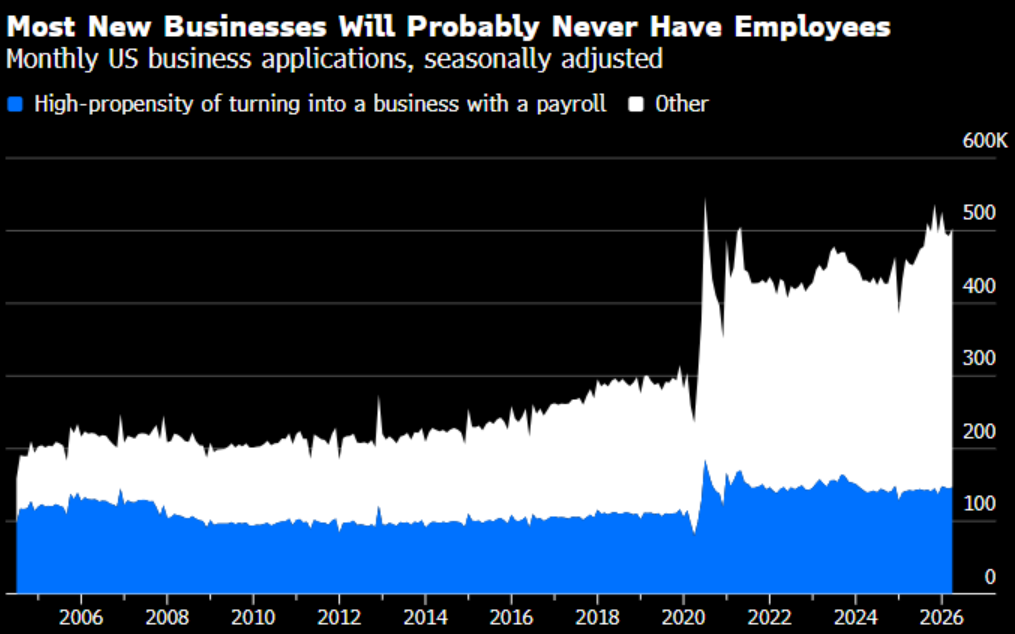
Source: Bloomberg
Sign up for our reads-only mailing list here.
