
My end-of-week morning reads:
• One Million New-Car Buyers Are Gone and They’re Not Coming Back Soon: WSJ on the demand hole left by affordability — a million households permanently priced out of the new-car market. The structural part of the auto cycle that doesn’t show up in monthly SAAR. High gas prices, rising interest rates and stubborn inflation are keeping buyers at home and cars on the lots (Wall Street Journal)
• Henry Ford Upped Wages So Workers Became Consumers. The Rest Is History.: Barron’s on the actual economic logic behind Ford’s $5 day — turnover costs, not altruism — and how the story keeps getting retold in service of whatever today’s argument needs. Useful corrective. The decision helped create America as we know it today. (Barron’s) see also Why Costco pays $30/hr and Target doesn’t: A clean Substack post on the operating math behind Costco’s wage premium — turnover savings, throughput, member economics. Standard reading for anyone who keeps citing the model without understanding it. (Justin Kuiper)
• A Stock Certificate From 1941 Taught Me More About AI Than Anyone from OpenAI: A Substack riff using a 1941 stock cert as a way to think about durable franchises vs. narrative compression. Good Sunday reading for anyone trying to value the current cohort. (Apers Insights)
• The Midwestern Exodus Is Finally Ending: WSJ on Akron and the broader Rust Belt finally adding population again — remote work, housing arbitrage, returnees. The story underneath the next decade of regional politics. Longtime migration away from parts of Rust Belt starts to reverse; housing affordability is pull for metro areas like Akron, Ohio. (Wall Street Journal)
• The best analysts chew gum: A short Substack on the silly little focus rituals that actually move research productivity. Gum, walking, standing desks — the unsexy operational stuff that compounds. (OptimistiCallie)
• Is Peter Thiel the target of Pope Leo’s Gandalf quote? An investigation: Ars Technica doing exegesis on a single line in Magnifica Humanitas and asking whether the Vatican is now subtweeting tech-right billionaires. Probably yes. (Ars Technica)
• There’s a Simple Reason Why I’m Sure A.I. Won’t Achieve Consciousness: The individual pieces create a kind of illusion. (Slate)
• A $300-a-Month Gym Is Gen Z’s Social Club: Younger consumers in major cities are discovering more chances to find friends and romance in reformer classes, run clubs and spa-heavy gyms. (Bloomberg) see also Something Strange Is Happening at College Graduations Across the Country: Slate on the AI-titan commencement-speaker circuit getting booed off stages this season — and what the senior class’s mood signals about the labor market they’re walking into. (Slate)
• These Japanese Oyster Farmers Know How to Throw a Good Party, and Everyone Is Invited: There’s a phrase in Japanese, “waku waku,” that expresses a bubbling and happy excitement for something to come. At the train stations on the Itoshima Peninsula, this phrase seems to jump from the mouths of day trippers young and old. There’s a lot of anticipation for the day parties that they will join. It’s a short jog from the city of Fukuoka to visit the kakigoya. Buying directly from the farmers means that the oysters are fresh and the prices are low. A NYT travel piece on the Hiroshima oyster harvest festival. Genial, food-photo-heavy, exactly the palate cleanser this list needs. (New York Times)
• A sleep-time ‘sweet spot’ is linked to healthy aging, study finds: Turns out 6.4 to 7.8 hours of sleep a night might be ideal. Here are some tips on how to get the “just right” amount. WaPo on a new study putting the longevity sleep window at seven hours — not five, not nine. File under “things to actually do” rather than “things to read about doing.”(Washington Post)
Video of the day: How Pulp Fiction Was Filmed | Everything you didn’t know about Quentin Tarantino’s movie
Be sure to check out our special Masters in Business this week, Remembering Jonathan Clements with Bill Bernstein and Jason Zweig. The two recall Clements’ impact on the investor community; they discuss his posthumous book, “Money and Me.”
More ETFs Than Stocks
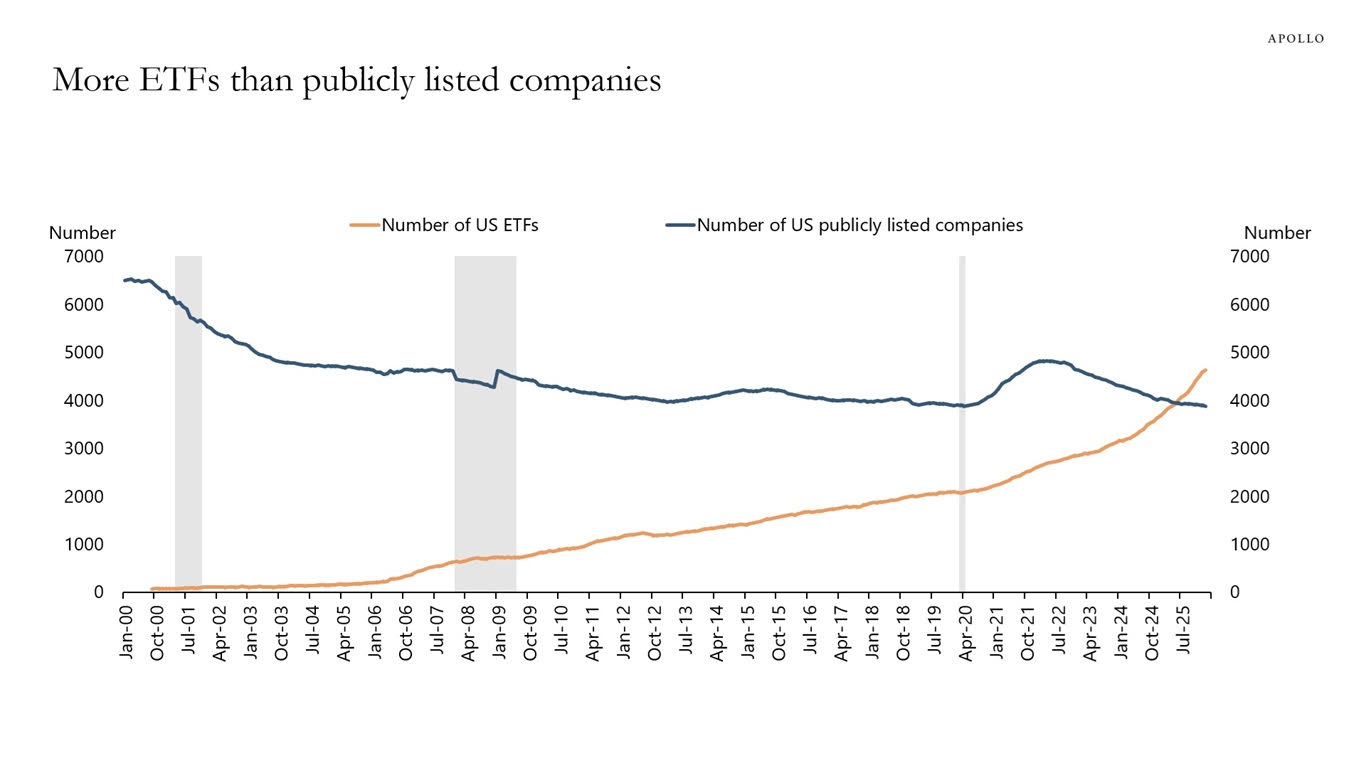
Source: Apollo
Sign up for our reads-only mailing list here.
