
Avert your eyes! My Sunday morning look at incompetency, corruption and policy failures:
• Why Almost Everyone Loses—Except a Few Sharks—on Prediction Markets: A WSJ analysis shows a small number of accounts on Polymarket and Kalshi—often pros using data-driven algorithmic trading—take home most of the winnings. Polymarket and Kalshi run on the same dynamic as every other market — informed pros take retail money. The only surprise is how many retail bettors keep showing up. (Wall Street Journal)
• What $25 Billion Spent on the War in Iran Really Means: $25 billion is similar to: The annual budget of NASA. Spending on military aid to Israel after Oct. 7. Spending by U.S.A.I.D. before it was disbanded. The cost to expand Obamacare subsidies for one year. These are all comparisons to other aspects of the U.S. federal budget. An Upshot interactive translating the bill into the things we said we couldn’t afford. Opportunity-cost journalism at its best. (New York Times) see also The real cost of the Iran War: $72 billion for the first 60 days: Popular Information crunches the numbers. The official accounting is at least $47 billion too low. (Popular Information)
• This Summer, the American Water Crisis Becomes Real: From the West to the Mississippi, the water-infrastructure stories are converging. The summer of 2026 may be the year the abstract becomes the ordinary. Concerns over water access are poised to consume summer in the US, as crises in Corpus Christi and across the Colorado River threaten to boil over. (Wired)
• Meet Clout-as-a-Service: Where weaponised FOMO meets digital gaslighting: What happens when “experiences” evolve from physical presence to virtual tags. On the influencer-rental market and the manufactured-virality economy. The internet is mostly performance now; the prices are finally legible. (Girl Online)
• In Wine Country, Sales Are Down and Fraud Is Rampant: Ian Frisch on a luxury market in retreat, and the fakes that always flourish when the real stuff stops moving. Fraud loves a soft tape. The industry’s murky supply chain has long attracted scammers and con artists. In the words of one expert, “Wine and fraud go hand in hand.” (DealBook)
• The Convenient Narrative Letting Insurers Off the Hook: Blaming hospitals isn’t wrong. But it’s incomplete—and it’s exactly the story insurers want told. On the framing tricks that keep health insurers blameless in the public discourse. Worth reading before your next employer-benefits meeting. Blaming hospitals isn’t wrong. But it’s incomplete—and it’s exactly the story insurers want told. (Health Care Un-Covered)
• Babies Are Bleeding to Death as Parents Reject a Vitamin Shot Given at Birth: An Essential Shot, Vitamin K, which help the blood to clot, are one of three key interventions for newborns, along with an antibiotic eye ointment and the hepatitis B vaccine. The government doesn’t track vitamin K rejections, but hospitals have seen a rise in parents opting out of the shots for their newborns, often driven by unfounded fears. Hundreds of children die each year from spontaneous bleeding in the brain, a common result of vitamin K deficiency, suggesting that many related deaths go unreported. The vitamin-K refusal trend produces preventable infant deaths. (ProPublica)
• The media blackout of Jared Kushner’s historic, ongoing corruption scandal: As Trump’s son-in-law returns to Pakistan for more talks with Iran, major news outlets are largely ignoring an egregious conflict of interest. Judd Legum documents how the press has failed to cover Kushner’s ongoing foreign-payments scandal. (Popular Information) see also How the Trump family’s business deals could open the door for future presidents to profit from office: The problem of conflicts of interest goes back a decade to when Trump first ran for office, but some government ethics experts and historians argue it’s more pressing than ever as conflicts pile up in his second term that they consider unprecedented, blatant and dangerous to democracy. The AP’s Bernard Condon on the precedent being set in real time. The norm erosion outlasts the administration that caused it. (PBS)
• The Corporate Thriller Lied to Us: On the genre’s long arc from ‘corporations are scary’ to ‘corporations are simply the world.’ A useful frame for what we expect storytelling to do. Criterion Channel is hosting a retrospective on Hollywood’s “corporate thrillers” from the 1980s through the early 2000s. If anything, their message about the capitalist rot in America’s institutions looks far too tame for how the last couple of decades turned out. (Jacobin)
• Adam Silver Goes to War: The mild-mannered NBA commissioner has overseen a time of peace and prosperity for his league. Until now. The NBA commissioner is taking on tanking, gambling controversies, and a bloated playoff format. Now, with the 2026 playoffs under way—the capstone of the most turbulent regular season in modern NBA history—Silver for the first time faces real trouble. The quality of the product has diminished. Narratives surrounding the league are prevailingly negative. Things once taken for granted—commercial satisfaction, cultural prestige, national relevance—no longer seem guaranteed. Peacetime is a thing of the past; for the foreseeable future, the commissioner will be at war—with fans, with media critics, with players and coaches, with the game itself. I came to Nashville wanting to know: Does Adam Silver have the stomach for this fight? Tough room. (The Atlantic)
Video of the day: Stronger Than Steel. Lighter Than Plastic. Why Aren’t We Using It?
Be sure to check out our Master’s in Business interview this weekend with Howard Lindzon, known as “The Larry David of Finance.” He is General Partner at the seed fund, Social Leverage, he was one of the first seed investors in Robinhood, which IPOd at $30B in 2021, eToro, Manscaped, and Beehiiv. Previously, he founded Wallstrip, a daily online video show acquired by CBS (2007). He also co-founded Stocktwits, which pioneered the “cashtag.” Recognized by Institutional Investor as a “Super Angel;” his podcast is Panic with Friends.
Trump used the presidency to promote family businesses 110 times in 16 months
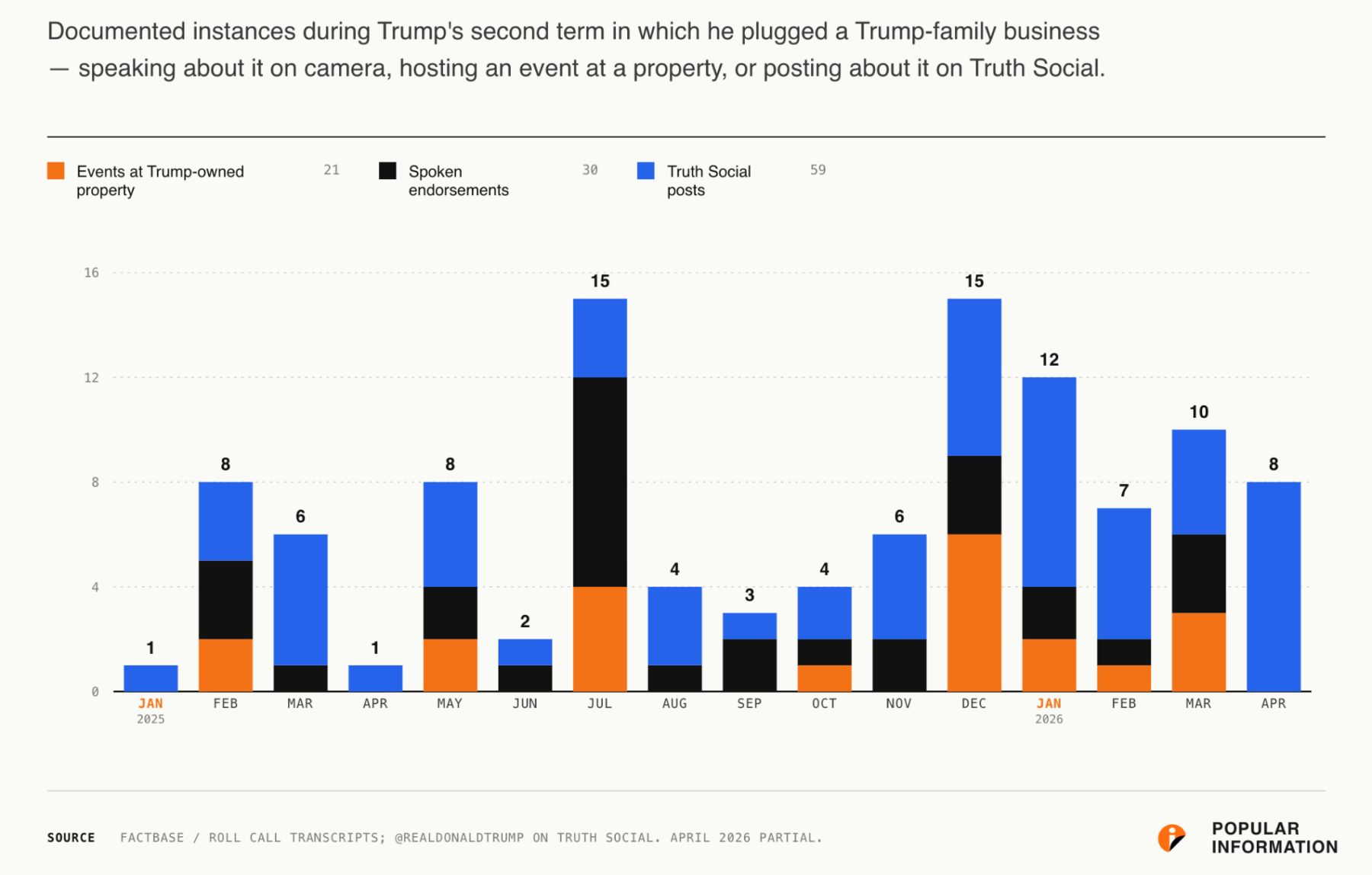
Source: Popular Information
Sign up for our reads-only mailing list here.
~~~
To learn how these reads are assembled each day, please see this.
