The weekend is here! Pour yourself a mug of Danish Blend coffee, grab a seat outside, and get ready for our longer-form weekend reads:
• Squillions: Where is all that cash, who’s using it, and for what? The answer proposed by Bullough is bizarre: nobody knows. ‘The number of banknotes is increasing, and the question of why the value of banknotes has increased so markedly remains unanswered.’ Central bankers don’t have much interest in the question. It is immensely valuable for any country to be able to produce currency that’s in worldwide demand: for the cost of printing a few bits of paper, a developed economy receives billions of dollars of value in pounds, dollars or euros. John Lanchester in the LRB on the new top-of-the-curve wealth — how big the numbers actually are, where the money goes, and what it does to politics and culture. Lanchester on money is always worth your evening. (London Review of Books)
• Sweeping the strait: the companies gearing up to clear the Gulf of mines: Defence companies and marine contractors are preparing to deploy uncrewed mine-clearing systems in and around the Strait of Hormuz, as efforts to reopen the vital shipping lane draw attention to a new generation of naval drones. A new generation of uncrewed vessels could help restore traffic in vital shipping route. (FTAlphaville free)
• JPMorgan Fights Over Millions of Comic Books Locked in a Mississippi Warehouse: They’re among thousands of characters represented in roughly 8.2 million comics, graphic novels, figurines and table-top games held for months in a 600,000-square-foot warehouse formerly operated by a major comics distributor that went bankrupt in 2025. Publishers have formed alliances to free the items but at least one powerful adversary is impeding them: JPMorgan Chase & Co. (Bloomberg free)
• The Empire of Wuxi, China’s Biotech Giant: China wants to be the world’s biotech superpower. But to understand how it got here, it’s best to start with its crown jewel: the WuXi companies. The WuXi companies are the dominant biotech services consortium in China and have become the lightning rod of U.S. political wrath, most notably as an early target of the BIOSECURE Act. ChinaTalk on how WuXi AppTec quietly became the back-end of half the world’s drug pipeline, and what BIOSECURE would actually do to US pharma if it ever takes effect. (China Talk)
• How Digitization Has Created a Golden Age of Music, Movies, Books, and Television: Digitization is disrupting a number of copyright-protected media industries, including books, music, radio, television, and movies. Once information is transformed into digital form, it can be copied and distributed at near-zero marginal costs. This change has facilitated piracy in some industries, which in turn has made it difficult for commercial sellers to continue generating the same levels of revenue for bringing products to market in the traditional ways. A JEP review arguing that, all the bellyaching about streaming aside, we are objectively living through a creative supply boom. A useful corrective to the “everything is mid” narrative. (American Economic Association)
• Google Search as you know it is over: Instead of returning a simple list of links, Google Search will drop users into AI-powered interactive experiences at times. Google is also introducing tools that can dispatch “information agents” to gather information on a user’s behalf, along with tools that let users build personalized mini apps tailored to their needs. TechCrunch on the AI-overview pivot quietly cratering publisher referral traffic. The business model underneath most of the open web is being rewritten in real time. (TechCrunch)
• The Vaginal Wellness Boom Is Here: The NYT on the suddenly enormous “feminine wellness” product category and the gap between the marketing and the science. Mostly a story about how easy it is to medicalize a normal body and charge $40 for it. Gaps in women’s health knowledge and care have created a business opportunity. What could go wrong? (New York Times)
• 34 Hours in New York During Art Week: A timestamped trip to New York during May’s wild art week – 4 art fairs, 12 galleries and a few good meals. A breezy dispatch from Frieze and the surrounding fairs. Useful both as an Art Week field report and as a snapshot of where the buying mood is right now. (First Edition)
• Audrey Hepburn’s Sons Recount Her Remarkably Resilient Life: Sean Hepburn Ferrer and brother Luca Dotti have feuded in the past over multiple issues related to their mother—but the books they’ve written about her agree that Hepburn was one of a kind. Vanity Fair on two new Hepburn biographies and the wartime childhood that gets glossed over in the icon version of the story. Surprisingly moving. Sean Hepburn Ferrer and brother Luca Dotti have feuded in the past over multiple issues related to their mother—but the books they’ve written about her agree that Hepburn was one of a kind. (Vanity Fair)
• Stephen Colbert Ends ‘Late Show’ With Joyous Paul McCartney ‘Hello Goodbye’ Performance, as Ex-Beatle Turns Lights Out at Ed Sullivan Theater: Paul McCartney, a surprise guest on the final episode of “The Late Show With Stephen Colbert,” provided a poignant capper to the series by being given the ceremonial honor of turning out the lights in the Ed Sullivan Theater, a location with which he has plenty of history. The final number had McCartney and Colbert singing the Beatles‘ classic “Hello Goodbye,” accompanied by Elvis Costello, former band leader Jon Batiste and current band leader Louis Cato, eventually joined on stage by a parade of staffers dancing through and around the stag in a line, as the house band finally gave the ’60s tune a New Orleans-style coda. Variety on the Macca-closes-the-Ed-Sullivan-Theater stunt that ended the show. The Beatles bookend was on the nose, but earned. (Variety) see also Stephen Colbert’s Last Show: Laughing Well Is the Best Revenge: The “Late Show” cancellation was a disappointment. But a surreally lovely final episode turned it into a cancellebration. The NYT’s formal review of the finale. The show held its tone to the end, which in 2026 broadcast comedy is itself a small victory. (New York Times) see also The Goodbye Stephen Colbert Wanted to Say: The Atlantic on Colbert’s finale — the segments he picked, the guests he chose, and what the whole valedictory says about what late night was supposed to be. A measured send-off that lands. The late-night host ended his talk show the way he started it—with empathy, and an eye for entertainment. (The Atlantic)
Video of the day: How One of the Universe’s Biggest Secrets Was Discovered
Be sure to check out our Masters in Business interview this weekend with Vimal Kapur, CEO and Chairman of DJIA component Honeywell International. The firm is in the midst of dividing into three companies: Honeywell Automation, Honeywell Aerospace, and Solstice Advanced Materials. The firm has fully integrated AI as the intelligence layer in all of its automation processes and products.
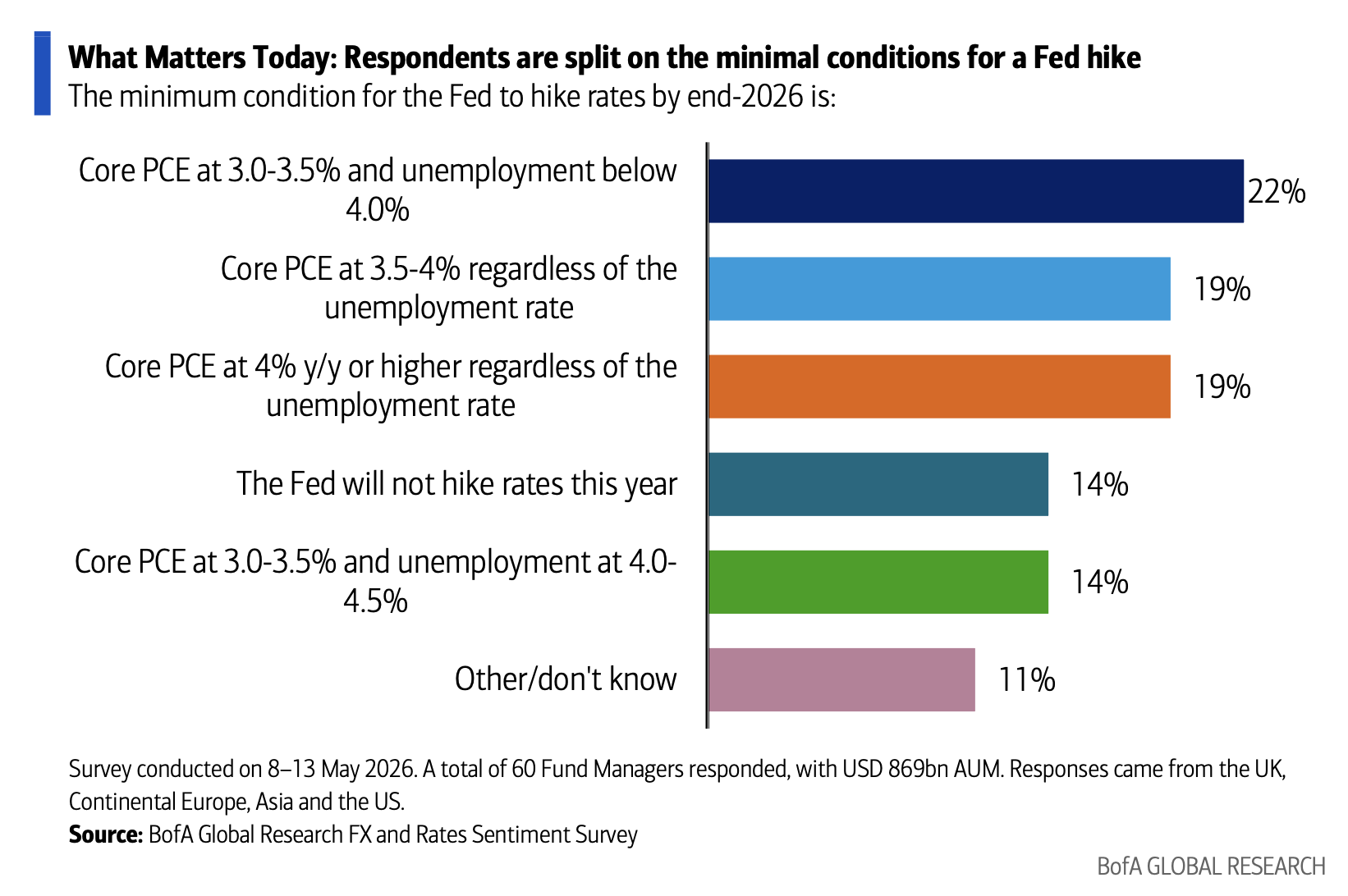
Investors see a low bar for Fed hikes
Source: BofA Global Research
Sign up for our reads-only mailing list here.
~~~
To learn how these reads are assembled each day, please see this.
