
The weekend is here! Pour yourself a mug of Danish Blend coffee, grab a seat outside, and get ready for our longer-form weekend reads:
• SpaceX: The AI IPO: SpaceX’s revenue in 2025 was $18.7 billion, which works out to a potential price-to-sales (P/S) ratio of 93x. The highly-anticipated Form S-1 filing document arrives as SpaceX officially unveils financials for the space rocket startup founded by Elon Musk in 2002. Trung Phan’s notes reframes the SpaceX IPO as an AI infrastructure play more than a launch business. The valuation barely makes sense, even if you accept the reframe. (SatPost by Trung Phan)
• Ukraine is turning the tables: The FT on the cumulative weight of Ukrainian deep strikes, drone economics, and Russian logistics rot. The war isn’t over but the trajectory just shifted. (Financial Times) see also All non-drone militaries are obsolete: Noah Smith on the Ukraine lesson: a $300 drone burning a $3M tank is not an edge case, it is the new mean. Procurement budgets pointing the wrong direction. All warfare is drone warfare now. (Noahpinion)
• The Average Guys Outsmarting Wall Street on Prediction Markets: How prediction-market ‘sharps’ have made millions wagering on everything from war to Rotten Tomatoes. A NYT Magazine feature on the regular-Joe Polymarket bettors who keep posting risk-adjusted returns that would have any quant shop’s head spinning. The story everyone wants to be true, told carefully. (NYT Magazine)
• Encyclical Letter Magnifica Humanitas of his Holiness Pope Leo’s on AI: In his letter, the first American Pope says Humanity faces a pivotal choice: either to construct a new Tower of Babel or to build the city in which God and humanity dwell together (Vatican)
• How Barnes & Noble Became Private Equity’s Most Radical Retail Experiment: A Bloomberg feature on the surprise comeback of Barnes & Noble under Elliott — local manager autonomy, smaller stores, books actually displayed face-out. The rare PE story with a happy ending. (Businessweek)
• Being creative requires taking risks: Henrik Karlsson on why nothing actually creative comes out of the optimization mindset. Short, dense, worth saving and re-reading. (Escaping Flatland) see also Hacks vs. Artists: Nick Maggiulli on the difference between churn-it-out hacks and the people who actually care — applied to investing, writing, and most of what we do for money. A good Monday read. (Of Dollars and Data)
• The Strange Melancholy of Slaying Monsters: The MIT Reader on the long literary history of heroes who feel hollow after the kill — Beowulf to The Last of Us. Better than the cover sells. From “Shadow of the Colossus” to “Undertale,” video games have turned one of their oldest rituals into an ethical dilemma. (The MIT Press Reader)
• ‘The devil’s child’: the rise and fall of the only female yakuza: A Guardian long-read on Mako Nishimura — the only woman ever to make it inside Japan’s yakuza hierarchy — and the wreckage on the way in and out. She fought her way into the Japanese underworld, but drug addiction and the slow demise of organised crime gangs almost destroyed her. Reads like a novel and is somehow true. (The Guardian)
• How Bill Lawrence Became TV’s Most Prolific Showrunner: The creator of “Rooster,” “Scrubs” and “Shrinking” — not to mention “Ted Lasso” and “Bad Monkey” — did not expect to have a career renaissance in his late 50s. The Wrap on Bill Lawrence’s Scrubs-to-Shrinking arc — the showrunner economics of building a stable of writers, recycling cast, and quietly running half the comedy slate. (The Wrap)
Video of the day: SNL Documentary By James Franco
Be sure to check out our special Masters in Business this week, Remembering Jonathan Clements with Bill Bernstein and Jason Zweig. The two recall Clements’ impact on the investor community; they discuss his posthumous book, “Money and Me.”
Is AI Profitable Yet? (No.)
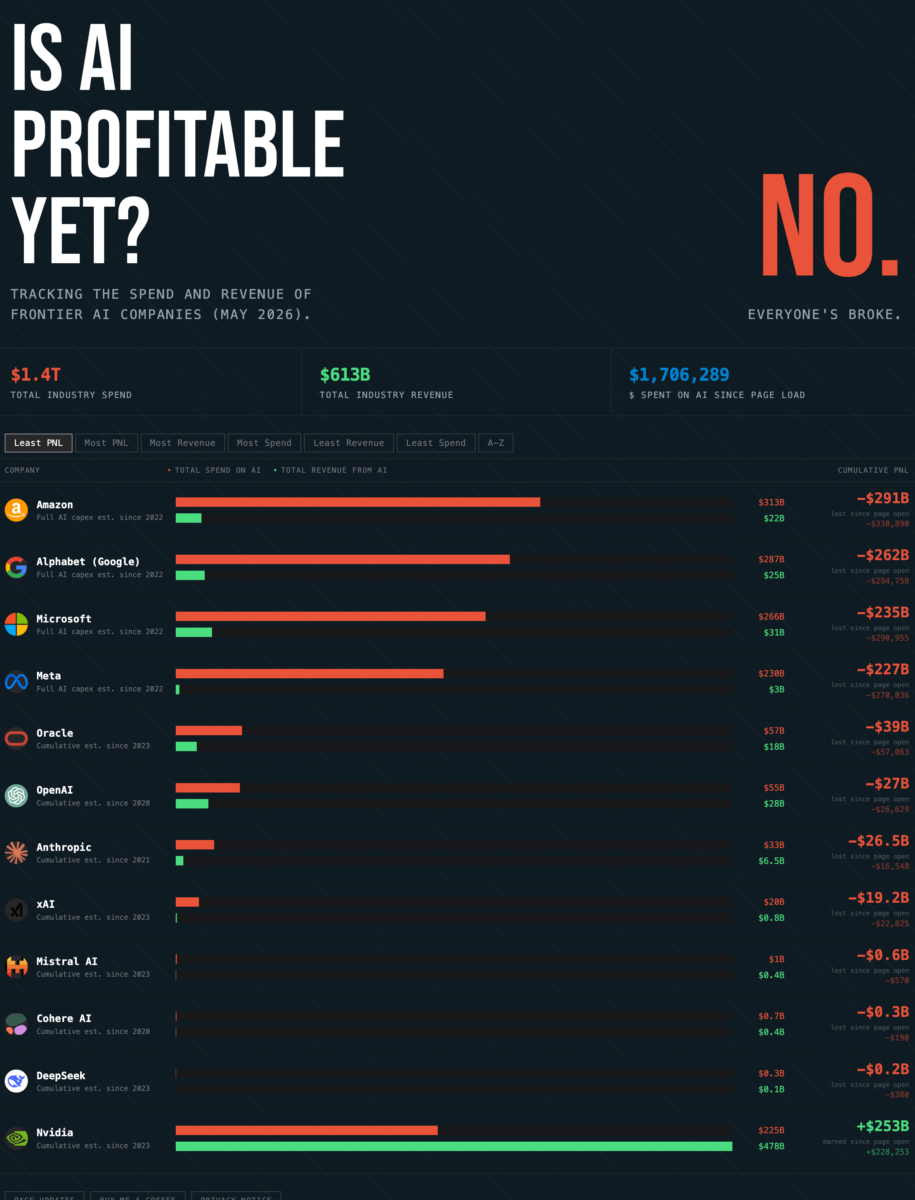
Source: Is AI Profitable
Sign up for our reads-only mailing list here.
~~~
To learn how these reads are assembled each day, please see this.
