
My end-of-week morning train WFH reads:
• Congrats. You’re About to Unwittingly Make Elon Musk a Trillionaire. SpaceX is IPOing next week. And there’s a good chance you’re gonna own a portion of it—whether you like it or not. (The Bulwark)
• Oil industry warns Trump administration of price spikes within weeks: Politico on the API and major-producer warnings going into the White House — Hormuz risk, tanker insurance, refining maintenance, all aligned the wrong way. The Semafor piece’s nervous companion. Industry executives said the loss of oil through the Strait of Hormuz is draining petroleum inventories to dangerously low levels. (Politico) but see Why isn’t oil more expensive? With peace talks between Iran and the US in limbo, one of the main questions looming over global energy markets is why the price of oil isn’t much higher than it is. Semafor on the puzzle of mid-$60s crude in the middle of an Iran war — Saudi spare capacity, US shale resilience, and demand softness all pulling in the same direction. The bear case in one note. (Semafor)
• The United States Capital Structure.The U.S. federal government is arguably the largest issuer of safe debt in the world: roughly $28 trillion of marketable Treasury debt. These Treasurys are backed only by the full faith and credit of the United States Treasury. There is no specific source of revenue that is earmarked to pay back these Treasurys, unlike, say, municipal bonds that are backed by toll revenue. How safe are these promises, really? (The Two Cents)
• After 60/40: The Hidden Cost of Uninvested Capital Through the J-Curve. When building a strategic private markets allocation, the waiting period can carry a meaningful cost. The question is not only how to access private markets, but how to manage uncalled capital during the ramp-up period. Apollo making the case for private-markets allocation by costing out the cash drag during the J-curve. Sponsored research, but the framework is worth the read regardless. (Apollo)
• I Fed the People Building the Metaverse: A former Reality Labs caterer’s essay on what cooking inside Meta’s metaverse division actually looked like. The food sociology of a tech-cycle bust, told with affection. (Yeast Confections)
• How much more software do we really need?: Probably a lot, but not necessarily the kinds people have made money on so far. Noah Smith with the question every VC deck quietly avoids — the marginal utility of net-new SaaS in a market already drowning in seat licenses. A useful counterweight to AI-app exuberance. (Noahpinion) see also What We Learned About the AI Threat From Q1 Software Earnings: In most cases, the death of software companies has been exaggerated, according to Morningstar analysts. (Morningstar)
• 1,000 True Fans. To be a successful creator you don’t need millions. You don’t need millions of dollars or millions of customers, millions of clients or millions of fans. To make a living as a craftsperson, photographer, musician, designer, author, animator, app maker, entrepreneur, or inventor you need only thousands of true fans. Kevin Kelly’s 2008 essay, still the cleanest articulation of the creator economy. Re-reading it in 2026 is a useful reality check on what actually scaled and what did not. (The Technium)
• Sticker Shock at the Pump Fuels a Surge in Hybrid Sales: Sales of hybrid cars carried the day in May as buyers seek better fuel economy. WSJ on the consumer pivot the auto industry kept saying would not happen — buyers walking past pure EVs to hybrids the second gasoline tipped. Toyota, of all companies, was right. (Wall Street Journal)
• This Is the Formula That Defeated Orban. It Would Defeat Trump, Too. outlandish xenophobic and antisemitic propaganda had served Orban well for years. It didn’t work against Peter Magyar — probably because so many Hungarians got to see him in person, many of them repeatedly. This is another lesson of his success: Old-fashioned in-person politics can be a powerful antidote to media fearmongering. NYT opinion on the Hungarian opposition playbook that finally landed — coalition discipline, local infrastructure, and abandoning the moral-high-ground talking points. Specific, transferable, worth the read. (New York Times)
• Emily Blunt Was Drunk in a Club When a Phone Call Changed Her Life: WSJ profile of Emily Blunt pegged to the new Devil Wears Prada follow-up. The opening anecdote earns the headline; the rest is better than the celebrity-profile genre usually allows. The English actress is having a blockbuster year, between reprising her breakout role and starring in Spielberg’s ‘Disclosure Day’ (Wall Street Journal)
Video of the day: How Shakespeare Manipulates An Audience
Be sure to check out our Masters in Business interview this weekend with Chris Davis, Chairman and Portfolio Manager of Davis Funds. The firm oversees $20 billion in client assets, with Davis (and colleagues) co-investing $2 billion in their own mineus alongside shareholders. Davis was named Morningstar’s Portfolio Manager of the Year; he also sits on the boards of Berkshire Hathaway and Coca-Cola.
Consumers are in a foul, foul mood
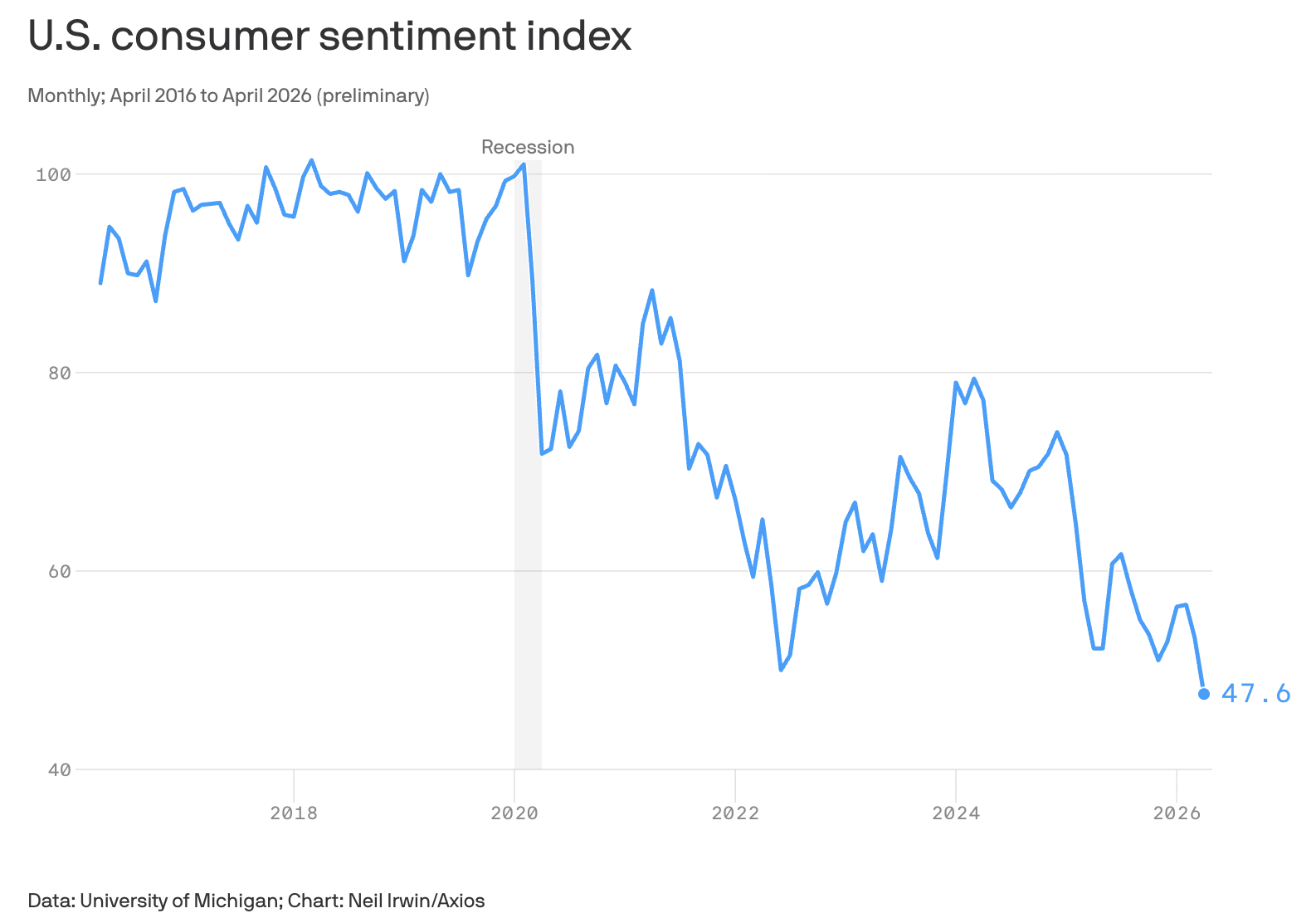
Source: Axios
Sign up for our reads-only mailing list here.
