
My morning train WFH reads:
• Iran Is a Bigger Defeat Than Vietnam: FP makes the strategic case that Iran is a worse strategic loss than Vietnam. The comparison will annoy people; the argument is sharper than expected. A war of choice has turned into a strategic disaster for Washington. (Foreign Policy)
• 10 things Elon Musk can — but probably won’t — do with $1 trillion: Vox’s Future Perfect takes the high road: here’s what a trillion could actually accomplish in EA-style giving terms. Useful framing exercise. (Vox) see also Elon Musk Is a Trillionaire, and the Rest of Us Aren’t: “Musk wants more money, and wants to make SpaceX a problem for the public markets, funded by the public markets, with liquidity provided by the public markets,” Ed Zitron, author of the Where’s Your Ed At newsletter and host of the Better Offline podcast, told CNET in an email. “He’s essentially dumping his stock onto retail investors who have been misled about AI and Musk’s own business acumen.” (CNET)
• Why Most Stocks Aren’t Worth Owning: A small number of stocks drive most of the market’s long-term return. Morningstar revisits the Bessembinder finding that the index returns are entirely concentrated in a handful of names. Pair it with this week’s Triple-Digit Club piece. (Morningstar)
• Is Lloyd’s of London the world’s oldest podshop?: FT Alphaville draws the line from 17th-century coffeehouse syndicates to the modern multi-strategy hedge fund. The history is the punchline. (Financial Times)
• How Rivian Is Pulling Off Its $45,000 R2 Electric SUV: Rivian’s make-or-break bet on an affordable EV. The engineering is impressive; the question is whether they can actually build them at that price without bleeding cash. Automaker’s fans love startup’s new R2, but high lease costs show the challenges in the changing electric-vehicle market. (Wall Street Journal).
• Hype and Glory: The SpaceX Frenzy Continues: While I don’t know anyone who loves Microsoft or its products, it’s a wildly successful company with a long track record. Last year Microsoft earned $125 billion in profits on $318 billion in revenue. And yet at the end of trading yesterday the stock market placed a higher value on SpaceX, which went public last Friday, as it did on Microsoft, and more than it placed on Amazon, which made $78 billion in profits last year. Half book review, half quiet warning. (Paul Krugman)
• The Hacker Sent by Anthropic to Calm the Government’s Nerves About AI Safety: WSJ profile of Nicholas Carlini and Anthropic’s policy-shop charm offensive. The strategy keeps paying off. He recently rang the alarm about the dangers of AI—and now he’s part of a team arguing for the latest models to be released (Wall Street Journal)
• The importance of connections: Ways to live a longer, healthier life. Social connection, prosociality, spirituality, optimism, and work—growing evidence suggests these five factors can play an important role in improving the well-being of people and communities.(Harvard T.H. Chan)
• An Annotated Analysis of Trump’s Iran Deal: Official agreement envisages trade relief for opening the Strait of Hormuz and limits on Iran’s nuclear program. WSJ goes paragraph-by-paragraph through the leaked draft text, marking concessions in red. The annotations are doing more work than the analysis. (Wall Street Journal) see also Iran is Trump’s Katrina: Noah Smith argues the Iran misadventure punctures the competence brand the way Katrina did Bush’s. The political half-life of disasters is shorter than it used to be, but the framing sticks. (Noahpinion)
• How ‘Toy Story’ Won Over Every Generation: As ‘Toy Story 5’ is released, a look at what the series has meant to children—and their parents—over the years. WSJ on why Toy Story keeps cycling through new audiences as Toy Story 5 hits theaters. Pixar’s most patient cash cow. (Wall Street Journal)
Video of the day: The psychology behind why some homes feel good (but most don’t)
Be sure to check out our Master’s in Business this weekend with Seth Klarman, CEO and portfolio manager of The Baupost Group. Founded in 1982 with $27 million in seed capital, over the past four decades, Baupost has grown to $22 billion, with annual net returns of over 20%. The legendary investor is known for his patient, risk-averse, and contrarian approach to finding deeply discounted securities across equities, distressed debt, and real estate. He is the author of Margin of Safety (1991) and the editor of the 7th edition of Security Analysis (2023).
AI Set to be Largest CapEx Cycle Ever … and Soon Majority Externally Financed
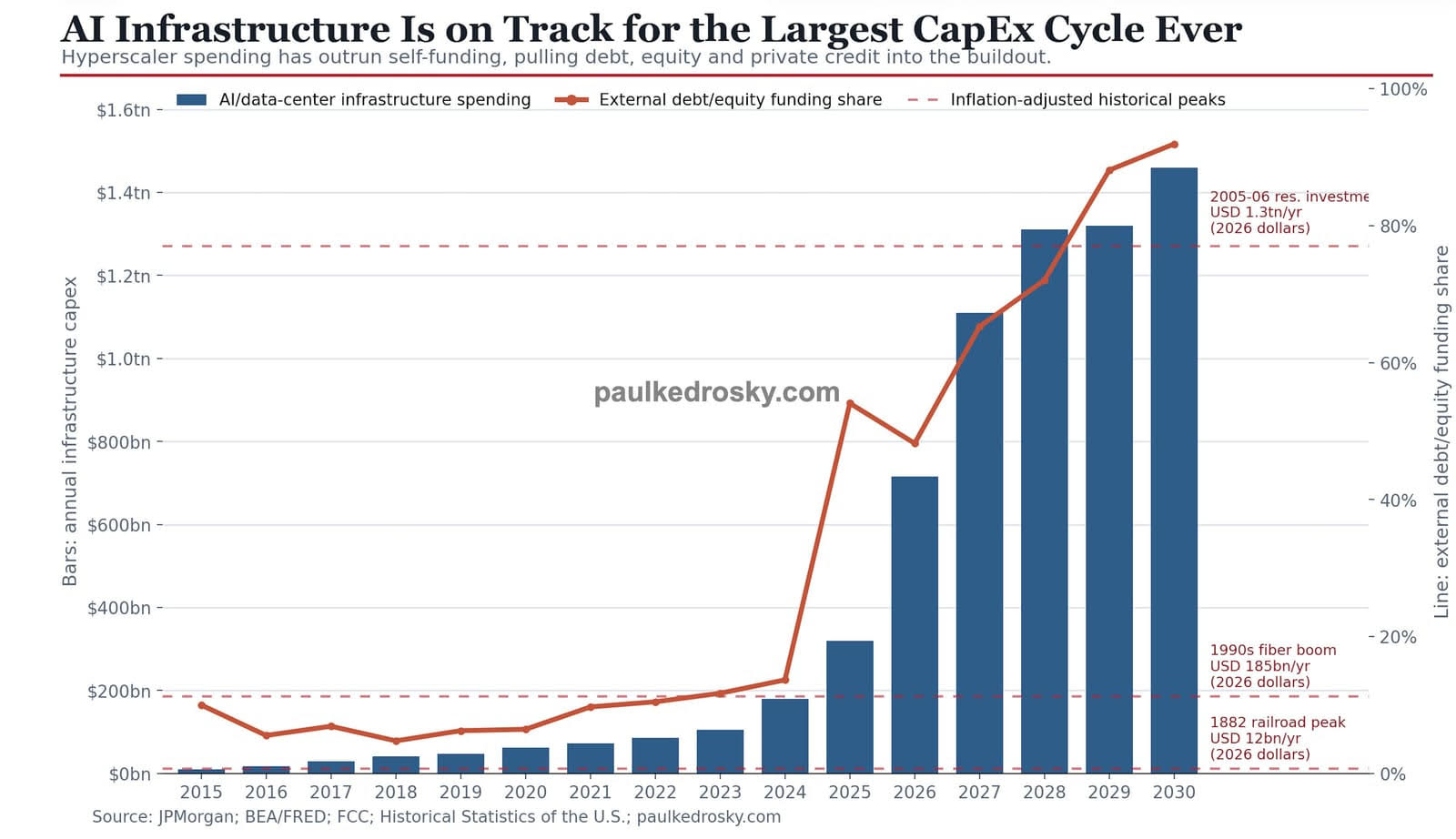
Source: Paul Kedrosky
Sign up for our reads-only mailing list here.
