
My Two-for-Tuesday morning train WFH reads:
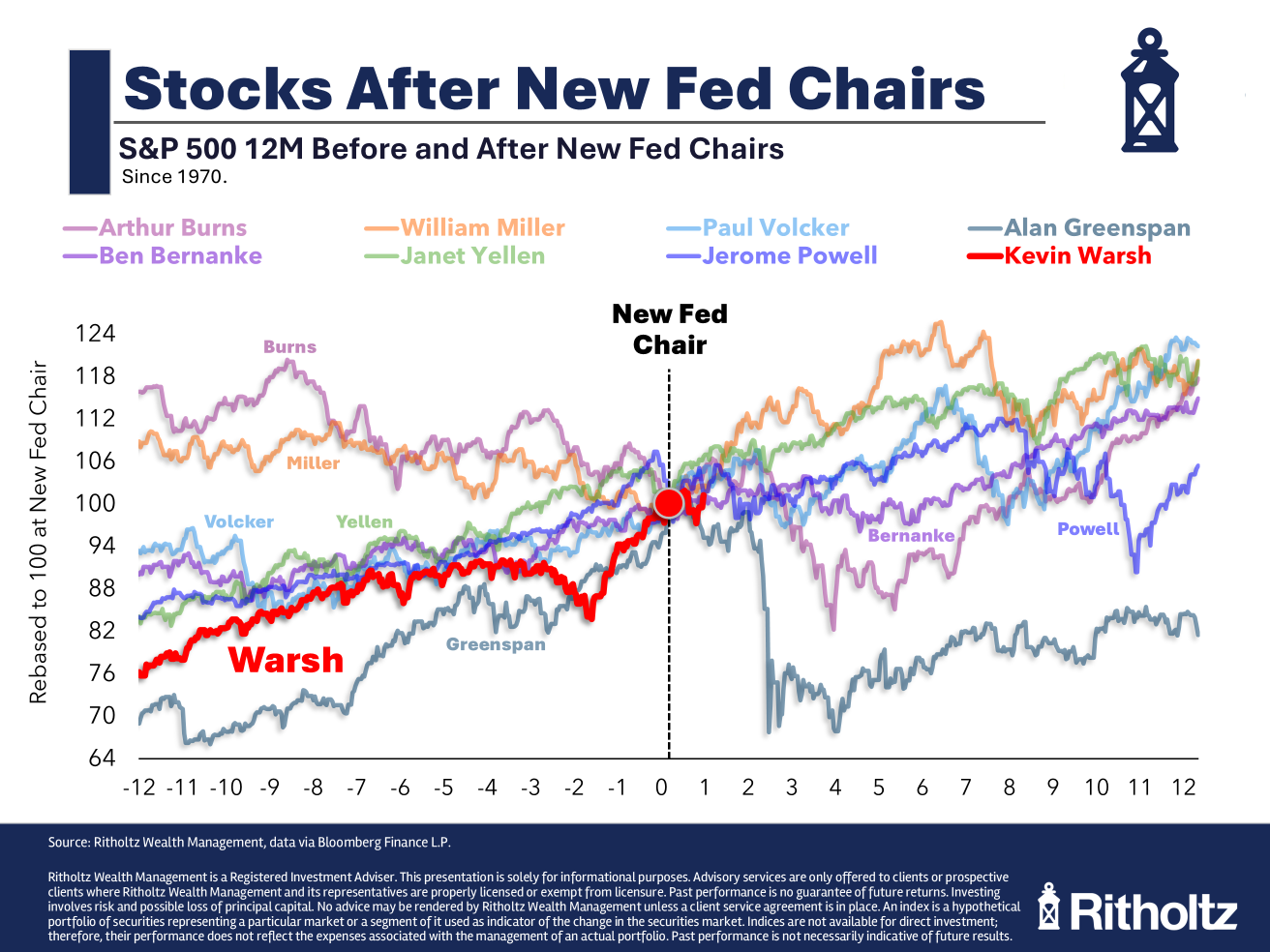
• Trump picked Kevin Warsh to cut rates. The new Fed chief just told us he has other plans. Here’s what the central bank’s hawkish agenda means for your money. MarketWatch on Warsh’s first public posture as Fed chair — independence-flavored, not rate-cut-flavored. The political collision is already scheduled. (Marketwatch)
• Alan Greenspan Was Wrong About One Thing. It Was a Big One. “The modern risk-management paradigm held sway for decades,” he said, referring to the esoteric economic models that had assured traders of the soundness of the billions in securities that had been layered on top of home mortgages — securities that in 2007 and 2008 suffered tremendous losses and caused banks to fall like dominoes. “The whole intellectual edifice, however, collapsed in the summer of last year.” (New York Times) see also Celebrating Greenspan’s Legacy of Failure: How AG Became the ex-Maestro My 2014 piece on Greenspan’s reputational arc — running fresh today after his death at 100. One of the most interesting and weirdest tenures ever for a Fed chairman (2014). (The Big Picture) see also Free Lunch: Myths of the Greenspan Era: My 2006 review of David Cay Johnston’s Free Lunch, written in the thick of the Greenspan era. Besides, how many Fed Chairs will retire in our lifetimes? Perhaps we can act as a counter-ballast to all the accolades and bon mots. Now would be as good a time as any to discuss some of the myths and misunderstandings of the Alan Greenspan era:, (2006) (The Big Picture)
• How Investors Are Choosing Between Active and Passive Strategies: CIO on how institutional allocators are actually splitting the active/passive bucket in 2026. Useful baseline against the louder takes. Both approaches have benefits, but the current market volatility has changed how allocators weigh cost and governance differences. (Chief Investment Officer)
• Technology, Capital and Skills Rethinking the story of AI and inequality. Will AI bring capital-biased technological change? How will AI affect the market for skill(s)? Will AI bring capital-biased technological change? (Paul Krugman)
• Secretive Wall Street Powerhouse Jane Street Seizes the AI Spotlight: The firm has surged from a handful of staffers to 3,500 with plans to recruit more than 500 employees this year. ‘Every day there’s more data, and we’re digesting it and processing it faster,’ one engineer says. WSJ on Jane Street’s increasingly public AI ambitions after years of quiet dominance in market-making. The lab is now the strategy. (Wall Street Journal)
• Ten Years After Brexit, the Dismal Verdict Is In: A decade later, the cost of that freedom — of the return, as Mr. Johnson repeatedly put it, of precious national sovereignty — is blindingly apparent. The vote to leave the European Union was a real cry of pain from a large section of the electorate that thought itself left behind by economic progress. The desperation remains. The “sunlit meadows” were a mirage. NYT marks the Brexit decade with a clear-eyed scorecard. The numbers won’t surprise you; the framing does some work anyway. (New York Times)
• Microsoft’s Satya Nadella: We Can’t Let AI Giants Eat the Economy: In interview, Microsoft’s CEO offers a blistering critique of AI power balance and calls for earning society’s permission. WSJ exclusive with Nadella on the antitrust framing of AI — coming, notably, from a CEO at one of the giants. The positioning is the substance. (Wall Street Journal)
• Ukraine, Iraq, and Occam’s Razor: Or, what Putin and Trump have in common with every other leader who initiates a war. “Both conflicts have produced a similar outcome: a weaker power has trapped a stronger one in a costly confrontation,” Fiona Hill, who ran Russian and European affairs at the National Security Council during the first Trump administration, wrote in a policy paper for the Brookings Institution this week. “Like Putin, Trump did not have a plan for what would happen next.” The root of the issue is that both presidents sparked wars with limited understanding of the opposing side, Ms. Hill said in an interview. “Both projected their own centralized views of their own roles onto Iran and Ukraine, so they thought if they could decapitate the system it would fall,” she said. Drezner argues the simplest explanation for U.S. foreign-policy failures recurs across administrations: we keep mis-reading the local politics. Useful corrective. Or, what Putin and Trump have in common with every other leader who initiates a war. (Drezner’s World)
• U.S. science is in chaos: How did we get here? The prevailing emotions among scientists right now are rage and shock. A survey conducted by science news website STAT found that more than half of researchers with grants from the NIH—once a reliable source of $40 billion a year—reported some level of disruption to their funding: a total freeze, a delay in disbursement or a reduction in amount. And 81 percent of researchers in tenure-track positions said they were concerned that funding disruptions could affect their productivity enough to jeopardize their chances of getting tenure. (Scientific American)
• These ‘city killers’ threaten civilization. Hunt them down.: Investing in interplanetary defense isn’t expensive, and it could save the planet. WaPo’s interactive on the mid-sized asteroids no one is funding the budget to track. Low-probability, civilization-ending — exactly the risk humans price worst. (Washington Post)
Video of the day: Atomic Clocks Prove Reality Is Stranger Than You Think | NOVA
Be sure to check out our Master’s in Business with Seth Klarman, CEO and portfolio manager of The Baupost Group. Founded in 1982 with $27 million in seed capital, over the past four decades, Baupost has grown to $22 billion, with annual net returns of over 20%. The legendary investor is known for his patient, risk-averse, and contrarian approach to finding deeply discounted securities across equities, distressed debt, and real estate. He is the author of Margin of Safety (1991) and the editor of the 7th edition of Security Analysis (2023).
Sign up for our reads-only mailing list here.
