
The weekend is here! Pour yourself a mug of Danish Blend coffee, grab a seat outside, and get ready for our longer-form weekend reads:
• Meet the Bodyguards Signing Up to Protect America’s Frightened Billionaires: After a season of high-profile assassinations, political violence, and kidnappings, wealthy Americans are racing to hire personal security services. GQ on the private-security boom catering to anxious tech and finance moguls. Genuine threat or vanity expense — the budget moves either way. After a season of high-profile assassinations, political violence, and kidnappings, wealthy Americans are racing to hire personal security services. (GQ)
• China is training a robot future — one folded shirt at a time: Localized, low-cost data harvested in homes and factories gives China a scaling edge over the research-heavy and outsourced U.S. approach. Rest of World on the army of low-wage Chinese workers generating the physical-world training data behind the next robotics wave. The picks-and-shovels are humans, for now. (Rest Of World)
• The Interview: Scott Pelley on the Bari Weiss Era and His Last Days at ‘60 Minutes’ Pelley, who was at the network for 37 years, including as White House correspondent, anchor of the “CBS Evening News” and “60 Minutes” correspondent, was fired after an explosive series of events and much turmoil over the past few years at CBS. These events include a controversial financial settlement with President Trump. Pelley exits 60 Minutes with a candid read on the Bari-Weiss-influenced editorial drift. The institutional erosion at CBS News continues. (New York Times)
• How Much Stuff Do You Own? Some people have decided to answer that question by cataloging their belongings, one material possession at a time. A clear-eyed accounting of how much material life modern Americans carry around. Useful counterweight to the next “abundance” essay. Some people have decided to answer that question by cataloging their belongings, one material possession at a time. (Inconspicuous Consumption)
• I Read the Pope’s Encyclical on A.I. I’m Astounded By What He Wrote. It’s an urgent warning—and a celebration of humanity and what we can do at our best. (Slate)
• Are Memories Transferable — or Edible?: Quanta on the strange revival of memory-transfer experiments. The science is preliminary, the philosophical implications are not. In the 1960s, worm-training experiments and their strange implications captivated the nation. Columnist Claire L. Evans follows the neuroscientists who attempted to recapture the magic. (Quanta Magazine) see also Jeff Bezos Is Funding a Wild Hunt for the Brain’s ‘Core Algorithm’ Wired on the Bezos-backed neuroscience moonshot looking for a single learning rule under everything cognitive. Probably won’t work; the side-effects of the search are the interesting part. With $500 million in funding and a reported $2.5 billion valuation, Flourish wants to reinvent AI by putting real neurons under the microscope. (Wired)
• A Love Story: This is the template of a love story that many of us dream of living. It involves two people who will build a life together—and work through whatever comes their way. And something big is about to come their way. A Pudding-style data-and-illustration essay that’s genuinely affecting. Hard to summarize, easy to recommend. (Pudding)
• Stop eating Lady Gaga’s Oreos OR: The Great Switcheroo: Here’s a story from 30 years ago that would make no sense today. It’s 1992. Pearl Jam’s debut album Ten is selling well. But then MTV puts the music video for their song “Jeremy” in heavy rotation, and the band rockets into superstardom—shows suddenly sold out, fans smashing record store windows, the whole shebang. That’s familiar enough, but what happens next is not. Pearl Jam responds to this hullabaloo by refusing to make music videos for the next five years. They decline photoshoots and interviews. When their producer tells them that their song “Better Man” is a surefire hit, they cut it from their second album. Nevertheless, that album sells nearly a million copies in its first week, setting a record. Then it sells six million more, staying at #1 on the Billboard chart for over a month. Funny, useful, and probably going to ruin your next supermarket trip. (Experimental History)
• Trinidad Chambliss Is Making Millions Playing College Football. The NCAA Wants to Stop Him. The 23-year-old star quarterback talks to Vanity Fair about his landmark legal case, his coaches past and present, and his upcoming season at Ole Miss. Vanity Fair on a small-school transfer earning more than most NFL rookies — and the NCAA case trying to claw it back. The post-NIL ecosystem in one player. (Vanity Fair)
• What Steven Spielberg Taught Me About Fear, Catharsis, and Being Human: Hollywood is struggling, but Spielberg insists that the big screen is still the best place to work out our collective dreams, joys and sorrows. A NYT Magazine essay on what Spielberg’s films actually do to audiences — and why theatrical exhibition still matters. A surprisingly personal piece. Catharsis, and Being Human: Hollywood is struggling, but Spielberg insists that the big screen is still the best place to work out our collective dreams, joys and sorrows. (New York Times)
Video of the day: Steven Spielberg on Aliens, Young Directors and Being Turned Down For Bond
Be sure to check out our Masters in Business interview this weekend with Jean Eric Salata, Chair of EQT Group and Chair of EQT Asia. EQT is a purpose-driven global investment organization with over $310 billion in total assets under management, making it the largest private markets firm headquartered outside the United States.
The BBC has become the world’s top news website… by collapsing a little less than its competition
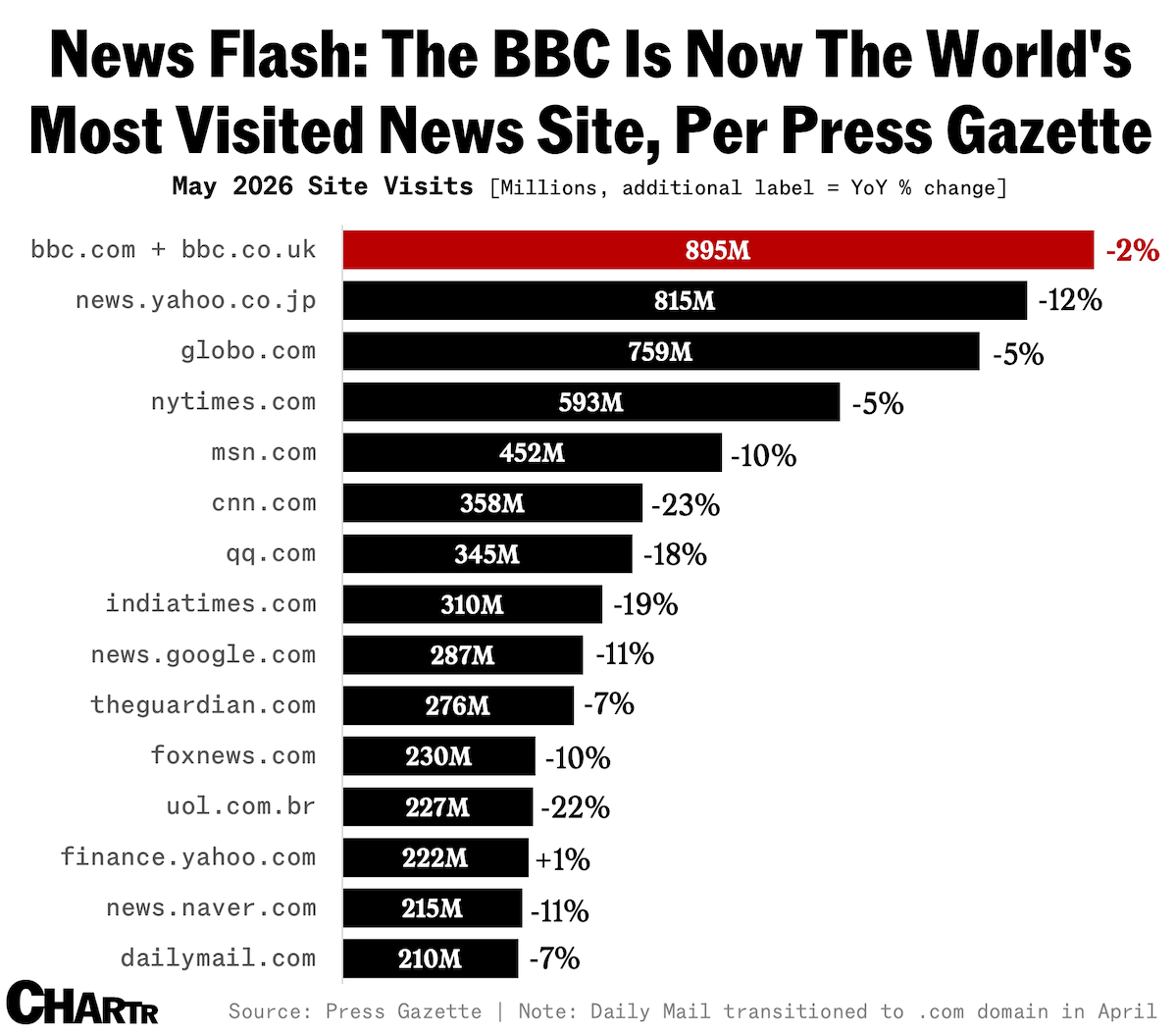
Source: Sherwood
Sign up for our reads-only mailing list here.
~~~
To learn how these reads are assembled each day, please see this.
