
My end-of-week morning reads:
• Europe chose insurance. America chose growth. Europe and America chose different points on the efficiency-equity trade-off. That used to be a matter of preferences. It isn’t anymore. Visitors notice something else, even the ones who have never heard of a purchasing power parity adjustment for GDP per capita comparisons across borders. They notice the wealth. The cars, the houses, the restaurants, the sheer scale of consumption. They notice the contrast between what is happening here and what is happening back home. You don’t need the IMF’s World Economic Outlook to see it, though the WEO will confirm it: even after adjusting for purchasing power, U.S. GDP per capita is now roughly 38% higher than the EU average. (The Two Cents)
• Boomers’ massive wealth will mostly be passed down to people who are already rich: Baby boomers are expected to pass $36 trillion to their heirs in the next two decades, an analysis found. The great wealth transfer is coming — and it’s going exactly where you’d expect. The Washington Post on the data showing intergenerational wealth concentration accelerating, not dissipating. (Washington Post) but see Hey … can you pay me back now? Welcome to the summer of financed fun, where one friend books the Airbnb and everyone else promises the money is coming. The psychology of the awkward IOU — why asking friends to pay you back is one of money’s great social minefields. (Substack)
• The Insider’s Guide to San Francisco’s A.I. Boom: The city is the tech industry’s hub for artificial intelligence, 30 miles north of the home of companies like Meta and Google. What if San Francisco is the new Silicon Valley? San Francisco has had its share of tech companies since the dot-com boom, but the money pouring into artificial intelligence has lately supercharged the city’s tech profile. Last year, they raised nearly $35 billion of venture capital funding. The change is visible. Rents are climbing again. City buses are filling back up. And the face of San Francisco is starting to look younger. The NYT maps the geography, social dynamics, and power structures of SF’s AI scene. Where the money is, where the talent eats, and who’s actually building things versus just talking about them. (New York Times)
• The Fun Shortage Is Real, and It’s Making America Miserable: With fewer places to relax and socialize, and steeper prices for entry, having fun is quantifiably harder than it used to be. Bloomberg on the fun shortage: hotels, theme parks, and summer camps priced past the middle class. Even leisure is bifurcating. (Bloomberg free)
• The creator economy is above the law: How influencers get away with anything. the Polymarket campaign was definitely illegal. However, there’s a reason that Polymarket and most content creators don’t abide by these laws: They’re barely being enforced. Scott Galloway’s shop argues the creator economy operates in a regulatory vacuum. Influence without accountability rarely ends well. (ProfG Media)
• The year is 2063 and you were never interesting. You’re never going to be someone’s eccentric grandmother because you spent your best years consuming the lives of strangers. A sharp bit of speculative fiction: the year is 2063 and you were never interesting. The algorithm always knew. (Substack)
• Navigating by Aliveness: One thing that’s missing from those discussions is any consideration of aliveness. Yet I think it might be the key to understanding how to think and feel about AI, how to respond to it, how to integrate it into our lives or not – and how to ensure, as technology marches on, that we don’t lose sight of what really matters for a meaningfully productive life. Oliver Burkeman on navigating by ‘aliveness’ rather than obligation — his usual gentle antidote to productivity culture. (Oliver Burkeman)
• The last astronomers: Amid a flood of AI advances, astrophysicists are questioning the soul of their field. (Science)
• The only bias uncovered in the White House’s Smithsonian report is its own: A White House report alleges radical bias at the National Museum of American History. But the assembled evidence reveals a large and vibrant institution carrying out its mission. A pointed WaPo column: the only bias uncovered in the White House’s Smithsonian report is its own. (Washington Post) see also A Huge Escalation in Trump’s Smithsonian Meddling: A White House report details what the administration wants to change in museums—and suggests that a crackdown could be coming. The Atlantic on a huge escalation in Trump’s Smithsonian meddling — the American History museum is now squarely in the crosshairs. (The Atlantic)
• The Wimbledon boy living a dream that defies belief: If it were a movie script, Arthur Fery’s remarkable Wimbledon adventure would probably never have made it to the big screen because it seemed too far-fetched to be believable. A 23-year-old who grew up within walking distance of Centre Court. Ranked 114th in the world. A wildcard entrant with only two previous Grand Slam match wins. Wimbledon semi-finalist? Reuters’ profile of the young tennis sensation whose run at the Championships is the feel-good sports story of the summer. (Reuters)
Video of the day: Why The Best Player Alive Barely Runs
Be sure to check out our bonus episode of Master’s in Business with David Risher, CEO of Lyft, one of North America’s largest ride-sharing networks. He joined Lyft’s board in 2021 when the firm was burning cash and losing ground to Uber. Lyft has returned to profitability, with its stock rising more than 75% since Risher took the reins as CEO in 2023. In Q1 2026, the firm had 28.3 million active riders and did $4.9B in gross bookings, with $1.7B revs, and $132.8m in EBITDA. Previously, he held senior roles at Microsoft and Amazon.
Percent Change in Median House Prices from 2000 to 2025 in the US
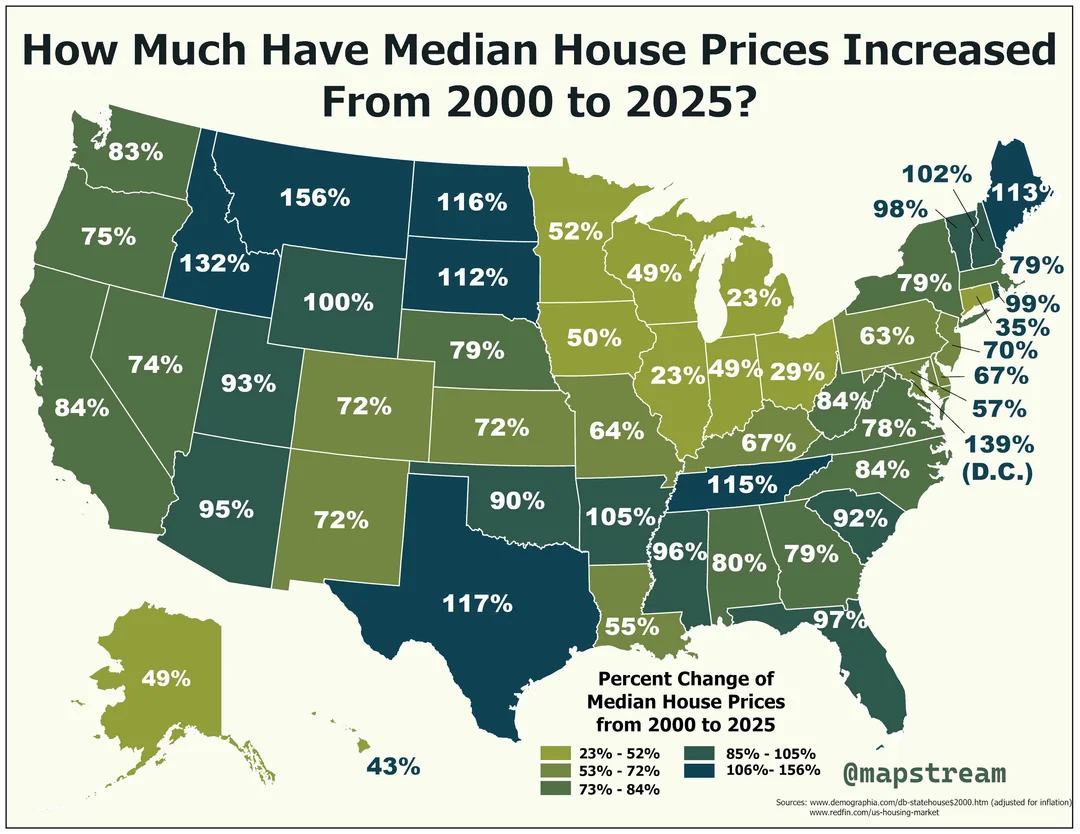
Source: Data is Beautiful
Sign up for our reads-only mailing list here.
