
My end-of-week morning reads:
• Wall Street Traders Are Having Their Best Year Ever: JPMorgan, Goldman and other big banks are raking in trading revenue this year as “the market is clearly extremely risk-on.” (Wall Street Journal)
• Robotaxi Riders Are Falling Asleep, Sparking Frantic 911 Calls: Passengers are also spilling food, getting sick and, in at least two instances, giving birth in self-driving vehicles. (Bloomberg free) see also Popular Cars to Avoid and What to Buy Instead: Skip high-selling models with low scores or reliability ratings and consider these winners instead. Consumer Reports’ annual name-and-shame list — the best-selling models that score poorly on reliability, safety, or owner satisfaction, plus what to buy instead. (Consumer Reports)
• From spicy claypot chicken to ‘digitally enabled technology infrastructure player’: Back in 2017, a tiny US-listed drinks company called Long Island Iced Tea suddenly announced that it would henceforth be known as Long Blockchain Company and promptly jumped as much as 500 per cent. It ended pretty much as you’d expect. Even the Nasdaq was shamed into taking action, delisting the company from its exchange. The SEC then got involved, and today the company is no more. Did doubt for even a minute t hat this would end in any other way?! (Financial Times)
• This factory was severely short on workers. Then it offered flexible work. With U.S. manufacturers struggling to staff up, a handful are opening the doors to people who may not be seeking a traditional career in the industry or even a 40-hour workweek. (NPR)
• Generative AI Is an Engineering Disaster: A shockingly inefficient trillion-dollar project. (The Atlantic)
• The Misinformation Gap: The Psychologist Who Defined the Dunning-Kruger Effect Says You’re Probably Using It Wrong: Dunning, co-discoverer of the Dunning-Kruger effect, investigates the misinformation gap built into our brains: We don’t know what we don’t know. (ZME Science) see also Too Many Books? Mendel Uminer faced a crisis when his landlord objected to the 10,000 volumes in his New York studio apartment. (New York Times)
• The solarisation of Pakistan’s energy economy: Distributed solar is driving up electricity demand, bringing huge social and economic benefits. (Ember)
• What are the cool kids doing in NYC this summer? Ditching their phones. Pervasive techno-pessimism has sparked a burgeoning analog movement and offline “Summer of Ludd” festival. (Washington Post)
• Why Is Digital Freedom Making Us Exhausted and Sad? From “The Burnout Society” to “The Tonality of Thought,” tech philosopher Byung-Chul Han’s ultra-short books reveal why online liberation has felt more like voluntary captivity. (The New Atlantis) see also A Philosopher’s One-Word Theory to Explain Why the World Feels So Weird: Once you learn what the “uni-context” is, you won’t stop seeing it everywhere. (Derek Thompson)
• How coach-on-pitch Messi undid England’s tactics on the fly: As England conceded control of the World Cup semi-final because of their own fatigue and Thomas Tuchel’s in-game changes, veteran Messi strolled authoritatively and effectively served as Argentina’s on-field coach. So how did Messi find and exploit England’s weaknesses to deliver victory for Argentina in Atlanta? (BBC)
Video of the day: Why Twitter became such a disaster
Be sure to check out our Masters in Business this weekend with Jason Wenk, founder and CEO of Altruist, a modern custodian built as a clean sheet from the ground up, fully integrated with artificial intelligence. He began his career at Morgan Stanley before launching Retirement Wealth Advisors, and then FormulaFolios. The through-line of his career has been creating lower-cost, tech-enabled, financial advice.
Retail Resilience Defies Doomsayers
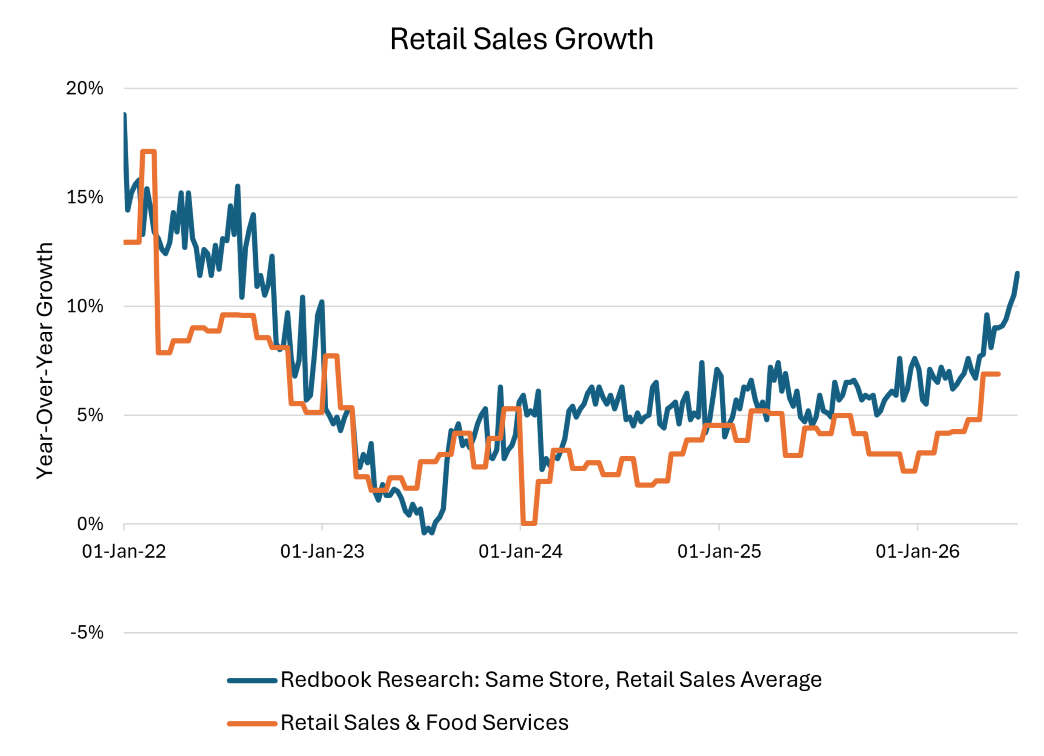
Source: Federal Reserve Bank of Richmond
Sign up for our reads-only mailing list here.
