
My mid-week morning reads:
• Prediction Markets Are Minting a New Type of Insider Trader: Sites like Polymarket were built to price uncertainty. New data shows they might be rewarding privileged knowledge instead. (Businessweek free)
• Treasury Flags Concern Over ‘Potentially Abusive’ Tax Trades: The US Treasury Department has expressed concern over a number of high-profile tax strategies touted by Wall Street that it says may be “too good to be true.” (Bloomberg free) see also ‘Black Holes for Capital Gains’: New Tax Trick Takes Off in ETFs: Investors are seeding ETFs with appreciated assets, taking advantage of an infamous loophole to wash out taxable gains. The ETF structure that lets wealthy investors eliminate capital gains taxes entirely. Bloomberg explains how it works — and why the Treasury just flagged it.(Bloomberg)
• The U.S. homeownership rate may not be as high as you think: Only about half of U.S. adults live in homes they own. The official homeownership rate counts households, not people — and the distinction matters enormously for understanding who’s actually building wealth. One economist has a new way of looking at the issue. (Washington Post)
• Once Bitten: Why Investors Won’t Buy Back a Stock That Burned Them: Every investor has a name or two they’ll never own again – and it’s rarely about the fundamentals. How a single bad experience — one stock crash, one market downturn — permanently distorts an investor’s behavior for decades. The scar tissue is real and measurable. (Essentia Analytics)
• American AI is locked down and proprietary. It’s losing. China’s open-weights AI strategy is winning: its companies are taking the lead. The closed-source American AI model is losing ground to open-source Chinese alternatives. The irony: America’s obsession with IP protection may be the thing that costs it the AI race. (Ben Werdmuller)
• The Chatbot That Foretold Why People Share Secrets With ChatGPT: A Wired excerpt from a new book on ELIZA — the 1960s chatbot that predicted, with eerie accuracy, why humans would eventually pour their hearts out to machines. In the 1960s an MIT professor named Joseph Weizenbaum created a chatbot called ELIZA. The conversations people had with it set precedents for the chatbots to come. (Wired)
• A.I. Drones Are Coming. We Are Not Ready.: Autonomous weapons are no longer theoretical. The world needs a regulatory framework before AI-powered drones make human decision-making in warfare obsolete. (New York Times) see also Armed robots are on the horizon, as Silicon Valley pitches new military tech: The defense-tech pipeline is filling fast — and the Pentagon is eager to buy. (Washington Post)
• ‘Whataboutism’ makes the internet exhausting. Why people think this way: “It’s normal for us to have egocentric processing, to filter the world through our own experiences,” said Micheline Maalouf, a Florida-based licensed mental health counselor and content creator with more than 1 million followers on TikTok. (CNN)
• It’s no longer illegal to destroy the one thing endangered species need most to survive: The Trump administration gutted habitat protection provisions of the Endangered Species Act. What that means for hundreds of species that depend on places, not just policies. A twisted definition of one word is putting hundreds of rare animals at risk. (Vox)
• As Odd as a Clockwork Orange: The Unreliable Narrator and Primary Sources : The Memory Hole revisits Kubrick’s masterpiece through the lens of 2026 — and finds it uncomfortably prophetic about state violence, media manipulation, and the aestheticization of cruelty. (The Memory Hole).
Video of the day: The Zombie Debts Making Wall Street Rich
Be sure to check out the latest Masters in Business with Jason Wenk, founder and CEO of Altruist, a modern custodian built as a clean sheet from the ground up, fully integrated with artificial intelligence. He began his career at Morgan Stanley before launching Retirement Wealth Advisors, and then FormulaFolios. The through-line of his career has been creating lower-cost, tech-enabled, financial advice.
Venture capital is already having a record year
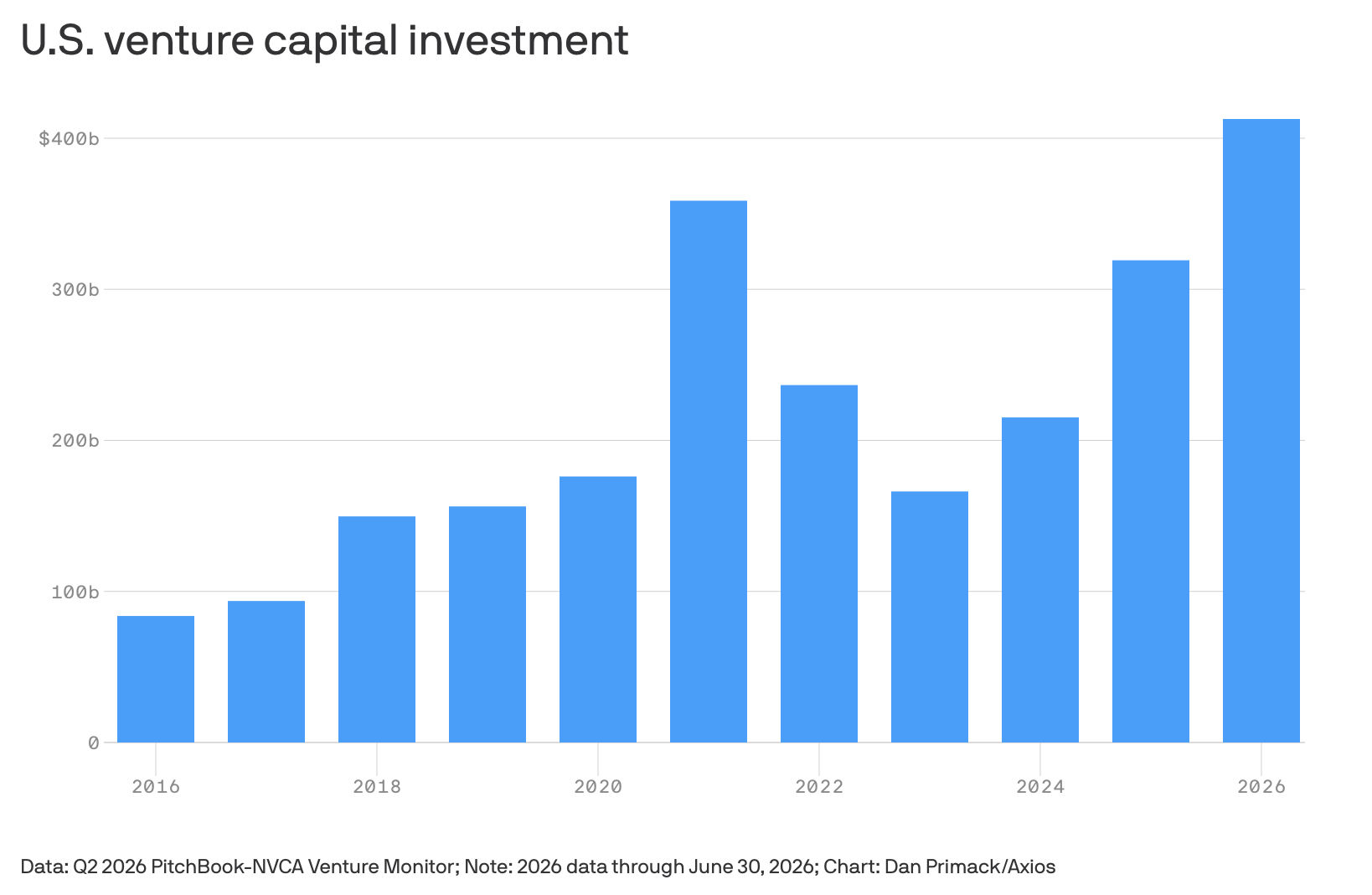
Source: Axios
Sign up for our reads-only mailing list here.
