
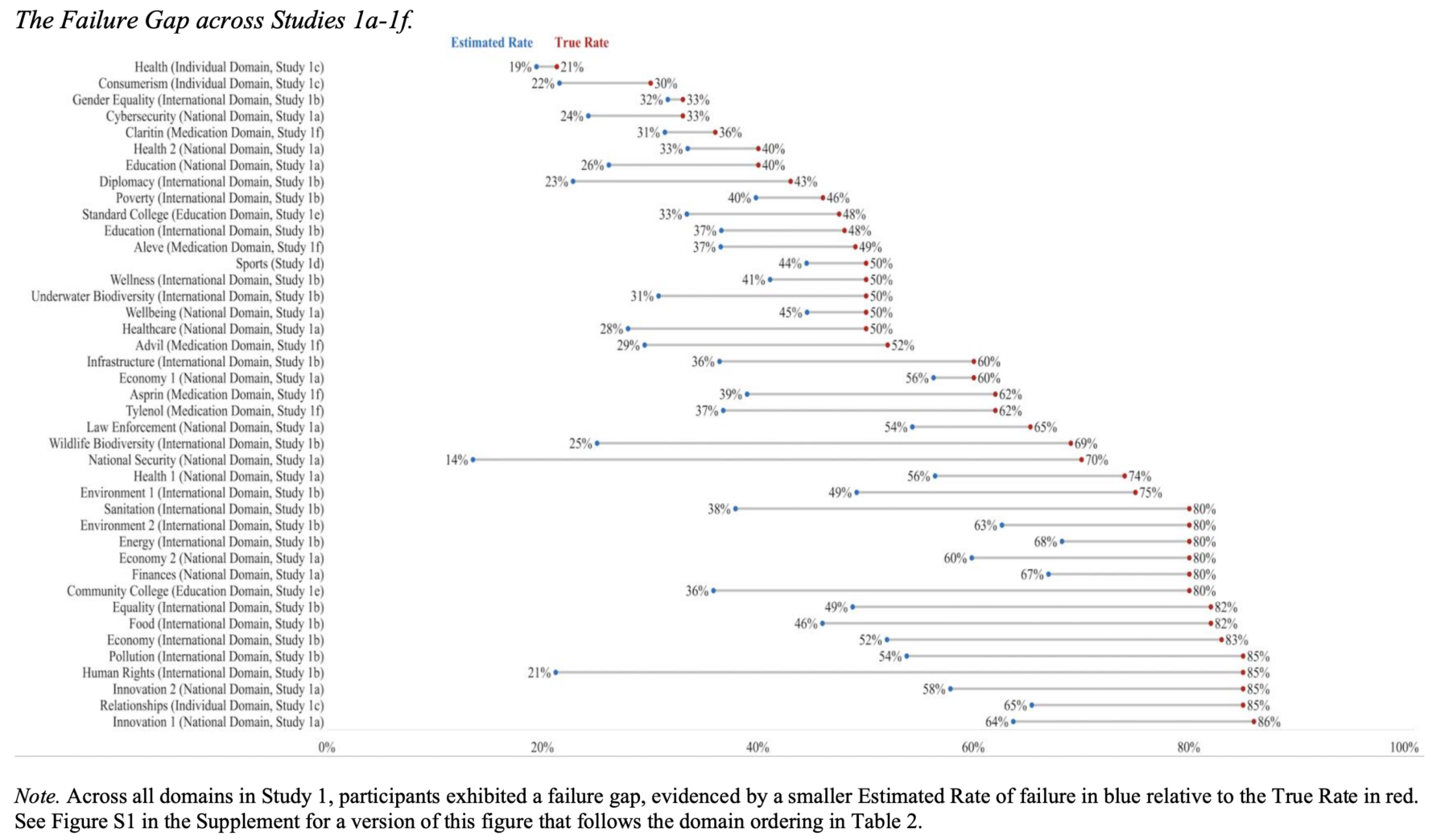
We are all systematically blind to how often things fail.
A 2025 research paper, titled The Failure Gap, goes into great detail about this. The paper’s authors reviewed over 30 “life domains”; they determined that failure occurs about 61% of the time. But ask people what the failure rate is, and they wildly underestimate it: About 41% is the average number they give.
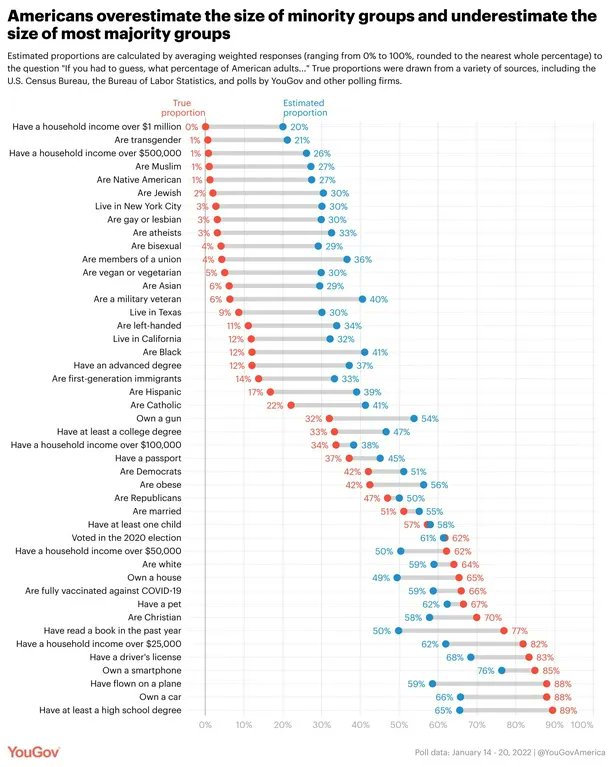
This is a variant of a question we discussed here two years ago: “What do people actually know relative to what they believe they know?“ The chart nearby looks remarkably similar to the one above…
We collectively underestimate restaurant closures, college non-completion (true rate ~64% at the 20 largest U.S. colleges), OTC painkiller inefficacy (~52% get no meaningful relief), hospital hand-hygiene lapses (~50%), and TSA screening misses. We even estimated NHL teams collectively lose only 44% of games — a logical impossibility in a league where every game produces a winner and a loser.1
Why else would anyone ever invest in a restaurant and/or a play? For every Hamilton, there are 100,000 plays that never get anywhere. Every successful restaurant you see is an exception, not the rule. Long hours, razor-thin margins, lots of management headaches, and ever-changing trends make it an extremely difficult business. A great restaurant may be a good business, but the industry itself is incredibly difficult. It’s a lousy business, defined by its most notable exceptions — and fast food.2
To find out how often we underestimate failure rates, the authors scanned 2.4 million news articles, plus social media and online reviews. The result? Failure is under-reported relative to its actual occurrence in every domain. One shocking example: glowing Advil reviews on Amazon collapsed their inefficacy estimates from 30% to 7% vs. a 52% actual rate.
In our age of social media, we see a further driver of this yet: Failure is under-shared. This somehow creates an unholy combination of survivorship bias and availability heuristic, making our collective failure estimations not just wildly wrong, but consistently so, and in the same direction.
I have been using the phrase denominator blindness, but the paper implies a new variant: “Base-rate blindness.”
~~~
Check out the full paper below…
Previously:
Another Reason Why Polling is So Bad (August 15, 2024)
Source:
The Failure Gap
Eskreis-Winkler, Woolley, Kim & Polimeni
Journal of Personality and Social Psychology (2025)
Thank you to Joachim Klement for bringing this to my attention: The failure gap, Jul 17, 2026
__________
1. I discuss this extensively in How Not to Invest. In addition to survivorship steering us to underestimate how often things fail, we further underestimate just how fragile and rare success can be.
2. Unlike World Cup soccer, the NHL produces zero ties…
