
My back-to-work morning train WFH reads:
• Broadening the Base: more than 60% of stocks beat the S&P 500 in June and July: A natural outcome of rising market breadth has been the rise in dispersion, which measures how differently stocks are performing relative to each other. S&P 500 dispersion has reached historically high levels, and Exhibit 4 shows that S&P 500 Equal Weight Index dispersion has tracked closely with its cap-weighted peer. This is not surprising given the increased scrutiny faced by companies across the size spectrum, which is typical during an earnings season. Anu Ganti on the rally spreading out beyond the mega-cap hyperscalers. More than 60% of stocks beat the S&P 500 in June and July, equal-weight tech is ahead of its cap-weighted counterpart by 19% year to date, and roughly 85% of reporting companies have beaten estimates. (S&P Dow Jones Indices)
• King Carney Activates Kong Mode With Zero F*s: At two minutes to midnight on Friday, Mark Carney did what no Canadian prime minister has done in living memory — looked at the most powerful man in the world, checked his watch, and told his negotiators to come home. Not paused. Suspended. (I F*ing Love Australia) see also Great, Scott…: Michael Green discloses that he sent Treasury Secretary Scott Bessent a proposal earlier this year — a Sovereign Debt Optimization Facility swapping deep-discount vintage long bonds for current-coupon par bonds. What Treasury announced last week was a cash buyback program, materially different in both mechanics and optics. (Michael Green)
• From Thomas Paine to Dell Webb: 250 Years of Retirement Angst: It’s the question that keeps millions of Americans up at night: Do I have enough saved for retirement? A long view of an anxiety that predates the 401(k). Almost half of American families have no retirement plan at all, per the Federal Reserve, and those leaning on Social Security face a 22% benefit cut if Congress lets the trust fund run dry in 2032. (Barron’s)
• We Went to Wall Street’s Exclusive Wilderness Camp. Everyone Was Spooked by AI. Between fishing outings and poker games, veteran finance pros shared fears about the artificial-intelligence trade. Money managers and economists made their annual pilgrimage to Grand Lake Stream, Maine, traded suits for cargo pants, and then spent the week asking the one question that actually matters now. (Wall Street Journal)
• Corner the Market, Get Cornered: The Class Action Against Compass: “Today, Compass is a living, breathing real estate leviathan.” Jonathan Miller on Castaneda/Gelfand v. Compass, just filed in federal court, alleging the post-Anywhere firm is an illegal monopoly and pointing to forced StreetEasy delistings. The complaint calls Compass a Leviathan; Miller expects more suits to follow, likely on the sales side next. (Housing Notes)
• Sports Bettingʼs Rise and the Line Between Entertainment and Problem Gambling: Bettors are overoptimistic: in our study, they expect to break even but actually lose 7.5 cents per dollar wagered, with losses on parlays especially underestimated. Overoptimism is largest among bettors who partake in a complex type of bet known as a parlay. Compared to other forms of betting, parlays are more likely to be driven by bias. (Initiative for Financial Decision-Making)
• How big is America’s “obesity penalty”? GLP-1s offer a rare insight into the social and economic effects of carrying extra weight. GLP-1s have created a rare natural experiment. Doctors promise better mobility and cleaner metabolic numbers, but the interesting data is in what happens to the social and economic returns to losing weight. (The Economist free)
• How Satellite Advances Are Changing the Game for Ukraine: Michael Schwirtz on the new tool in Ukrainian drone teams’ hands — near real-time information on Russian troop movements and locations. Ukrainian drone teams have a powerful new tool: near real-time information on troop movements and locations. (New York Times)
• More People Call in Sick on August 24 Than Any Other Day: The second ‘sickest’ day of the year falls after Super Bowl Sunday in February. (Bloomberg)
• The Improbable Longevity of “It’s Always Sunny in Philadelphia” The irreverent comedy is the longest-running sitcom in history, yet has won no major awards. What gives? (New Yorker)
Video of the day: China’s BYD Is Taking Over the World’s Shipping Lanes — And Nobody Knows
Be sure to check out our Masters in Business this past weekend with Alex Morris of TSOH Investment Research. He is the author of “Buffett and Munger Unscripted: Three Decades of Investment and Business Insights from the Berkshire Hathaway Annual Shareholder Meetings.” The book was named one of Amazon’s “Best Books of 2025.” To write it, he reviewed every Berkshire annual meeting from 1994 through 2024 — 100s of hours of video covering more than 1,700 shareholder questions over 31 years — after Berkshire released the meeting archives.
How big is America’s “obesity penalty”?
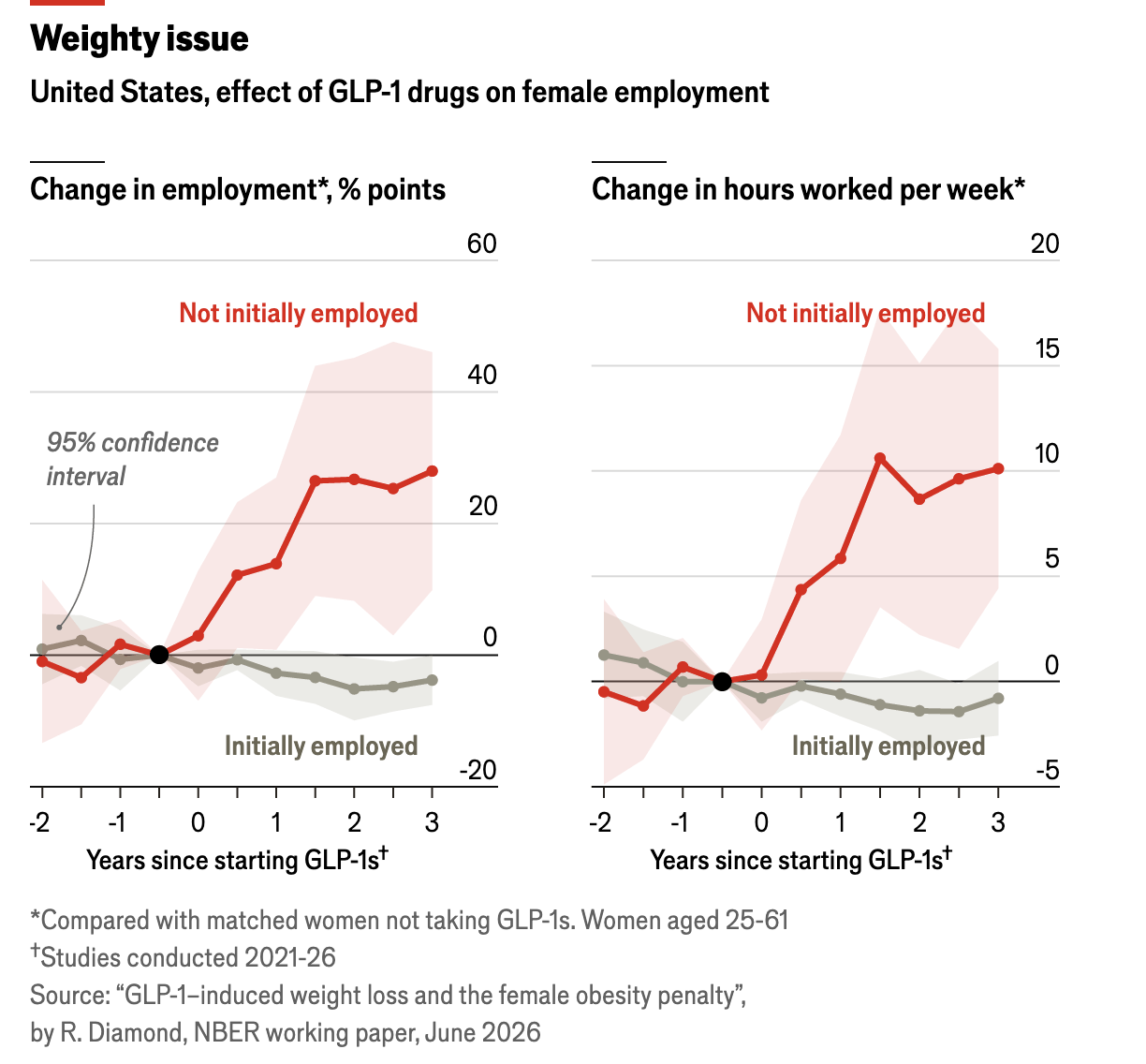
Source: Economist
Sign up for our reads-only mailing list here.
