
My Two-for-Tuesday morning train reads:
• A Breakdown of the Financial Advice That’s Flying All Over TikTok: The Journal reviewed nearly 50 hours of money advice across 212 accounts. A majority were run by people with no apparent financial license or certification. (Wall Street Journal)
• The Credit Market Lens: The Return of Financial Engineering – Not 2008, But Not Nothing: Leverage and complexity are gaining ground in late-cycle credit markets. The read is caution rather than crisis, with diversification and risk management doing the work. (PIMCO) see also Private Credit Is Under Growing Strain, Despite Industry’s Upbeat Tone: The marks say one thing and the underlying borrowers say another. (Wall Street Journal) see also Private credit under strain as troubled loans swell: FT analysis shows signals of stress in the market are back to levels last seen in 2017 (FT Alphaville)
• Worried about earnings growth cooling? There’s evidence that the market has been pricing in this concern for a year: After topping out late last year, the forward P/E has trended lower. It currently sits at 20.1x, which is right in line with the five-year average. Sam Ro notes the forward P/E topped out late last year and has drifted down to 20.1x — right in line with the five-year average. (TKer)
• There Aren’t Enough Ships to Handle China’s Booming Car Exports: Chinese car exports are outrunning global shipping capacity, with specialized carriers booked years out and charter rates following. BYD bought its own vessel. As demand slumps at home, Chinese cars are flooding other markets—and testing the shipping industry (Wall Street Journal)
• Why the Legendary Erdős Problems Are Falling to AI: Konstantin Kakaes on the May 2026 announcement that shook mathematics — an internal OpenAI model produced a counterexample to the “unit distance” problem, a conjecture Erdős made in 1946. AI’s greatest mathematical successes have come from answers to problems posed by a mid-20th century iconoclast. By examining what makes the Erdős problems unique, mathematicians are trying to understand how AI might change the rest of math. (Quanta Magazine)
• Iran’s Secret Plan to Escalate the War: Intercepted communications and other intelligence point to a strategic shift by hard-line leaders toward raising the costs for the U.S. and its regional allies. • Iran’s Secret Plan to Escalate the War: Intercepted communications and other intelligence suggest a strategic shift by hard-line leaders to raise the costs for the U.S. and its regional allies (Wall Street Journal)
• Why Aging May Be a Program, Not a Breakdown: Rockefeller cell biologist Junyue Cao read gene expression across millions of mouse cells and concluded aging is not haphazard wear and tear but a “remodeling of the cell society.” Not a Breakdown: By deciphering the molecular signatures of millions of mouse cells, Junyue Cao has found that aging is not haphazard wear and tear but rather a “remodeling of the cell society.” (Quanta Magazine)
• Did Poop Enable the Evolution of Complex Animals?: Kiona N. Smith on a study arguing the Cambrian explosion was fueled by waste. The first animals emerged about 600 million years ago; things got complicated 60 million years later. In a recent study, evolution gets even messier than usual. (Ars Technica)
• How 10,000 American Cities Got Their Names: Carl Churchill mines a century-old federal report in which geographer Henry Gannett of the United States Geological Survey catalogued the origins of some 10,000 town and city names. Good semiquincentennial reading. The federal government used to catalog the origins of town names nationwide. A 334-page report reveals the influences that shaped American communities as they spread across the country. (Wall Street Journal)
• Trump Races to Prepare for New Strains of Deadly Viruses After Cutting Biosecurity Experts: Ian Duncan on the scramble to rebuild biological-attack defenses. By the end of Biden’s term the White House had as many as 30 people working on biosecurity; staffing cuts early in the second Trump administration gutted the expertise. (Washington Post)
Video of the day: “Yacht Rock” Is Bullsh*t
Be sure to check out our Masters in Business interview this weekend with Dr. Ankur Crawford, EVP and Portfolio Manager at Alger. She heads the firm’s flagship Alger Capital Appreciation strategies. She was an Engineer at Intel, won the Intel Ph.D. Fellowship, and was awarded fellowship Natl Academy of Sciences, Engineering & Medicine, and holds several U.S. patents. She was recognized as a “Top Women in Asset Management” in 2020 and serves on the board of The Knowledge House, a Bronx-based charity teaching technology skills to underserved communities.
LLMs ranked by capabilities, sized by billion parameters used for training
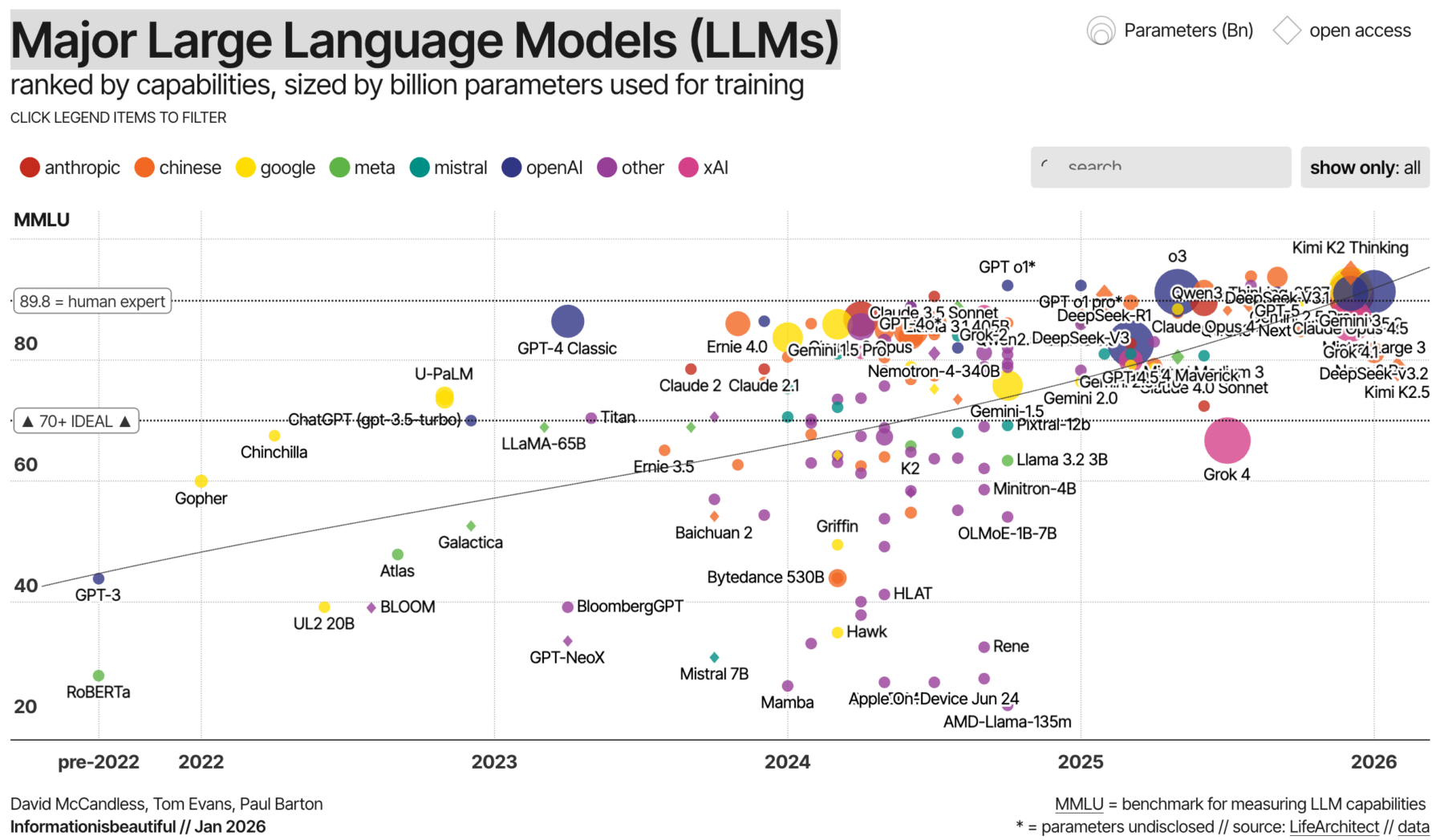
Source: Information Is Beautiful
Sign up for our reads-only mailing list here.
