
The weekend is here! Pour yourself a mug of Danish Blend coffee, grab a seat outside, and get ready for our longer-form weekend reads:
• How Bots Took Over Our Lives: The New Yorker on the quiet colonization of daily life by automated agents — customer service, social media, dating, commerce. The bots aren’t coming; they’re here, and we barely noticed. During the 2016 election, much of the country was introduced to the concept of internet bots for the first time. Now, just a decade later, it feels like they’re everywhere. (New Yorker)
• Dear Ben I want to begin by apologizing for the thing I am about to do, which is to write you a nonfiction essay explaining why I no longer wish to write nonfiction essays, a maneuver so self-defeating that I can already feel the irony tightening around my ankles like a fishing line attached to a rod in my own hands. Panoptica’s open letter — a pointed piece of criticism addressed to its subject with the directness the format allows. (Panoptica)
• Department of Cerberus: Deputy Defense Secretary Stephen Feinberg wants America’s war machine to get cozier with companies. The private equity firm he co-founded is building a constellation of next-generation businesses to answer the call. (Businessweek)
• The New Premium Product: Books Written by People: Some publishers think AI could not only help authors but replace them. The Financial Times on the emerging market premium for human-authored books in an era of AI-generated content. Authenticity is becoming a luxury good. (Financial Times)
• how to enter side doors: a field guide to jobs, cold emails, and making yourself legible to the right people. Velvet Noise on the art of the unconventional path — the opportunities that never get posted, the rooms you enter through relationships rather than applications. (velvet noise)
• The Cash Machine: Mispriced Assets on the companies that generate so much free cash flow they’ve become perpetual motion machines — and whether the market is correctly pricing that durability. A baseball team’s television network, a retiree’s annuity, and the label that tells you they have nothing to do with each other (Mispriced Assets)
• Why Sony Can’t Bring Back Its Classic Walkman Models (as Explained by a former Sony engineer). The supply chains, components, and manufacturing processes that made the original Walkman possible no longer exist. You can’t resurrect a product when the ecosystem that built it is gone. (Obsolete Sony’s Newsletter)
• Curing Concrete: Concrete makes up half of all human-made stuff on our planet. And its use will double, in part to battle climate threats created by the production of concrete itself. Industry can deliver cleaner versions, but how soon? The answer might lie with four Indonesians from a tiny, disappearing island. (Bloomberg)
• What the Crackup of the Heritage Foundation Says About the Post-Trump Right: The bastion of American conservatism best known for Project 2025 has been consumed by an ideological — and generational — civil war. The Heritage Foundation currently finds itself engulfed in an internal struggle that mirrors the one roiling the Republican Party: how to harness the energy unleashed by Trumpism without being completely overrun by its conspiracy- and nativist-minded elements, particularly among the rising generation that has known little else. The New York Times Magazine on the civil war inside the conservative movement’s flagship institution — and what the fight reveals about what comes after Trump. The bastion of American conservatism best known for Project 2025 has been consumed by an ideological — and generational — civil war. (New York Times Magazine)
• Fish Bad, Sugar Good… And Other Medieval Ideas About Food: Literary Hub on medieval dietary science — the humoral theory that made sugar a health food and fish a danger, and what it says about how nutritional consensus forms. And Other Medieval Ideas About Food (Literary Hub)
Video of the day: Why Miami No Longer Pays Off
Be sure to check out our Masters in Business interview this weekend with Som Seif Purpose Investments, founder/CEO, Toronto-based asset manager launched in 2012. He grew his first firm, Claymore Investments to $8B in assets by creating 34 ETFs over 6 years, establishing it as Canada’s leader in low-cost exchange-traded funds; he sold to BlackRock in 2012. Next, he co-founded Wealthsimple, which became the default investing app for a generation of Canadians. His wealth management firm, Purpose, was founded at the end of 2012, and manages>$31B in ETFs, mutual funds, alternatives, private assets, and digital assets. Som was named to Canada’s Top 40 Under 40 in 2011.
All US Cities Which Used to Have More Than 100,000 People But Don’t Anymore
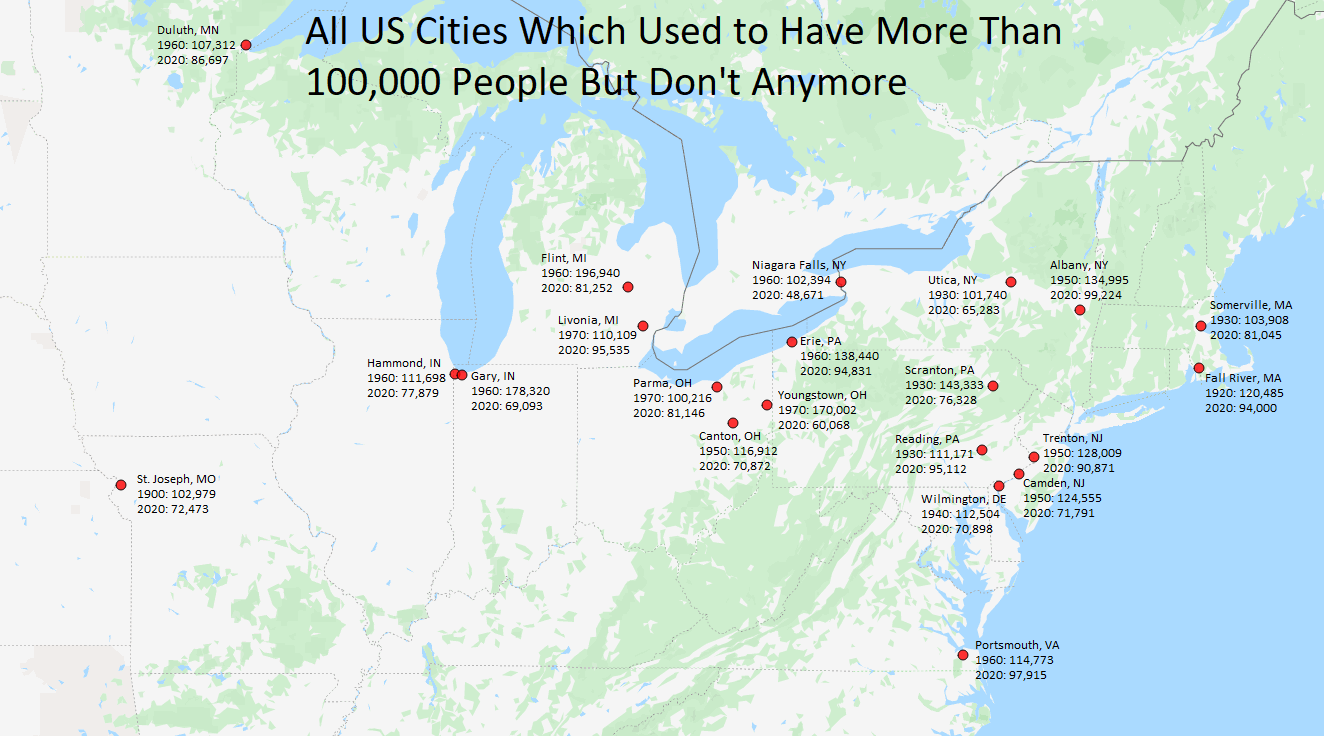
Source: Reddit
Sign up for our reads-only mailing list here.
~~~
To learn how these reads are assembled each day, please see this.
